
Commercial · 10 min
Commercial Modular Buildings: Uses, Costs and Timelines
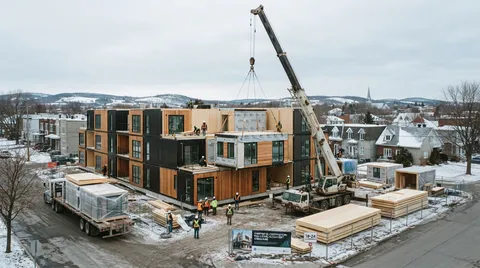
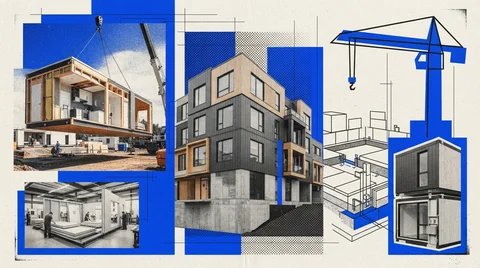
In short — Commercial modular covers a wide range of uses: offices, schools and daycares, clinics, hospitality, and temporary site offices. The argument is the same as in residential — speed: a commercial modular building can be delivered in a fraction of the time of conventional construction, because factory production runs in parallel with site preparation. Some uses are sold outright; others are rented (temporary site buildings in particular).
For a business, institution, or developer, the commercial modular building answers a specific need: adding space quickly and predictably, whether permanent or temporary. This guide covers uses, the buy-versus-rent decision, costs and timelines, and the rules to verify.
The main uses
Offices. From a small office building to an expansion of an existing headquarters, modular offers factory-finished workspaces delivered fast. Useful when a company grows faster than its building.
Schools and daycares. When a school board or childcare service runs out of space, modular makes it possible to add classrooms or a turnkey daycare without shutting a site down for over a year. Speed limits disruption to operations.
Clinics and institutional buildings. Healthcare spaces, administrative offices, and community services benefit from the same scheduling advantage, with layouts adapted to their use. These three institutional uses are covered in detail in our article Schools, Daycares and Clinics: Modular in Quebec.
Hospitality. Hotel rooms are repetitive — exactly the product a factory builds best. A modular hotel project can therefore be deployed quickly, a real asset in regions where construction labour is scarce.
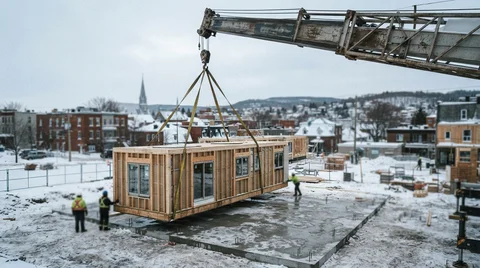
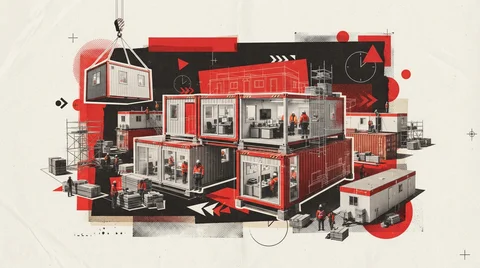
Temporary site offices and buildings. This is the most familiar use: trailers and modular buildings set up on a construction site, often rented rather than purchased. They can be delivered within days, relocated, and reused on another site.
"Commercial modular sells two things conventional construction offers poorly: speed and reversibility. You can deliver fast, and sometimes move or take back the building afterward."
Buy or rent: the first decision
| Criterion | Purchase (permanent) | Rental (temporary) |
|---|---|---|
| Typical use | Office, school, clinic, hotel | Site office, transitional space |
| Duration | Long-term | A few months to a few years |
| Foundation | Permanent | Often on temporary supports |
| Reuse / relocation | Rare | Designed for it |
| Financial logic | Investment (asset) | Operating expense |
The choice depends on how long the need lasts. A permanent need justifies buying on a foundation; a transitional need (construction site, supplementary space) is better suited to rental.
Costs and timelines: what to compare
As with residential, cost comparisons only make sense at equivalent use and by verifying what is included (land, foundation, hookups, interior finishes, building mechanical). The cost per square foot of a commercial building varies widely depending on use: an office, a clinic, and a site building have different technical requirements — and different price tags.
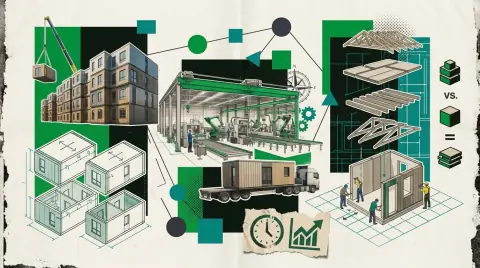
On timelines, the principle holds constant: factory production overlaps with site preparation, compressing the overall schedule. On-site assembly is often measured in days. For a detailed look at how this works and per-square-foot price ranges, see our guides on building a modular multiplex and on modular construction pricing.
Regulations: permanent or temporary, both are governed
A permanent commercial modular building is subject to the Quebec Construction Code just like a site-built structure: structural requirements, fire resistance, egress, accessibility, and use-specific commercial building requirements where applicable. It requires a municipal permit, compliance with zoning, and a builder holding an RBQ licence.
A temporary building (a site office, for example) often falls under different rules and temporary permits, which vary from one municipality to the next. In every case, confirm the applicable requirements with the municipality before placing an order. For a clear picture of what gets built in the factory versus what happens on site, see our guide on modular, manufactured, or prefab homes.
In summary
- Commercial modular covers offices, schools and daycares, clinics, hospitality, and site buildings.
- The first decision is buy (permanent) or rent (temporary), based on how long the need lasts.
- The key advantage is speed and schedule predictability; cost comparisons require equivalent scope.
- A permanent building is regulated like any commercial structure; a temporary building falls under rules specific to that use, to be confirmed with the municipality.
Sources: Régie du bâtiment du Québec (Construction Code), APCHQ, Institut de la statistique du Québec. Article written by Jeremy Soares. Last updated: June 24, 2026.

8Module
Modular multi-residential buildings (6 to 24+ units) factory-built in Quebec.
Visit websiteCommercial partnership — we receive compensation. Disclosure
Frequently asked questions
What types of commercial buildings can be built using modular construction?
Is it better to buy or rent a commercial modular building?
How much does a commercial modular building cost per square foot?
Does a commercial modular building require a standard permit?
How long does it take to deliver a modular site building?
Sources
- Code de construction du Québec — Régie du bâtiment du Québec (RBQ)
- Données sur la construction non résidentielle — APCHQ
- Statistiques de la construction — Institut de la statistique du Québec (ISQ)

Comments
A question or comment on this article? The comments section will be enabled soon.