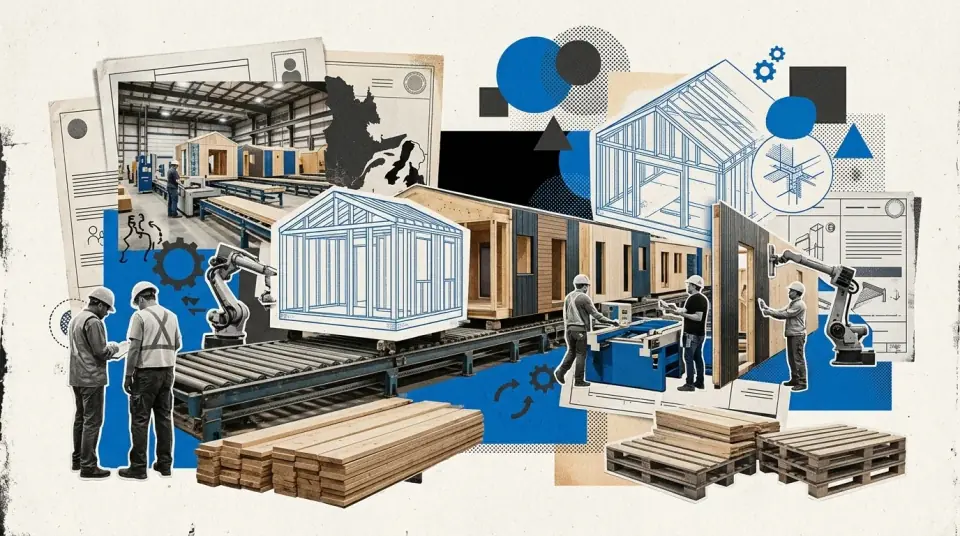
Fundamentals · 15 min
Quebec Modular Construction Glossary
In short — Modular, factory-built, prefab, volumetric, turnkey, CSA A277, cost per door, minor variance, PIIA: the vocabulary of modular construction mixes process, regulatory, land-use, and financing terms — and the confusions are costly, from a refused loan to a misread municipal by-law. This glossary defines more than 60 terms in plain English, as they are used in Quebec.
This glossary is built to be cited and consulted: each term is defined in two to four sentences, without unnecessary jargon. For an overview of the process itself, start with our article on what modular construction is.
Before the definitions, one essential reference point — the three main families of prefabrication, which are constantly confused:
| Family | What leaves the factory | Degree of factory finishing |
|---|---|---|
| Volumetric (3D modular) | Complete three-dimensional modules | High: interior finishing often included |
| Panelized (2D) | Flat wall, floor, and roof panels | Medium: assembly and finishing happen on site |
| Components and sub-assemblies | Roof trusses, joists, bathroom pods | Variable: complements traditional construction |
A — B
Accessory dwelling unit (ADU / UHA). A secondary dwelling created on the lot of a principal residence — in the basement, as an addition, or as a backyard suite. More and more Quebec municipalities allow them (in French, UHA: unité d'habitation accessoire); modular makes it possible to install one quickly.
Agricultural zone (CPTAQ). Territory protected for agriculture under Quebec law, where residential construction is heavily restricted. Building there requires, apart from exceptions set out in the law, an authorization from the Commission de protection du territoire agricole du Québec (CPTAQ) — a separate process that comes before the municipal permit. Before buying rural land, verify its status with your municipality and the CPTAQ.
Building permit. Mandatory municipal authorization before undertaking most construction work — including the installation of a modular building, because factory fabrication exempts you from nothing. Required documents, timelines, and fees vary from one municipality to another: check with your municipality.
C
CCU (planning advisory committee). A committee of citizens and elected officials (comité consultatif d'urbanisme) that studies planning-related applications — minor variances, PIIA, conditional uses — and makes recommendations to the municipal council. Its opinions are not decisions: the council decides. Its meeting calendar directly affects a project's schedule; check with your municipality.
Certificate of authorization. An authorization required for certain work or uses that fall outside the building permit: demolition, tree felling, a change of use, or the installation of a sign, depending on local regulations. The same term also refers to environmental authorizations issued by the Government of Quebec for projects affecting sensitive environments. The list of covered work varies from place to place: check with your municipality.
Certificate of location. A document prepared by a land surveyor that records the state of a property: boundaries, buildings, servitudes, encroachments, and apparent compliance with regulations. It is required in most real estate transactions and often requested by the lender. For a modular project, an up-to-date certificate helps confirm that the planned placement respects the zone's setbacks.
CMHC (Canada Mortgage and Housing Corporation). The federal housing agency: mortgage loan insurance, financing for rental and affordable projects, market research and data. CMHC has extended its multi-unit loan insurance to modular construction, which normalized the financing of these projects in Canada.
Cost per door. A real estate industry indicator: a project's total cost divided by its number of units ("doors"). Useful for comparing projects, provided you compare similar unit types and finish levels — a studio and a two-bedroom obviously do not cost the same. There is no universal cost per door for modular.
Craning. The lifting operation that places modules on the foundation or stacks them into storeys. It requires a lift plan, a crane sized to the weight and reach, clear access, and a favourable weather window. It is a distinct budget line, to be planned from the start of the project.
CSA A277 (CAN/CSA-A277). The Canadian certification standard for factory-built buildings. In Quebec, the sale and leasing of factory-built buildings are governed by this certification under RBQ supervision: an accredited body audits the plant and the fabrication, and the affixed seal attests that what was built in the factory complies with the codes applicable at the installation site. It is the standard answer to the question "how do you inspect closed walls?"
D — F
Developer. The person or company that initiates, finances, and steers a real estate project, from land acquisition to marketing. In a modular project, the developer manages one additional interface: the factory contract and its coordination with the job site.
Factory-built building. The term used in Quebec's regulatory framework (bâtiment usiné) for a building, or part of a building, fabricated in a plant away from its installation site. In Quebec, the marketing of factory-built buildings is governed by a certification regime supervised by the RBQ (see CSA A277).
Factory-built home. The everyday Quebec term (maison usinée) for a house fabricated in a plant, in modules or in panels depending on the manufacturer. "Modular" specifies the process when the house is made of complete three-dimensional modules.
Factory deposit. The amount paid to the manufacturer to reserve a slot in the production schedule and launch module fabrication, before any delivery. An important financial particularity of modular: the money goes out earlier than on a conventional job site, which must be planned for in the financing structure and protected by the contract.
Floor area ratio (FAR) / density. Regulatory parameters that limit how intensively a lot can be built: the ratio of floor area or building footprint to lot area, the number of dwellings, the height or number of storeys. They determine how many units a lot can hold — a decisive figure for a multi-unit project. Each zone has its own maximums: check with your municipality.
G — L
GCR (Garantie de construction résidentielle). The organization that administers Quebec's mandatory warranty plan for new residential buildings covered by regulation. The regime also applies to homes produced through prefabrication when the building is subject to it.
Gentle densification. The gradual addition of housing in existing neighbourhoods without changing their scale: accessory units, subdivision of large properties, small plexes inserted into the urban fabric. Modular lends itself well to it, thanks to short, minimally invasive job sites.
Highly prefabricated. The qualifier used by Quebec's public programs for buildings whose construction is largely carried out in a factory, without being limited to a single process. The SHQ's project call for "highly prefabricated" multi-unit housing entrenched the expression.
Housing Accelerator Fund (FACL). A federal initiative to speed up housing creation (Fonds pour accélérer la construction de logements). In Quebec, it applies through a Canada-Quebec agreement rather than direct agreements with cities; it is notably this envelope that funds the SHQ's project call for highly prefabricated housing.
Housing co-operative (co-op). A collective organization whose residents are members and take part in managing the building. In Quebec, co-operatives are frequent sponsors of affordable housing projects and are eligible for public housing programs.
Housing office (OMH). A local public body that manages social housing on its territory, notably low-rental housing (HLM), and develops new projects. Housing offices are among the eligible applicants under Quebec's affordable housing programs.
Housing start. The moment a dwelling's construction officially begins, as defined by housing statistics. A particularity of modular: part of the "job site" takes place in the factory before the land is even touched, which shortens the delay between the official housing start and occupancy.
Interim financing. Temporary financing that covers the construction period, before the permanent loan. Its duration depends directly on the length of construction: it is one of the line items where modular's schedule compression produces a tangible saving.
Land use and development plan (RCM). The regional planning document (schéma d'aménagement et de développement) adopted by an RCM (regional county municipality, or MRC), which sets the broad land-use directions for its territory: urbanization perimeters, constraint zones, land designations. Municipal urban plans and by-laws must comply with it. It therefore frames a project well upstream of the municipality itself.
M — O
Minor variance. A procedure (dérogation mineure) that allows a municipal council to authorize a project that slightly departs from the zoning or subdivision by-law, when strict application of the by-law causes serious harm to the applicant and the variance does not harm the neighbourhood. The application is studied by the CCU, then decided by council after public notice. It is never a right: each case is judged on its own, and nothing guarantees the outcome.
Mobile home. A dwelling built on a chassis designed for relocation, generally installed without a permanent foundation. Not to be confused with a modular home: regulation, financing, and value differ fundamentally.
Modular construction. A method in which the building is fabricated as complete three-dimensional modules in a factory — structure, insulation, windows, and often interior finishes — then transported and assembled on the foundation. It is the most advanced form of prefabrication, known as "volumetric."
Module. The basic unit of modular construction: a three-dimensional structural box built in a factory, sized to be transportable by road. A dwelling can consist of one or several modules; a building, of dozens of modules stacked and set side by side.
Module joining ("marriage"). All the work that unites the modules after placement: continuity of the structure, the envelope, the interior finishes, and the mechanical and electrical systems. The quality of these joints is a major criterion for evaluating a manufacturer and its site partner.
Multi-unit residential (multifamily). A building with several dwellings, from the duplex to the apartment tower. Low- and mid-rise multi-unit housing is the segment where modular is growing most visibly in Quebec.
Non-profit housing organization. A non-profit (OBNL d'habitation) that develops and operates residential buildings for social or community purposes rather than profit. Non-profits are major sponsors of affordable housing projects in Quebec — see our feature on modular affordable and community housing.
Off-site construction. The generic international term for any method in which a significant share of construction happens somewhere other than the lot: volumetric modular, 2D panels, pre-assembled components. "Prefabrication" is its everyday synonym.
On-site assembly. The stage where delivered modules are set on the foundation, fastened together, and connected to services. A building's full volume can appear in a few days, before the joining and finishing work.
Oversize load transport. Road transport of a load exceeding standard dimensions or weights, subject to special permits, approved routes, and sometimes escort vehicles. Housing modules almost always fall into this category; the factory-to-site route must be validated at the design stage.
P — R
Panelized construction (2D). A prefabrication process in which the factory produces flat elements — walls, floors, roof sections — assembled afterwards on the job site. It travels better and adapts to more varied architecture than volumetric, but leaves more work on site.
Permanent foundation. A fixed, durable base (basement, crawl space, slab) to which a building is anchored. The distinction is decisive: a modular building on a permanent foundation is treated as a full-fledged immovable — regulation, mortgage financing, value — unlike a mobile home resting on a chassis.
Permitted use / conditional use. A permitted use is allowed as of right in a zone, provided the standards are met. A conditional use requires case-by-case approval by the municipal council, after CCU review and public notice. Which regime applies depends on the zone and the regulations in force: check with your municipality.
PHAQ (Programme d'habitation abordable Québec). The flagship program of the Société d'habitation du Québec for funding affordable rental housing for low- and modest-income households and people with special needs. Open to non-profits, co-operatives, housing offices, and private developers, under streams and parameters that evolve — always check the official page before applying.
PIIA (site planning and architectural integration program). A by-law through which a municipality evaluates a project's appearance and integration — materials, volumes, roofs, harmony with the neighbourhood — beyond the numeric standards of zoning. Approval goes through the CCU and then the municipal council, adding a discretionary step to the permit process. Only certain sectors are subject to it: check with your municipality.
Planning program (plan d'urbanisme). The official document that states a municipality's land-use vision: the vocation of sectors, desired densities, development directions. Zoning and subdivision by-laws must comply with it. It reads as an indicator of openings to come: a sector slated for densification will often see its zoning evolve eventually.
Pod (prefabricated unit). A complete sub-assembly built in a factory and inserted into a building — most often a fully finished bathroom. Pods industrialize part of a project that is otherwise built conventionally.
Prefabricated (prefab). The umbrella term: any building of which a significant part is fabricated in a plant rather than on the lot. Volumetric modular, panelized construction, and pre-assembled components are all variations of it.
Préusiné / usiné. Synonymous qualifiers in everyday Quebec usage: factory-made. "Préusiné" stresses that fabrication precedes installation; "usiné" is the most widespread form in Quebec's industry and regulations. You will meet both constantly in French-language contracts and brochures.
Quebec Construction Code. The regulation that sets the technical requirements applicable to construction work in Quebec. A modular building on a permanent foundation is subject to it in the same way as a site-built building — see our article on the RBQ and the Construction Code.
RBQ (Régie du bâtiment du Québec). The public body that oversees construction quality and contractor licensing in Quebec. It is notably under its supervision that the certification of factory-built buildings applies (see CSA A277); checking a contractor's RBQ licence is a basic reflex before signing.
RPA (private seniors' residence). A residential building for seniors offering services (meals, supervision, care depending on the category). In Quebec, operating an RPA is governed by a certification regime separate from construction; its repetitive unit layout makes it a natural candidate for modular.
S — Z
Scale factor. The central economic principle of modular: the factory becomes more efficient as the units produced repeat. A project with identical or very similar dwellings gets more out of the production line — hence modular's affinity with student housing, seniors' residences, and workforce housing.
Sequencing. The precise ordering of a modular project's operations: factory production, transport, foundation preparation, craning, joining, finishing. Modular's speed promise rests entirely on the quality of this sequencing.
Service connections (water / sewer). Hooking a building up to the municipal drinking water and sewer networks, where the street is serviced. In unserviced areas, you must instead plan a compliant well and septic system. Connection terms and fees are set locally: check with your municipality.
Servitude. A charge registered against a property in favour of another property or an organization: right of way, public utility, non-construction, view. It can prohibit building on part of the lot or restrict a building's placement. Servitudes appear on the certificate of location and in the land register; checking them before buying avoids bad surprises.
Setbacks (front, side, rear). The minimum distances to keep between a building and the lot lines, prescribed by the zoning by-law for each zone. They determine where the building can sit — and, in modular, the space left for the crane and for manoeuvring the modules. Values vary from zone to zone: check with your municipality.
Shell (ready-to-finish). A formula (prêt-à-finir) in which the manufacturer delivers a home whose exterior is complete but where part of the interior finishing is left to the buyer. Cheaper to buy than turnkey, it demands realistic time, skills, and a finishing budget.
Shop drawings. Detailed plans produced by the manufacturer from the architectural drawings, translating the building into production instructions. Their approval is a pivotal step: after it, changes become expensive, because production is under way.
Shoreline buffer strip (bande riveraine). A strip of protective vegetation along lakes and watercourses, where construction and much other work are restricted. In Quebec, its protection is governed by provincial rules that municipalities apply, and its depth depends on the characteristics of the site. Before placing a building near water, check with your municipality.
SHQ (Société d'habitation du Québec). The Government of Quebec body responsible for housing policies and programs, including the PHAQ. It is the SHQ that launched Quebec's project call dedicated to highly prefabricated multi-unit housing.
Site characterization / soil test. An analysis of the land carried out by a professional before construction: soil bearing capacity, possible contamination, suitability for a septic system in unserviced areas. For a modular project, it determines the type of foundation — and sometimes the very feasibility of the project. Some municipalities require it at the permit application stage: check with your municipality.
Social acceptability. The support of the community — neighbours, citizens, elected officials — for a real estate project. In modular projects, it often hinges on correcting one prejudice: the confusion between a modular building and a mobile home.
Subdivision. The operation that divides or reconfigures land into distinct lots, governed by each municipality's subdivision by-law. It is the required step to create a buildable lot out of a larger property: minimum lot dimensions, street layouts, and parkland contributions may apply. Requirements vary: check with your municipality.
Transport cap. A temporary roof or protective cover installed on a module to shield it from the weather during transport and storage, removed or integrated at assembly.
Turnkey. A contractual formula (clé en main) in which the seller or contractor delivers a finished, move-in-ready building: interior finishes, connections, and equipment included as per the contract. Compared with a shell home, the price looks higher but covers all the work.
Volumetric construction. The technical synonym for "3D modular": prefabrication in complete volumes rather than flat panels. The term appears mostly in technical literature and calls for tenders, to distinguish the process from other forms of prefabrication.
Wetlands and bodies of water. Ponds, marshes, swamps, bogs, lakes, and watercourses, protected by Quebec regulation. Work in or near these environments may require an environmental authorization from the Government of Quebec, on top of municipal permits. Characterizing the land before buying avoids discovering the constraint too late.
Zoning. The division of municipal territory into zones where the planning by-law prescribes the permitted uses, densities, and siting standards. It is the first document to check before any project: it determines what can be built, well before any question of process.
Zoning by-law. The municipal by-law that translates zoning into concrete standards, zone by zone: permitted uses, setbacks, heights, minimum building dimensions, materials, parking. It is what can restrict the placement of a tiny home or impose a minimum dwelling area. It varies from one municipality — and one zone — to the next: check with your municipality.
Sources: Régie du bâtiment du Québec (certification of factory-built buildings), Société d'habitation du Québec (PHAQ, prefabricated project call), Gouvernement du Québec and Gouvernement du Canada (Canada-Quebec agreement / FACL), CMHC (manufactured housing and modular financing). Article written by Jeremy Soares. Last updated: July 1, 2026.

8Module
Modular multi-residential buildings (6 to 24+ units) factory-built in Quebec.
Visit websiteCommercial partnership — we receive compensation. Disclosure
Frequently asked questions
What is the difference between modular, factory-built, and prefab?
What does CSA A277 certification guarantee?
Is a modular building a mobile home?
Sources
- Certification of factory-built buildings (CAN/CSA-A277) — Régie du bâtiment du Québec (RBQ)
- Programme d'habitation abordable Québec (PHAQ) — Gouvernement du Québec / SHQ
- Canada-Quebec Agreement on the Housing Accelerator Fund — Gouvernement du Québec
- Manufactured housing: affordable, quality homes — CMHC — Canada Mortgage and Housing Corporation



Comments
A question or comment on this article? The comments section will be enabled soon.