Non-profit · 7 min
Housing and Modular Construction in the Capitale-Nationale: The 2026 Picture
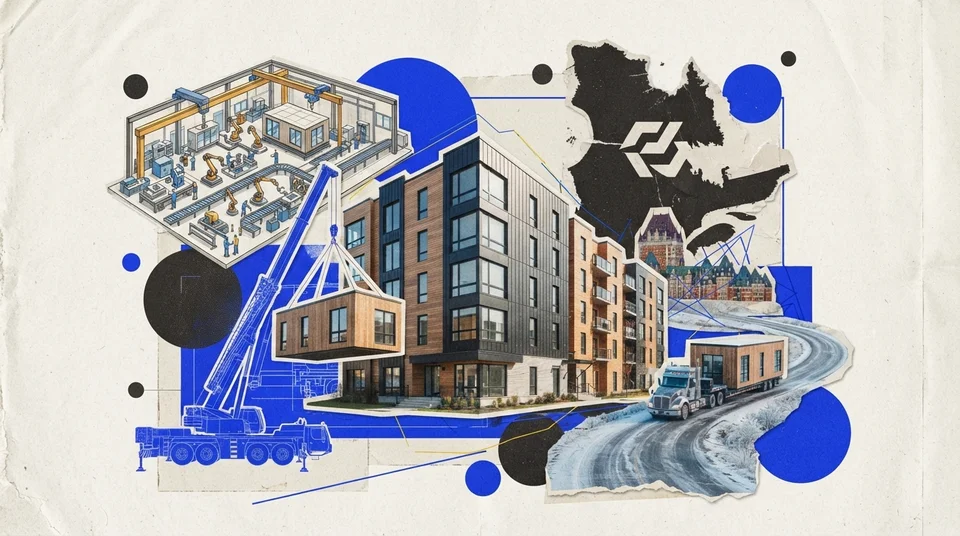
In short — The Capitale-Nationale is living a paradox: Quebec City authorized roughly 5,700 housing starts in 2025 — a jump of about 80%, the strongest growth among large Canadian cities — yet CMHC forecasts its rental market will remain under pressure until 2027, with a vacancy rate around 1.5%. Meanwhile, Charlevoix is inventing its own solutions: in La Malbaie, a 24-unit co-operative houses tourism workers with direct backing from employers. Here is where modular fits into that picture.
The housing situation in the region
In Quebec City, the indicators are improving on the surface: the CMA's vacancy rate rose back to 2.4% in October 2025 — from a historic low of 0.9% — and Mayor Bruno Marchand speaks of "encouraging signs." But the easing is uneven: in the most affordable rent segment, the rate hovers around 1%, and the average rent increase set a regional record of 6.4% in 2025 according to CMHC. Worse: CMHC forecasts that the Quebec City CMA will remain the province's tight exception, with the vacancy rate falling back toward 1.5% by 2027 and two-bedroom rents rising more than 8%, Le Soleil reports.
On the periphery, the dynamic is different but just as real. In Portneuf, growing towns like Saint-Raymond, Pont-Rouge and Donnacona are absorbing part of the demand spilling over from the capital — with a limited rental stock. And in Charlevoix, the tourism economy keeps running into the problem of housing its workforce. The overall mechanism is the one we take apart in our feature on the housing crisis and modular construction.
The region is not spared the seniors' residence crisis either: 127 residents were displaced by RPA closures in 2025 according to the AQRP, including a residence of about a hundred spots in Limoilou.
Recent projects and announcements
In Quebec City itself, the machine has restarted. The City has twice used Bill 31 exemptions to fast-track projects denser than zoning allows — 18 projects, representing roughly 2,800 units according to counts reported by regional media. Quebec also confirms 205 affordable units under construction in the capital, delivery in fall 2026. During the municipal campaign, Mayor Marchand committed to adding 5,000 single-family-type homes in the suburbs by 2029. And according to media reports, the Catherine-de-Longpré office tower (15 storeys at 1075 chemin Sainte-Foy) is to be converted into 222 social and affordable units — a $79-million-plus project targeting fall 2028 (Connect CRE).
The region's most instructive project, though, is in La Malbaie: the Coopérative de développement immobilier de Charlevoix built 24 workforce housing units at 100 rue John-Nairne — a build of about $5.8 million, including more than $3 million from Quebec. The formula is clever: employers who are members of the co-operative obtain unit-allocation rights for their workers, with rents of roughly $680 to $1,040 and move-ins starting in winter 2026. In Baie-Saint-Paul, 43 affordable units are expected to follow in summer 2026.
An honest observation: in the SHQ's first call for highly prefabricated housing (11 projects, 336 units, announced August 22, 2025), no project from the Capitale-Nationale was selected. A second call for 225 units was launched in September 2025 — the total selected had reached 566 units by mid-2026. The wind is turning on the homeownership side, however: as early as May 2026, municipalities in the Quebec City region were among those eyeing the prefab home neighbourhoods Quebec now funds to the tune of nearly $1 billion (Ma Beauce).
What modular can change here
In the capital, the argument is arithmetic: when CMHC forecasts an even tighter market in 2027, every month of construction saved counts. The independent data converges — project timelines cut by 20 to 50% according to McKinsey, deliveries 25 to 30% faster measured across more than 50 multi-family buildings by a field study funded by the U.S. Department of Energy. Cost savings remain contextual (0 to 20%): the reliable gain is the schedule.
In Charlevoix and Portneuf, the argument is structural. The La Malbaie model — a co-operative backed by employers — pairs naturally with factory construction: we detail these structures in our features on modular housing co-operatives and workforce housing in the regions. And for towns like Saint-Raymond, Pont-Rouge or Donnacona, the SHQ's standardized 24- and 36-unit buildings are exactly the format that changes the game without waiting for a major developer; our guide for municipalities explains how to get ready.
One last, quieter lever: Quebec City and Baie-Saint-Paul are among the first municipalities to have authorized accessory dwelling units (ADUs, "UHA" in Quebec) by simple bylaw, a possibility opened by Bill 31. A factory-built ADU set in a backyard is the residential version of gentle densification — we cover it in our feature on the modular tiny home and ADU.
The programs that apply
- PHAQ (Programme d'habitation abordable Québec): the SHQ's flagship program, open to non-profits, co-operatives, housing offices and private developers. The 2026-2027 Quebec budget funds a new round of 1,000 affordable units — the first since 2023.
- SHQ initiative for highly prefabricated multi-unit housing: 500 units in the first call, 225 in the second, funded by the $1.8-billion Canada-Quebec agreement (FACL). No regional winner to date — the next calls are open to communities that get ready.
- CMHC — mortgage loan insurance extended to modular (May 2026): after a pilot of more than 800 units, modular multi-unit housing is insurable across all CMHC products, including APH Select.
- Maisons Canada: the federal agency with $13 billion explicitly prioritizes prefabricated, modular and mass-timber construction.
For the detailed financing structure of a non-profit or co-operative project, see our guide to funding affordable modular housing.
Sources: Radio-Canada, Le Soleil, Le Charlevoisien, TVA CIMT-CHAU, Gouvernement du Québec (SHQ), CMHC, AQRP, Écohabitation. Article written by Jeremy Soares. Last updated: July 3, 2026.

8Module
Modular multi-residential buildings (6 to 24+ units) factory-built in Quebec.
Visit websiteCommercial partnership — we receive compensation. Disclosure
Frequently asked questions
Is Quebec City's housing market really easing?
What is special about the La Malbaie co-operative?
Can a Portneuf town aim for an SHQ prefabricated building?
Sources
- Crise du logement : le maire de Québec voit des signes encourageants — Radio-Canada
- Le marché locatif de Québec restera sous pression en 2026 — Le Soleil
- Taux d'inoccupation à Québec : les données 2025 de la SCHL — Radio-Canada
- Un chantier de 6 M$ pour les 24 logements abordables de La Malbaie — Le Charlevoisien
- 205 logements abordables seront construits à Québec — Gouvernement du Québec
- De nouveaux règlements et nouvelles lois pour les UHA — Écohabitation
- Quebec City office tower to be converted into affordable housing — Connect CRE Canada
- Accessibilité à une première propriété : Québec veut encourager le préfabriqué — Ma Beauce


Comments
A question or comment on this article? The comments section will be enabled soon.