Residential · 10 min
Mortgage and Financing for a Modular Home in Quebec
In short — A modular home installed on a permanent foundation in Quebec is, in the vast majority of cases, financed like a traditional home: a standard mortgage, the same conditions, and CMHC mortgage loan insurance available if your down payment is less than 20%. Financing becomes more complicated in three situations: if the home is not on a permanent foundation (it then resembles a mobile home, which is financed differently), if you are buying ready-to-finish (a construction loan with draws rather than a simple mortgage), or if you are paying the manufacturer before delivery. Sort out these points with your lender before signing.
Financing is the number-one objection when considering a modular or factory-built home — often because people confuse this type of home with a mobile home. These are two very different realities in a lender's eyes. This guide explains how financing for a modular home in Quebec actually works, what changes depending on the type of home and the purchase arrangement, and the pitfalls that derail a file at the last minute.
The starting point: permanent foundation = standard mortgage
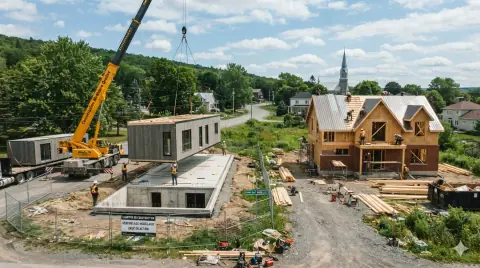
The most important rule comes down to one sentence. A modular or factory-built home fixed to a permanent foundation (footing and concrete foundation, or compliant piles) is considered real property, just like any home built on-site. It is built to the Quebec Construction Code, it has an address, it gains value along with the land — and it is therefore eligible for a standard mortgage under the usual conditions.
That means: standard amortization, rates comparable to a traditional home, and — a key point for many buyers — the possibility of a down payment as low as 5% on the first portion of the price, with CMHC mortgage loan insurance (or a private insurer) when the down payment is below 20%. If the distinction between modular, factory-built, and prefab is not clear to you, read Modular, manufactured, or prefab: the differences first — because that distinction is exactly what determines your financing.
"The question a lender asks is not 'is it prefab?' but 'is it permanently fixed to the ground?' That is where everything is decided."
The crucial difference from the mobile home
This is the most costly mistake. A mobile home rests on a chassis with wheels, or is placed without a permanent foundation, often in a park where the land is rented. In a lender's eyes, it is not the same type of asset: it can be financed through a personal property loan (similar to a car loan), with a shorter amortization, a higher rate, and a larger down payment — and it tends to depreciate rather than appreciate.
The modular home on a foundation does the opposite: it appreciates with the market and the land. The table below summarizes the gap.
| Criterion | Modular home (on foundation) | Mobile home (without permanent foundation) |
|---|---|---|
| Status | Real property | Often personal property |
| Loan type | Standard mortgage | Personal property loan (similar to a personal/auto loan) |
| Down payment | From 5% (with mortgage insurance) | Generally higher |
| Amortization | Standard | Often shorter |
| Interest rate | Comparable to market | Generally higher |
| Value over time | Tends to appreciate | Tends to depreciate |
| Eligible for CMHC mortgage insurance | Yes, if criteria met | Restricted conditions |
Before making any commitment, have the status under which your project will be financed confirmed in writing. That is what separates a straightforward file from a costly one.
Turnkey or ready-to-finish: two different files
The purchase arrangement also changes the financing. A turnkey home, delivered complete, has a known value: the lender grants a standard mortgage on that value. A ready-to-finish home resembles a project in progress: several lenders finance it through a construction loan, disbursed in draws as the stages advance, and they may require a higher down payment or a work schedule. The two arrangements are compared in detail in our guide on turnkey or ready-to-finish: which to choose?
The trap of deposits to the manufacturer
A manufacturer often requires staggered deposits during factory production — before the home is delivered and therefore before there is a building to mortgage. The mortgage, however, is generally disbursed only at delivery, against an existing asset. This cash-flow gap surprises many buyers. Common solutions: a construction loan with draws aligned with the manufacturer's stages, or bridge financing. This needs to be sorted out before signing the manufacturing contract, not after.
Common pitfalls to avoid
- Believing that "prefab" = "mobile." That is false for a home on a foundation. Have the misunderstanding corrected with the lender, backed by foundation documentation.
- Confirming financing too late. Obtain a pre-approval that explicitly mentions the type of modular/factory construction and the delivery method.
- Overlooking the deposit/mortgage timing gap. Plan the cash flow for the factory phase.
- Underestimating off-home costs. Land, foundation, utility connections, permits, transport, and crane are not always included in the advertised price — see the details in our price guide.
- Choosing a non-accredited builder. A contractor without a valid Régie du bâtiment du Québec (RBQ, Quebec's building authority) licence complicates eligibility for the warranty and financing — a flag to check from the outset (see How to choose your builder).
Assistance and incentives: verify, do not assume
Depending on your situation, certain federal and Quebec programs may reduce the cost of home ownership or energy improvements (for example, measures related to first-home purchase or energy efficiency). The rules, amounts, and criteria change regularly: verify eligibility directly with CMHC and Revenu Québec (Quebec's tax authority) at the time of your project rather than relying on a figure you heard somewhere. Never treat any figure as certain without having validated it at the source.
In summary
- On a permanent foundation, a modular home is financed like a traditional home: standard mortgage, down payment from 5% with CMHC mortgage insurance.
- A mobile home without a foundation is financed differently (often a personal property loan), at less favourable terms: do not confuse the two.
- The ready-to-finish route often goes through a construction loan with draws.
- Anticipate the timing gap between deposits to the manufacturer and mortgage disbursement.
- Confirm everything in writing with your lender before signing, and verify any assistance programs at the source.
Sources: CMHC — Canada Mortgage and Housing Corporation (mortgage loan insurance), Revenu Québec (housing-related incentives), Régie du bâtiment du Québec (RBQ). Article written by Jeremy Soares. Last updated: June 24, 2026. This content is informational and does not constitute financial advice; validate your situation with a licensed lender.

8Module
Modular multi-residential buildings (6 to 24+ units) factory-built in Quebec.
Visit websiteCommercial partnership — we receive compensation. Disclosure
Frequently asked questions
Will a bank or Desjardins finance a modular home?
What is the financing difference between a modular home and a mobile home?
Does CMHC insure mortgages on modular homes?
Can a ready-to-finish home be financed like an ordinary home?
How do you pay the manufacturer if the mortgage is only disbursed at delivery?
Sources
- Mortgage loan insurance and eligibility — CMHC — Canada Mortgage and Housing Corporation
- Credits and rebates related to housing — Revenu Québec
- Contractor licences and RBQ verification — Régie du bâtiment du Québec (RBQ)


Comments
A question or comment on this article? The comments section will be enabled soon.