Residential · 8 min
Lifespan and Resale Value of a Modular Home
In short — A modular home on a permanent foundation, built to the Quebec Construction Code and well maintained, has a lifespan comparable to a traditional house — we are talking decades, not a disposable product. On resale, it sells today at values comparable to site-built homes in most regions of Quebec: what sets the price is the location, the upkeep and the quality of the finish, far more than the manufacturing process. The lingering confusion comes from the mobile home, which does depreciate — but that is not the same thing.
"Does it last? Does it resell?" Those are the two questions that hold back the most buyers looking at a modular home. They deserve an honest, nuanced answer, because the wrong answer — "prefab loses value" — rests on a confusion. This article separates fact from received wisdom, and explains what really weighs on a modular home's value over time.
Lifespan: the same house, the same decades
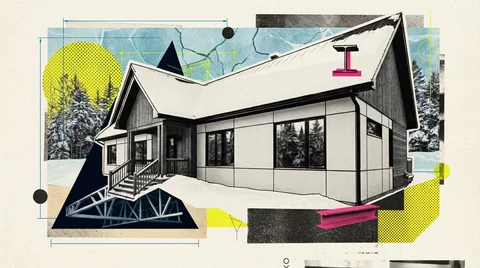
A modular or factory-built home installed on a permanent foundation is built with conventional construction materials (wood or steel framing, insulation, cladding) and complies with the Quebec Construction Code, like a traditional house. Its structure has no reason to age faster.
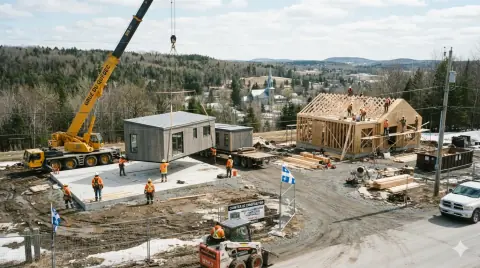
Better still: the modules are designed to withstand transport and crane lifting, which often requires a frame reinforced beyond a classic site build. Fabrication in a factory, sheltered from the weather, also reduces a major enemy of durability — moisture absorbed during construction. If the distinction between the processes (modular, factory-built, prefab) is not clear to you, start with Modular, manufactured, or prefab: the differences.
Like any house, its actual longevity depends on maintenance: roof, envelope, sealants, mechanicals. Well maintained, it crosses the decades just like a site-built home.
"What wears a house down is not where it was assembled. It is water, time and lack of maintenance — exactly as for any house."
Resale: the received idea versus the facts
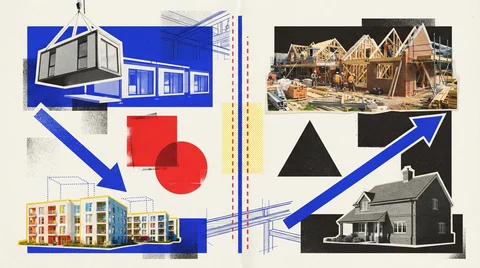
The idea that "prefab resells poorly" comes straight from the mobile home, which sits on a chassis without a permanent foundation, is often installed on leased land, and — like a vehicle — tends to depreciate. The modular home on a foundation is a different animal altogether: it is real property, attached to land that appreciates with the market.
In practice, a modular home built to the Code and well maintained resells today at values comparable to comparable traditional houses in most regions of Quebec. The average buyer, on a visit, cannot even tell a finished modular home from a site-built one — and it is often the appraiser, more than the buyer, who looks into the process.
| Criterion | Modular home (on foundation) | Mobile home (no foundation) |
|---|---|---|
| Status | Real property | Often movable property |
| Value trend | Appreciates with the market and the land | Tends to depreciate |
| Lifespan | Decades (comparable to traditional) | More limited |
| Resale perception | Comparable to traditional | Frequent discount |
What really weighs on resale value
The manufacturing process is not the first factor. What pushes the resale price up or down, in the usual order:
- Location. The land, the neighbourhood, the services, the region's appeal — as for any house, it is the dominant factor.
- Maintenance. A well-kept house sells better, period. Consistent upkeep shows.
- Quality of finish. High-end finishes and durable materials support the value; low-end finishes drag it down — whatever the process.
- Energy efficiency. A high-performing envelope and low energy costs are a selling point buyers appreciate in Quebec.
- Compliance and the original warranty. A house built by an accredited contractor, with permits and warranty in order, reassures the buyer and the appraiser (one more reason to choose your builder carefully from the start).
Protecting your value: the right reflexes at purchase
Resale is prepared at purchase. Four decisions that help:
- Buy on a permanent foundation, to stay clearly in the "real property" category — which also secures the financing (see Mortgage and financing for a modular home).
- Choose an accredited builder and a warranty in good standing.
- Do not under-invest in the finish: it is what the buyer sees and appraises.
- Keep the documents: permits, warranty, plans, maintenance invoices — a clean file reassures and speeds up the sale.
To situate purchase prices by formula and region, see our modular home price guide for Quebec.
In summary
- On a foundation and built to the Code, a modular home lasts as long as a traditional house — decades, with normal maintenance.
- It resells at comparable values in most regions of Quebec.
- The idea of a "prefab discount" comes from the mobile home, which is a different case.
- Location, maintenance and finish weigh far more than the manufacturing process.
- Value is protected at purchase: permanent foundation, accredited builder, warranty, quality finish, complete file.
Sources: CMHC, Institut de la statistique du Québec (ISQ), APCHQ. Article written by Jeremy Soares. Last updated: June 24, 2026.

8Module
Modular multi-residential buildings (6 to 24+ units) factory-built in Quebec.
Visit websiteCommercial partnership — we receive compensation. Disclosure
Frequently asked questions
How long does a modular home last?
Does a modular home gain value at resale?
Why do people think prefab resells poorly?
What influences resale value the most?
How do I protect my modular home's resale value?
Sources
- Marché de l'habitation et valeurs de revente au Québec — SCHL (Société canadienne d'hypothèques et de logement)
- Prix et statistiques du marché immobilier résidentiel — Institut de la statistique du Québec (ISQ)
- Données sur la construction et la rénovation résidentielles — APCHQ


Comments
A question or comment on this article? The comments section will be enabled soon.