Multi-residential · 10 min
Modular Construction: The Guide for Quebec Municipalities
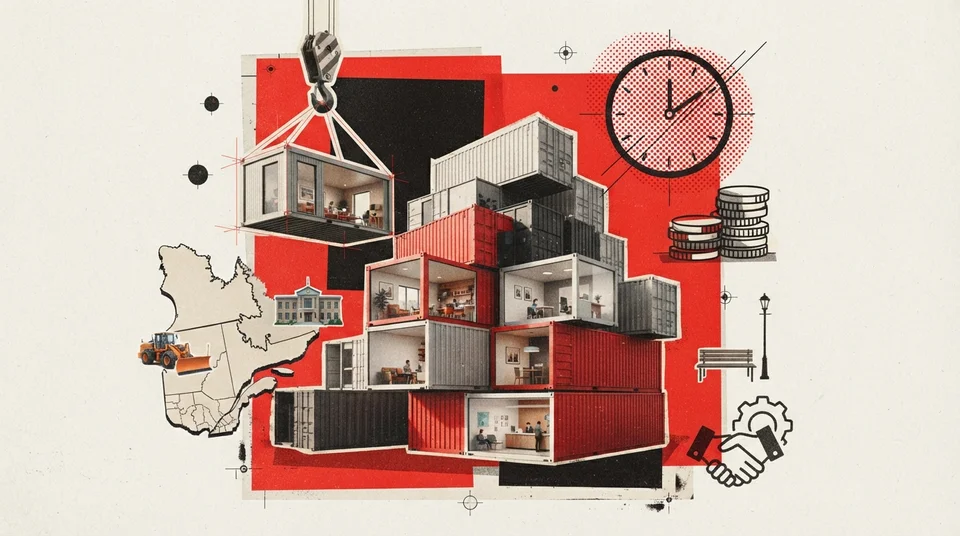
In short — A Quebec municipality does not need a special program to welcome a modular housing project: the levers are already in its hands. Zoning that allows multi-unit development, a permit process that treats the factory-built building like any other Code-compliant structure, a municipal lot put to use, and a partnership with a non-profit (NPO) or housing office are, in many cases, enough to bring a project out of the ground in a few seasons rather than a few years.
Across Quebec, municipal councils are looking to create housing — to retain young families, house local workers, or allow seniors to stay in their village. Modular construction comes up more and more in these discussions: short construction periods, limited disruption, compatibility with program schedules. This guide is addressed to elected officials, general managers, and planning departments who want to know concretely what to do — and what to avoid.
Why municipalities are turning to modular
The picture is familiar: even where the overall vacancy rate is recovering — CMHC — Canada Mortgage and Housing Corporation placed it at 2.9% in Quebec urban centres in October 2025 — the most affordable segment remains severely short, with vacancy rates around 1% to 1.3% depending on the market. In other words, market relief comes mainly from expensive new units; households with modest incomes still cannot find anything. That is precisely the segment municipalities want to see built, and it is where modular has the most to offer.
The reason is simple: in a modular project, factory manufacturing runs in parallel with foundation and infrastructure work. The local construction site becomes an assembly rather than a full build, which compresses the schedule and reduces the duration of neighbourhood disruption. For a primer on the process, see our article on what modular construction is.
For multi-unit projects of 6 to 24 units and up — the format best suited to the needs of small and medium-sized municipalities — Quebec manufacturers such as 8Module offer this type of rapid assembly.
Disclosure — 8Module is a commercial client of Modulaire Québec; we receive compensation when we refer a lead. This content remains editorial and independent — 8Module neither commissioned nor reviewed it. Full disclosure.
Governments have also taken a position: the Société d'habitation du Québec (SHQ, Quebec's housing corporation) launched a project call for 500 highly prefabricated housing units in January 2025, and the federal agency Maisons Canada (Build Canada Homes), launched in September 2025, explicitly prioritizes prefabricated and modular construction — its first wave of projects includes a site in Quebec, in Longueuil. A municipality that prepares its regulatory framework today is positioning itself to attract these investments.
Zoning: the first lever, and the most powerful
No financing program can compensate for a zoning bylaw that prohibits the project. Before anything else, the planning department should review three elements.
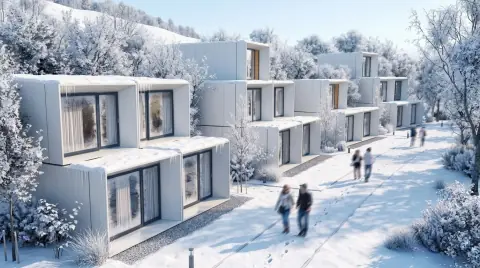
Permitted uses and densities. Many village cores are zoned single-family. Allowing duplexes, triplexes, or small multi-unit buildings in zones already served by water and sewer services is the most effective measure — and it benefits every construction method. Our article on the modular multiplex shows what kind of building is involved: conventionally designed structures, not trailers.
Appearance and dimension clauses. Some older bylaws contain minimum façade width, roof pitch, or minimum dwelling area requirements that were written, at the time, to block mobile homes — and that now inadvertently block perfectly Code-compliant factory-built structures. A review of these clauses is in order: target the quality of the outcome (siting, materials, integration into the built environment) rather than the manufacturing process. The same reflex applies to smaller units, as explained in our guide on municipal bylaws for tiny homes.
Discretionary tools. A well-calibrated PIIA (plan d'implantation et d'intégration architecturale, Quebec's site and architectural integration plan) can govern the appearance of a modular project without prohibiting it. Conversely, a discretionary process that is too heavy or unpredictable cancels the main advantage of modular: speed. The key is predictability — clear criteria, known in advance, applied quickly.
Permits and inspection: treating the factory-built building for what it is
This is the point that most often puzzles permit departments: a large part of the building arrives already closed — finished walls, plumbing, and electrical in place. How do you inspect what you cannot open?
The answer already exists within Quebec's regulatory framework. In Quebec, the sale of factory-built buildings is governed by the CAN/CSA-A277 certification, under the oversight of the Régie du bâtiment du Québec (RBQ, Quebec's building authority): an accredited certification body audits the factory and inspects manufacturing, and the seal affixed to the module attests to compliance with the codes applicable at the place of installation. The municipal inspector therefore does not need to open the walls: they verify the seal and certification documentation, then focus the inspection on what is done on-site — the foundation, connections, module assembly, and site finishing work.
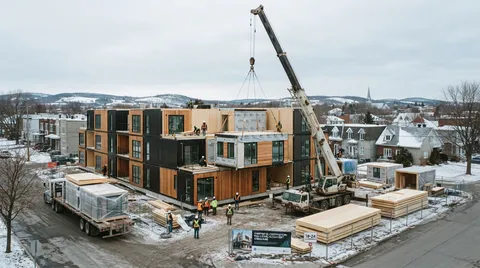
In practice, a modular project is treated like any other project: same plans, same zoning compliance review, same building permit. Two useful adjustments: train staff to recognize factory-built building certification, and manage the crane lift — setting the modules requires a crane and sometimes a temporary street closure, to be coordinated with public works.
Municipal land: the most decisive contribution
In most affordable housing projects, the land is both the primary obstacle and the most structural municipal contribution. Several approaches exist, from simplest to most involved:
- Sale at nominal value or transfer of a municipal lot to a non-profit (NPO) or housing office, with affordability conditions registered in the deed;
- Emphyteutic lease, which keeps the land in the municipal heritage while enabling the project;
- Land reserve: identify suitable lots now (serviced, well located, no major constraints), before the need becomes urgent;
- Infrastructure contributions: water or sewer extensions, access improvements.
Modular construction adds a particular requirement here: site accessibility. Modules arrive by oversize transport and are set by crane. A steeply sloped, landlocked, or narrow-street-access site can complicate or even prevent delivery. This criterion deserves a place in the municipal land evaluation grid alongside service coverage.
Partnerships: who leads the project?
A municipality is generally not in the business of becoming a real estate developer. The most common project structure relies on a specialized project lead:
- A housing non-profit (NPO), local or provincial, that develops and operates the project;
- A housing co-operative, where residents are members;
- The housing office for the territory, which already manages social housing;
- A private developer, under the program streams open to them.
The municipality's role is then that of facilitator: land, zoning, diligent permits, tax relief where applicable, and public support for the project. To understand how these organizations structure their projects, see our article on modular affordable housing.
Where financing programs fit in
Programs evolve quickly — their parameters must be verified when putting together a file — but the overall structure is stable: Quebec funds affordable housing through the SHQ, Ottawa through CMHC and its new initiatives, and certain envelopes explicitly target prefabricated construction.
| Program | Level | Key takeaway for a municipality |
|---|---|---|
| PHAQ (Programme d'habitation abordable Québec) | Quebec (SHQ) | Currently the flagship program for affordable rental; open to NPOs, co-operatives, housing offices, and private developers. A community contribution (land, taxes) strengthens applications. |
| Project call: 500 highly prefabricated housing units | Quebec (SHQ) | Quebec's first public program dedicated to highly prefabricated multi-unit housing; funded by the Canada–Quebec agreement under FACL (Fonds pour accélérer la construction de logements — Canada's Housing Accelerator Fund). A clear signal that Quebec is institutionalizing the approach. |
| FACL (Fonds pour accélérer la construction de logements — Canada's Housing Accelerator Fund) | Federal, via Canada–Quebec agreement | In Quebec, the envelope flows through the Canada–Quebec agreement rather than direct agreements with individual cities; it is this agreement that funds the SHQ's prefabricated project call, among other things. |
| Maisons Canada (Build Canada Homes) | Federal | Agency launched in September 2025, prioritizing prefabricated, modular, and mass-timber construction; first wave of projects on federal land, including a site in Longueuil. |
The practical message: the municipality generally does not submit the application itself, but a file supported by the community — identified land, conforming zoning, council resolution — stands out in all these programs.
Gentle densification: modular at small scale
Not everything goes through multi-unit buildings. Gentle densification — accessory dwelling units (ADUs) in back yards, conversion of large homes, small plexes inserted into the existing urban fabric — creates housing without transforming a neighbourhood's character. Modular lends itself well to this: a factory-built unit installs in a few days, with minimal disruption. Allowing ADUs opens a discreet but real path to housing creation.
Community acceptance: naming the concerns, showing the product
Housing projects, modular or not, sometimes face resident opposition. Modular adds a specific prejudice: confusion with mobile homes or "low-end prefab." Three practices make a measurable difference in public consultations:
- Show comparable completed projects. Images of recent modular buildings — often impossible to distinguish from conventional construction — defuse the aesthetic objection better than any argument.
- Explain the quality framework. Factory-built building certification, Code compliance, in-factory inspection: the process is governed, and saying so early prevents the vacuum from being filled by myths.
- Emphasize the construction duration. Fewer months of crane, trucks, and noise is an argument that speaks directly to immediate neighbours. Our article on the timelines of a modular project provides concrete reference points.
It is also important to remain honest: modular does not immunize against delays in site development, permitting, or utility connections. Recent Quebec municipal projects have shown this — factory speed does not excuse rigorous site preparation and municipal scheduling.
Where to start: the recommended sequence
- Compile an inventory of municipal lots that are owned or acquirable, serviced, and accessible for oversize transport and a crane.
- Review zoning in serviced zones: multi-unit uses, dimension and appearance clauses inherited from the anti-mobile-home era, openness to ADUs.
- Identify a project lead (NPO, co-operative, housing office) and formalize the partnership by resolution.
- Document the municipal contribution (land, taxes, infrastructure) to strengthen program applications.
- Prepare the permit department: training on factory-built building certification, coordination of the crane lift with public works.
Sources: Société d'habitation du Québec (PHAQ, project call for 500 highly prefabricated housing units), Régie du bâtiment du Québec (factory-built building certification), Gouvernement du Canada (Maisons Canada / Build Canada Homes), CMHC — Canada Mortgage and Housing Corporation (2025 Rental Market Report). Article written by Jeremy Soares. Last updated: July 1, 2026.

8Module
Modular multi-residential buildings (6 to 24+ units) factory-built in Quebec.
Visit websiteCommercial partnership — we receive compensation. Disclosure
Frequently asked questions
Can a municipality prohibit modular construction on its territory?
Who inspects a building whose walls arrive already closed?
Is modular only for major urban centres?
What is the first concrete step for a municipal council?
Sources
- Quebec Affordable Housing Program (PHAQ) — Gouvernement du Québec / SHQ
- Project Call — 500 Highly Prefabricated Housing Units — Gouvernement du Québec / SHQ
- Factory-Built Building Certification (CAN/CSA-A277) — Régie du bâtiment du Québec (RBQ)
- Maisons Canada (Build Canada Homes) — Gouvernement du Canada
- 2025 Rental Market Report — CMHC — Canada Mortgage and Housing Corporation

Comments
A question or comment on this article? The comments section will be enabled soon.