Residential · 9 min
Turnkey or Ready-to-Finish: Which One to Choose?
In short — A turnkey home is delivered move-in ready: everything is finished, you unpack and live in it. A ready-to-finish (prêt-à-finir) home is delivered closed and weathertight (structure, roof, windows, and sometimes rough plumbing and electrical), but it is up to you to complete the interior finishing. Ready-to-finish costs less to buy — often 15 to 30% less — but it demands time, skills, and more complex financing. Choose based on three things: your budget, the time you can put in, and your tolerance for managing construction work.
When shopping for a modular or factory-built home in Quebec, this is one of the first decisions to make — and one of the most misunderstood. "Turnkey" and "ready-to-finish" do not describe two tiers of home quality: they are two levels of completion at delivery. Comparing the price of one against the other without knowing this is comparing two different things. This guide explains exactly what each option includes, what it leaves for you to do, and how to choose without any nasty surprises.
What each option means
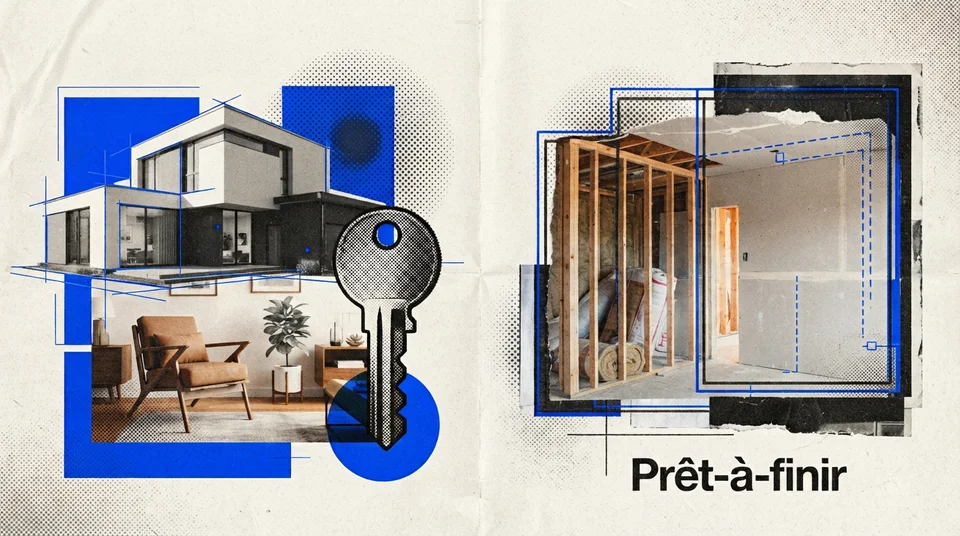
A turnkey home is delivered complete. At handover, the floors are laid, the walls are painted, the kitchen and bathroom are installed, and basic appliances are often included. You turn the key and move in. The builder handles all coordination from A to Z and bears responsibility for the finished result.
A ready-to-finish home (prêt-à-finir — sometimes called a "semi-finished" or "closed shell") is delivered closed and weathertight: foundation, structure, roof, exterior cladding, and windows are all in place. Inside, the degree of completion varies widely from one builder to the next. Some deliver insulation, rough plumbing, and rough electrical; others stop at the shell. It is you — or the subcontractors you hire — who complete the work: drywall, paint, flooring, cabinetry, finishing.
The crucial point: there is no single legal definition of "ready-to-finish." Two builders can sell a "ready-to-finish" home that stops at entirely different stages. Hence rule number one of this guide: demand a precise written list of what is and is not included.
"A ready-to-finish home is not a cheaper house. It is a house where you pay part of the price in time and labour instead of money."
What each option includes — the comparison table
| Item | Turnkey | Ready-to-finish (typical) |
|---|---|---|
| Foundation and structure | Included | Included |
| Roof and exterior cladding | Included | Included |
| Windows and exterior doors | Included | Included |
| Insulation, rough plumbing, rough electrical | Included | Often included, confirm |
| Drywall, taping, paint | Included | Your responsibility |
| Flooring, cabinetry, countertops | Included | Your responsibility |
| Finished bathroom and kitchen | Included | Your responsibility |
| Trade coordination | Builder | You |
| Time before move-in | Shortest | Longer (depends on your pace) |
Keep in mind that the "ready-to-finish" column above is an average: the only table that matters is the one your builder puts in writing in the contract. For a sense of price ranges by option, see our guide to modular home prices in Quebec.
Price differences — and the "cheaper" trap
On paper, ready-to-finish costs less to buy — often in a range of 15 to 30% below the equivalent turnkey home. The gap comes from the finishing work you take on: finishing labour represents a significant portion of a new home's cost.
The trap is confusing purchase price with total cost. Once the shell is delivered, you need to buy finishing materials, hire (or be) the labour, and absorb unforeseen costs. Depending on your choices and how much work you do yourself, the total cost of a ready-to-finish home can approach that of a turnkey — or stay significantly lower if you have the skills. The real savings are greatest especially when you provide a large share of the finishing labour yourself.
Three hidden costs of the ready-to-finish option
- Time. A finishing build often stretches over several months. Until it is done, you may be paying rent or a mortgage elsewhere.
- Coordination. You become the general contractor: finding the trades, sequencing them, managing delays. It is real work.
- Budget risk. Without a firm overall price, overruns fall on you.
Financing: the difference that surprises most
This is the most commonly overlooked angle. A lender more easily evaluates a turnkey home: the finished value is known, standard mortgage in the usual sense. A ready-to-finish home resembles a project in progress, which pushes some lenders toward a construction loan (with staged drawdowns) rather than a simple mortgage, and sometimes toward a higher down payment. Verify this before signing: it is the kind of detail that can block a file at the last minute. We cover the mechanics in detail in our guide Mortgage and Financing for a Modular Home.
Warranties: who is responsible for what
In a turnkey build, the builder delivers a finished product and stands behind it. The Garantie de construction résidentielle (GCR) applies to eligible new homes built by an accredited contractor. In a ready-to-finish build, coverage applies to the part the builder completed (the shell, the structure); work you do yourself or through your own subcontractors is not covered by the builder's warranty. That is one more reason to document clearly who does what.
How to choose — the decision guide
Choose turnkey if: you want to move in quickly, you have neither the time nor the inclination to manage a build, you prefer a firm price and a single point of responsibility, or your financing is easier to secure on a finished home.
Choose ready-to-finish if: you have real renovation skills (or a reliable network), time to spare, a tight budget you can offset with your own labour, and the desire to customize the finishing to your taste. Choosing the right partner remains critical in either case — see How to Choose Your Modular Home Builder.
One final useful note: turnkey and ready-to-finish exist in both modular and factory-built homes. If the distinction between these processes is not clear to you, start with Modular, Manufactured, or Prefab Home: the Differences.
In summary
- Turnkey = delivered finished, you move in; highest price, least hassle.
- Ready-to-finish = delivered closed and weathertight, you complete the finishing; cheaper to buy (often 15 to 30% less), but more time and work.
- The "cheaper" is only real if you provide the finishing labour yourself.
- Financing and warranties differ by option — confirm before signing.
- In all cases: demand a precise written list of what is included.
Sources: Garantie de construction résidentielle (GCR), APCHQ, Régie du bâtiment du Québec (RBQ). Article written by Jeremy Soares. Last updated: June 24, 2026.

8Module
Modular multi-residential buildings (6 to 24+ units) factory-built in Quebec.
Visit websiteCommercial partnership — we receive compensation. Disclosure
Frequently asked questions
What is the real difference between turnkey and ready-to-finish?
Is ready-to-finish genuinely cheaper?
Can a ready-to-finish home be financed with a regular mortgage?
Does the warranty cover a ready-to-finish home I complete myself?
How much longer before I can move into a ready-to-finish home?
Sources
- Garantie de construction résidentielle (GCR) — ce qui est couvert — Garantie de construction résidentielle
- Données sur la construction résidentielle au Québec — APCHQ
- Licences et qualifications des entrepreneurs — Régie du bâtiment du Québec (RBQ)



Comments
A question or comment on this article? The comments section will be enabled soon.