Residential · 9 min
Factory-Built Home Trends in Quebec in 2026
In short — In 2026, the factory-built home in Quebec is driven by four forces: energy performance going mainstream (Novoclimat, passive house), the rise of small units (tiny homes, ADUs) and multigenerational living, the comeback of wood as the star material, and a labour shortage that makes the factory more attractive than ever. None of these trends is a fashion effect: they are responses to real pressures — housing costs, climate, demographics.
Every year, someone announces that prefab is about to "explode." The Quebec reality is more interesting: the factory is gaining ground not through novelty, but because it answers concrete problems better. Here are the five trends that really matter in 2026.
1. Energy performance becomes the norm
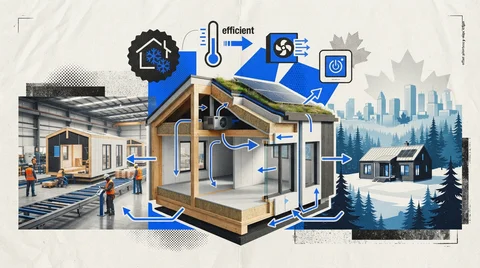
What used to be a "plus" is becoming an expectation. Under the pressure of energy costs and climate targets, the energy-efficient home — aiming for Novoclimat, even the passive house — is taking hold. The factory is well positioned to deliver that performance, because the envelope is easier to control under cover. Outlets like Écohabitation document this rise of sustainable housing.
2. Smaller, smarter
Housing costs are pushing toward more compact, better-designed units: the tiny home and the ADU are moving out of the margins, and municipalities are loosening their rules for "gentle density." The factory excels on small envelopes, where concentrated finishing benefits from serial work.
3. Multigenerational living settles in
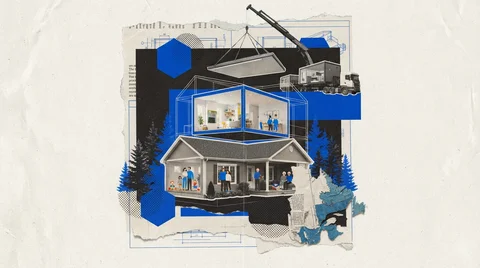
An aging population and the desire to keep loved ones close are feeding demand for the multigenerational home. It is natural ground for modular, which can integrate a second dwelling quickly and affordably.
4. Wood comes back strong
On the materials side, wood — local, renewable, a carbon store — is gaining ground, from residential to high-rise projects. The debate is sharpening rather than closing: see our wood and steel comparison. Internationally, wood prefabrication is breaking records, as our tour of modular construction around the world shows.
5. The labour shortage pushes the factory
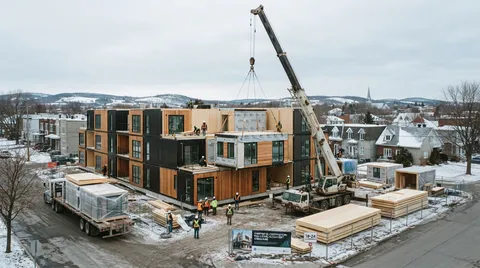
This may be the most structural trend. With labour scarce on job sites — an issue tracked by players like the APCHQ — the factory, where a stable team works year-round, becomes a competitive advantage. The logic holds as much for a house as for multifamily buildings, where speed counts double.
What to take away for 2026
The trends converge on a single idea: the factory is no longer the "cheaper second choice," but a serious answer to Quebec's energy, cost, demographic and labour constraints. For anyone planning a project, it mostly means one thing: aim for performance and choose your manufacturer carefully from the start.

8Module
Modular multi-residential buildings (6 to 24+ units) factory-built in Quebec.
Visit websiteCommercial partnership — we receive compensation. Disclosure
Frequently asked questions
What are the big factory-built home trends in Quebec in 2026?
Is the factory-built home gaining popularity in Quebec?
Does wood or steel dominate in 2026?
Sources
- Tendances en habitation durable — Écohabitation
- Architecture et design modulaires — Dezeen
- Marché de la construction et main-d'œuvre — Association des professionnels de la construction et de l'habitation du Québec (APCHQ)

Comments
A question or comment on this article? The comments section will be enabled soon.