Fundamentals · 9 min
Modular Home, Manufactured, or Prefab: What Are the Differences?
In short — "Modular," "manufactured," and "prefab" are not synonyms. The difference lies in how much of the home is built in a factory and how it is assembled on-site. That changes three concrete things: the price, the timeline, and the type of financing you qualify for.
If you are shopping for a new home in Quebec, you will quickly encounter these three terms — often used as though they mean the same thing. They do not. Understanding the distinction saves you two common costly surprises: a mortgage refused because the building type does not match, and a budget built on a flawed comparison of different products.
The definitions, without jargon
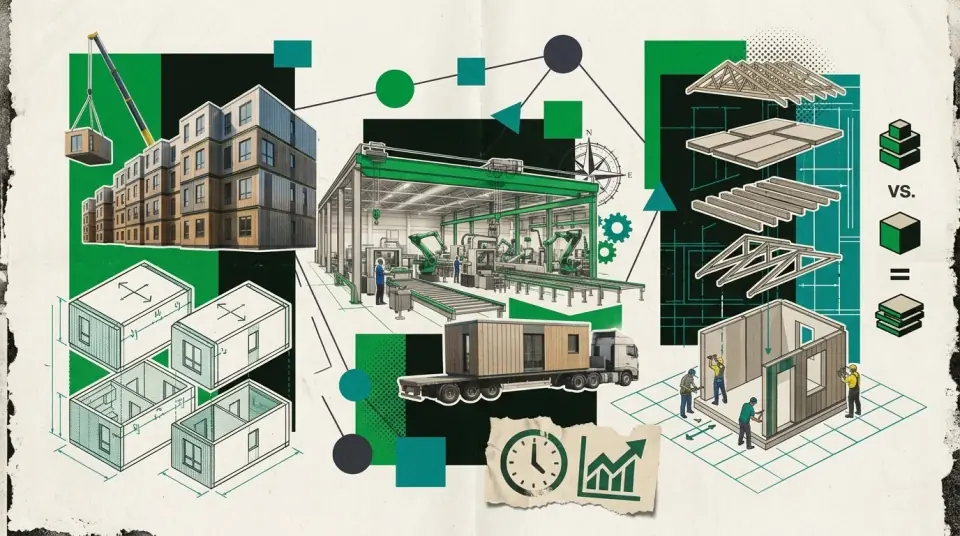
The term prefab is the umbrella word. It refers to any home where some portion is manufactured in a factory rather than on-site. Under that umbrella, several processes coexist.
A modular home is built as complete modules in a factory — sections of the home, with floors, walls, plumbing, and interior finishes often already in place — then delivered and assembled on the foundation. This is the most "factory-finished" process.
A manufactured home ("maison usinée") covers processes where the home is built in a factory but not necessarily as complete three-dimensional modules: sometimes panels (pre-assembled walls) or sections are delivered flat. In Quebec, "maison usinée" is in fact the common industry term for a large segment of this market.
The distinction is not merely a matter of vocabulary. It determines the degree of completion at delivery, the time needed for on-site assembly, and — returning to this shortly — financing conditions.
"The real economy of modular construction is not so much the price per square foot: it is the time."
What changes in practice: price, timeline, quality
Here are the most commonly observed differences. Keep in mind that these are indicative ranges: a high-end project can match or even exceed traditional construction costs.
| Criterion | Modular / manufactured | Traditional construction |
|---|---|---|
| Average timeline (signature to move-in) | 4 to 6 months | 8 to 14 months |
| Price per sq. ft. (turnkey) | $150 – $290 | $200 – $350+ |
| Weather sensitivity | Low (built under cover) | High |
| Customization | Moderate to high | High |
| Quality control | In-factory, inspected at each stage | On-site |
The cost advantage comes mainly from two factors: speed (less time, less on-site labour) and reduced material waste in the factory. For a detailed breakdown of prices by type and region, see our modular home price guide for Quebec.
Timeline: the real differentiator
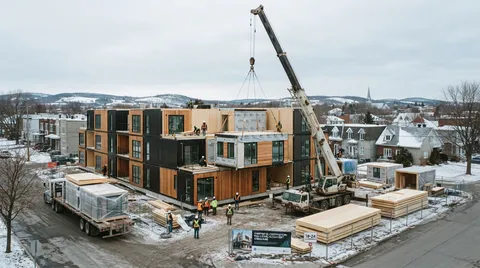
Because factory manufacturing happens in parallel with site preparation and foundation work, months are saved. The job site becomes an assembly rather than a ground-up construction. In multi-unit housing, the difference is even more pronounced: a building can be assembled in a matter of days once the modules are delivered (see our feature on the modular multiplex).
Regulation: it is a real home
A persistent confusion: prefab does not mean "mobile home." A modular or manufactured home on a permanent foundation is built to the Quebec Construction Code and subject to the same requirements as a home built on-site. It requires a municipal permit and can be inspected at every stage in the factory. For details on standards and warranties, see our article on modular construction and the Quebec Construction Code (RBQ).
Financing: the distinction that can block everything
This is where the difference becomes very concrete. A modular home on a permanent foundation is generally eligible for a standard mortgage, on the same terms as a traditional home. The conditions differ, however, from mobile homes or unfounded cottages. Before signing anything, confirm the financing type with your lender — common pitfalls are explained in our guide on mortgage and financing for a modular home.
And resale value?
Another misconception: prefab homes supposedly resell poorly. In practice, when built to Code and well maintained, these homes sell today at values comparable to traditional homes in most regions of Quebec. Finish quality and location carry far more weight than the manufacturing process.
In summary
- Prefab = the umbrella term. Modular = complete modules finished in a factory. Manufactured = factory-built, panels or modules depending on the builder.
- The main advantage is timeline (often 4 to 6 months), followed by cost.
- On a permanent foundation, it is a full-fledged home: Quebec Code, permit, standard mortgage.
- Compare equivalent products before judging on price.
Sources: Régie du bâtiment du Québec (Quebec Construction Code), APCHQ, CMHC — Canada Mortgage and Housing Corporation. Article written by Jeremy Soares. Last updated: June 24, 2026.

8Module
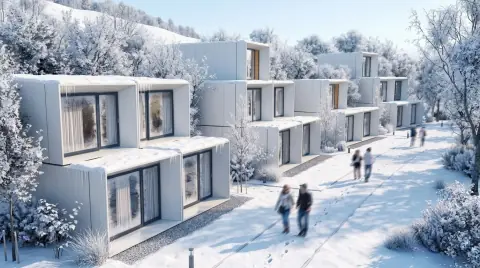
Modular multi-residential buildings (6 to 24+ units) factory-built in Quebec.
Visit websiteCommercial partnership — we receive compensation. Disclosure
Frequently asked questions
Is a modular home less structurally sound than a traditional home?
What is the difference between a modular home and a mobile home?
Can a manufactured home be customized?
How long does it take to move in?
Sources
- Quebec Construction Code — Régie du bâtiment du Québec (RBQ)
- Residential Construction Data — APCHQ
- Housing Market — CMHC — Canada Mortgage and Housing Corporation


Comments
A question or comment on this article? The comments section will be enabled soon.