
Residential · 10 min
How to Choose Your Modular Home Builder
In short — To choose a good modular home builder in Quebec, first verify three non-negotiables: a valid RBQ licence (verifiable online), an applicable new-home building warranty (the GCR for eligible homes), and a clear contract detailing what is included, the price, the schedule, and the deposit terms. Then ask precise questions about timelines, finishes, and after-sales service. The most reliable red flags: a builder rushing you to pay a deposit, a refusal to put things in writing, and the absence of a licence or warranty.
The modular process is sound; what makes the difference between a good and a bad project is the builder. The same type of home can be a success or a nightmare depending on the seriousness of the company that manufactures, delivers, and coordinates it. This guide gives you the framework to use: the verifications to make, the questions to ask, and the signals that should make you walk away.
The three non-negotiable verifications
Before even comparing prices, validate these three elements. If one is missing, move on to the next builder.
1. The RBQ licence. In Quebec, a construction contractor must hold an appropriate licence from the Régie du bâtiment du Québec (RBQ, Quebec's building authority). You can verify it yourself in the RBQ's public registry: exact name, licence number, sub-categories, active status. A valid licence is not an administrative detail — it is also a condition for many warranties and for financing.
2. The new-home building warranty. For an eligible new home built by an accredited contractor, the Garantie de construction résidentielle (GCR, Quebec's new-home warranty plan) protects the buyer (deposits, completion, defects and poor workmanship according to defined schedules). Ask whether the project is covered and under which plan. A home with no applicable warranty is a risk few buyers should accept.
3. A written, detailed contract. A verbal quote is worth nothing. Require a contract that specifies: the complete description, what is included and excluded, the firm price (or the calculation method), the deposit schedule, the manufacturing and delivery timeline, and the conditions in case of delay or change.
"A good builder has no problem putting everything in writing. The one who resists putting things in writing is already telling you something."
Questions to ask — the list
Ask them early, and note the answers. The way a builder responds is as revealing as what they say.
| Domain | Question to ask |
|---|---|
| Licence and experience | What is your RBQ licence number? How many years have you been building this type of home? |
| Warranty | Is the project covered by the GCR (or an applicable equivalent plan)? |
| Inclusions | What is included in the price — and what is not (land, foundation, utility connections, transport, crane, permits)? |
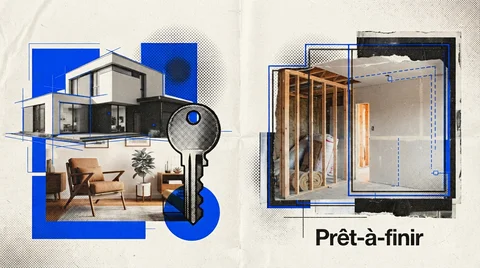
| Arrangement | Is this turnkey or ready-to-finish, and exactly where does your responsibility end? |
| Timelines | What is a realistic timeline, from signing to occupancy? What happens in case of delay? |
| Deposits | What is the payment schedule, and are the deposits protected? |
| References | Can I visit a delivered home and speak to recent clients? |
| After-sales service | How do you handle corrections after delivery, and within what timeframes? |
On inclusions, be especially vigilant: many budget surprises come from off-home costs (land, foundation, utility connections, transport). We detail them in our modular home price guide for Quebec. And clarify early whether the offer is turnkey or ready-to-finish — responsibility and financing depend on it (see our guide on turnkey or ready-to-finish).
Red flags
None of these signals is trivial. Several together: walk away.
- No verifiable RBQ licence, or a company name that does not match the registry.
- Pressure to sign or pay a deposit quickly, "before the price changes."
- Refusal to put inclusions and the timeline in writing, or a vague contract.
- An unusually large initial deposit, or payments not tied to verifiable milestones.
- No references, no home to visit, no client to speak to.
- A price significantly lower than all the others with no clear explanation of what has been removed.
- Vagueness about the warranty or about after-sales service.
- Erratic communication during the shopping phase (a preview of what the build will be like).
Verifying it yourself: the right habits
Do not rely solely on the sales pitch. Cross-reference your sources:
- The RBQ registry for the licence and its status.
- The GCR to confirm coverage and the contractor's accreditation.
- The Office de la protection du consommateur (OPC, Quebec's consumer protection office) to understand your rights and identify any complaint history.
- Real references: visit a delivered home, ask the owners how timelines, finishes, and after-sales service went.
Also make sure the builder is familiar with the process you are targeting. If the difference between modular, factory-built, and prefab influences your choice, read Modular, manufactured, or prefab: the differences, then verify that the financing will follow with our guide Mortgage and financing for a modular home.
In summary
- Three non-negotiables: valid RBQ licence, applicable new-home building warranty (GCR), written and detailed contract.
- Ask precise questions about inclusions, timelines, deposits, and after-sales service — and note the answers.
- Major red flags: pressure to sign, refusal to put things in writing, absence of a licence or warranty, price too good to be true without explanation.
- Verify yourself via the RBQ, the GCR, and the OPC, and require real references.
Sources: Régie du bâtiment du Québec (licence registry), Garantie de construction résidentielle (GCR), Office de la protection du consommateur du Québec. Article written by Jeremy Soares. Last updated: June 24, 2026.

8Module
Modular multi-residential buildings (6 to 24+ units) factory-built in Quebec.
Visit websiteCommercial partnership — we receive compensation. Disclosure
Frequently asked questions
How do you verify that a modular home builder is legitimate in Quebec?
What are the main red flags with a builder?
Is a new-home building warranty absolutely necessary?
What questions should you ask about the price?
Is a price much lower than the others a good deal?
Sources
- Verify a contractor's licence (Licence Holders Registry) — Régie du bâtiment du Québec (RBQ)
- New residential buildings warranty plan — Garantie de construction résidentielle (GCR)
- Your rights as a consumer in a construction contract — Office de la protection du consommateur du Québec

Comments
A question or comment on this article? The comments section will be enabled soon.