Fundamentals · 9 min
Advantages and Disadvantages of Modular Construction
In short — The main advantages of modular construction are speed (often 4 to 6 months), budget predictability, factory-controlled quality and lower dependence on weather. Its main disadvantages: transport and dimension constraints, a site that must be accessible to a crane, customization that is sometimes more structured, and the requirement to pay a deposit earlier in the process.
Modular construction has real strengths — but no method is perfect, and an honest guide has to say so. Here is a balanced assessment to help you decide whether modular suits your project, without overselling or dismissing it.
The advantages
1. Speed
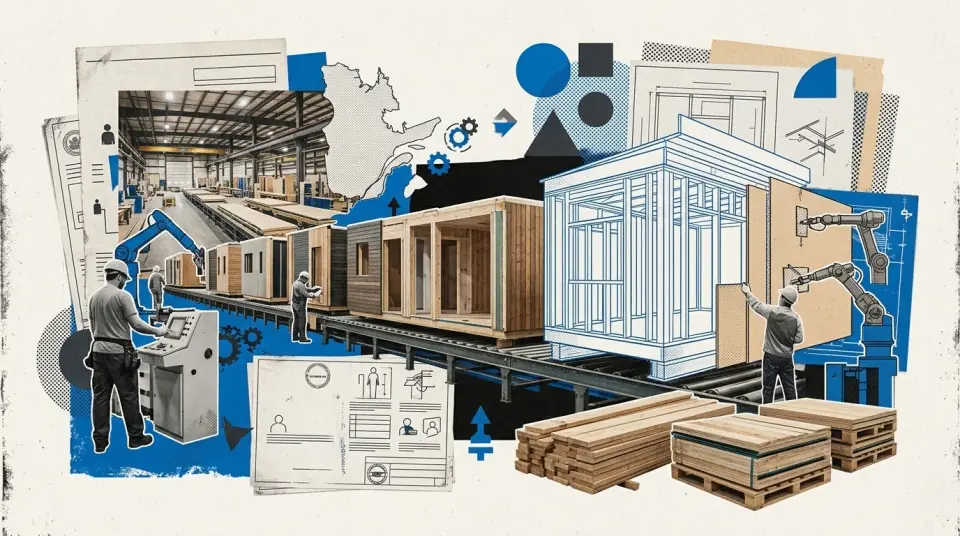
This is the number-one strength. Because modules are manufactured in the factory while the site and foundation are being prepared, months are saved. The build on site is often reduced to an assembly of a few days. For a buyer who is in a hurry, or an investor who wants to generate rental income sooner, that is decisive. The mechanism is explained in What is modular construction?
2. Budget and schedule predictability
Factory production, sheltered from the elements, reduces on-site surprises (weather delays, water damage, material theft). Price and delivery date are generally firmer than in traditional construction.
3. Controlled quality
The production line allows inspections at every stage and construction in dry conditions. Modules, designed to withstand transport and crane lifts, are often more rigid than a structure assembled on site.
4. Less waste and fewer disruptions
Factory production reduces material waste and limits the duration of on-site disruptions (noise, traffic, debris) — an advantage in urban settings or dense neighbourhoods.
The disadvantages
1. Transport and dimension constraints
Modules travel by road: their width and height are limited by road transport regulations. This bounds certain geometries and sometimes imposes design choices. A remote or difficult- to-access site increases delivery costs and complexity.
2. The site must be accessible to a crane
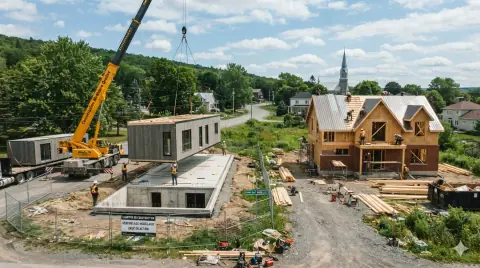
Assembly requires a crane that can reach the site and manoeuvre. A landlocked, steeply sloped or very narrow lot can complicate — or prevent — module placement. Verify this early.
3. More structured customization
You can generally modify plans and choose finishes, but architectural freedom remains greater in traditional construction, especially for complex shapes or highly atypical projects. The choice of structure (wood or steel) also influences the possibilities — see our comparison Modular Structure: Wood or Steel?
4. The payment schedule
Factory production often requires deposits earlier in the process, before you see the building assembled. This requires validating your financing and the builder's financial health well in advance.
5. Lingering misconceptions
Modular still carries a reputation as "cheap" or "less solid." That is largely untrue for buildings on foundations constructed to Code, but this perception can weigh on resale value in some poorly informed markets — a factor that is disappearing as the method becomes mainstream.
Pros and cons at a glance
| Dimension | Advantage | Disadvantage |
|---|---|---|
| Timeline | Often 4 to 6 months | Deposits required earlier |
| Weather | Manufactured under cover | — |
| Quality | Factory inspections | Still depends on the builder |
| Design | Plans can be modified | Transport and dimension limits |
| Site | Less on-site disruption | Crane access required |
| Cost | Reduced waste, faster schedule | Transport, crane and foundation on top |
Separating fact from fiction
Some of the "disadvantages" attributed to modular have more to do with perception than technical reality. Three examples deserve clarification.
- "It is less solid." On the contrary: a module must survive road transport and a crane lift, which demands greater rigidity than a structure simply assembled on site. On a foundation, it meets the same Quebec Construction Code.
- "You can't customize anything." False in most cases: modifiable plans, choice of cladding, kitchen and finishes are common. The limit mainly affects non-standard geometries and very large spans, not the usual aesthetic choices.
- "It resells poorly." Built to Code and properly maintained, a modular home sells at comparable values in most regions. Location and finish matter far more than the construction method.
The real trade-off is therefore not "good home versus bargain home," but speed and predictability versus total architectural freedom. It is a compromise, not a compromise on quality.
For whom is modular the best choice?
Modular shines when timeline and predictability matter, when the site is accessible, and when you accept structured customization in exchange for speed. That is often the case in multi-unit and institutional projects, where fast assembly changes the economics of the project. For a direct comparison of the two approaches, see Modular Home vs Traditional Construction.
In summary
- Advantages: speed, predictability, controlled quality, less waste and fewer disruptions.
- Disadvantages: transport and dimension constraints, crane access required, more structured customization, deposits required earlier.
- The right choice depends on your site, your schedule and your need for customization.
Sources: Régie du bâtiment du Québec (Code de construction), APCHQ, CMHC. Article written by Jeremy Soares. Last updated: June 24, 2026.

8Module
Modular multi-residential buildings (6 to 24+ units) factory-built in Quebec.
Visit websiteCommercial partnership — we receive compensation. Disclosure
Frequently asked questions
What is the biggest advantage of modular construction?
What are the main disadvantages of modular?
Is a modular home lower quality?
Can modular construction work on any lot?
Sources
- Code de construction du Québec — Régie du bâtiment du Québec (RBQ)
- Données sur la construction résidentielle — APCHQ
- Marché de l'habitation — SCHL


Comments
A question or comment on this article? The comments section will be enabled soon.