Non-profit · 11 min
Modular Construction for Affordable and Community Housing (Nonprofits)
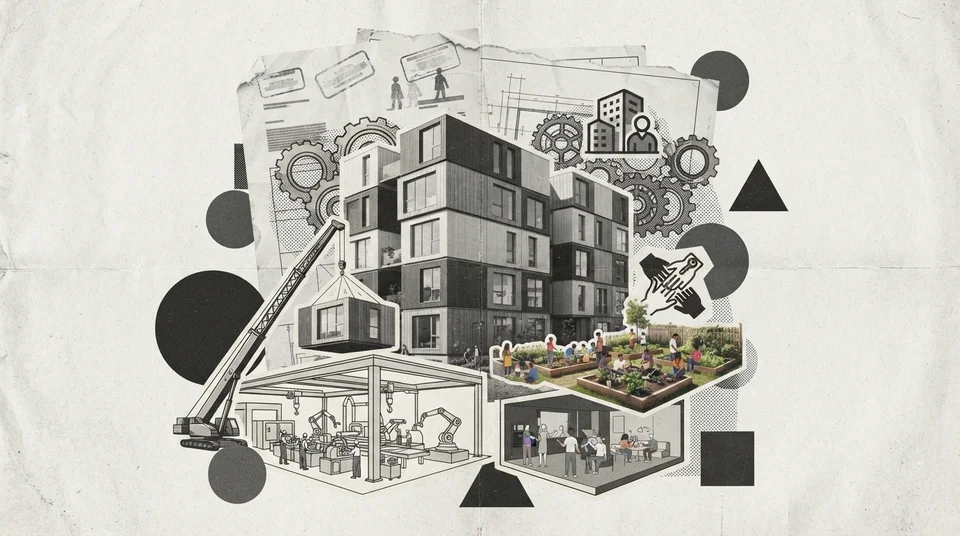
In short — For a nonprofit organization (NPO), a cooperative or a municipal housing office (office municipal d'habitation, OMH), modular construction directly addresses two constraints of affordable housing: deliver fast and deliver at controlled cost. A project can be assembled in a matter of days once the modules are delivered, and the building can be ready in approximately 8 months rather than 14 to 18. In a context of housing shortage, this compressed schedule — combined with the financing programs of the Société d'habitation du Québec (SHQ, Quebec's housing agency) and CMHC (Canada Mortgage and Housing Corporation) — makes modular a serious option for community housing.
The community sector faces a difficult equation: urgent needs, tight budgets and timelines constrained by financing programs. Modular construction does not solve everything, but it acts precisely where it matters most: time and predictability. This guide explains how modular applies to affordable housing, what to know about costs and financing, and how a nonprofit or housing office carries out such a project.
Why modular and affordable housing are a good fit
Three concrete reasons:
- Speed responds to urgency. When households are waiting for a home, every month counts. Delivering in approximately 8 months rather than 14 to 18 means housing people close to a year earlier.
- Repetition lowers the unit cost. Affordable housing typically consists of compact, similar units — exactly what a factory produces most efficiently, with consistent quality control.
- Predictability protects the budget. Factory fabrication is less exposed to weather and labour disruptions. For an organization whose financing is governed by cost caps, a more predictable schedule and cost reduce the risk of overruns.
"For a nonprofit, modular is not just a question of price per square foot: it is the ability to deliver within a program's deadlines and stay within a capped budget."
Cost per door, read correctly
In community housing as in rental, the useful unit is cost per door (per unit), and what it includes varies. Modules concentrate the savings (serial production), but the land, foundation, connections and common areas are added independently of the construction method.
Above all, never compare a "modules only" price to a conventional "turnkey" cost: those are two different things. Always insist on a detailed list of what is included and excluded. The cost-per-door calculation is explained in our guide on building a modular multiplex, and the return logic in our guide on modular rental building profitability.
Financing: SHQ, CMHC and programs
This is often the decisive step in a community project. Financing typically combines several sources:
- The Société d'habitation du Québec (SHQ) (SHQ, Quebec's housing agency) administers social and affordable housing assistance programs (affordable housing, housing allowances, rent supplements). Programs and conditions evolve — validate them directly with SHQ.
- CMHC (Canada Mortgage and Housing Corporation) offers financing products and initiatives for affordable and rental housing (National Housing Strategy), applicable to modular projects.
- Sector networks — the Réseau québécois des OSBL d'habitation (RQOH) and the Regroupement des offices d'habitation du Québec (ROHQ) — guide community developers.
- Municipalities and housing offices can contribute (land, guarantees, local programs). See our resources and references page.
One important point: most of these programs set constraints on schedule and cost caps. The speed and predictability of modular work in favour of meeting those constraints. A builder familiar with community projects helps align the fabrication schedule with program requirements. For details on programs and the financial structuring of a nonprofit project, see our guide on modular project financing and mortgages.
To verify in production: the names and conditions of programs (SHQ, CMHC) must be confirmed at the date of publication, as they change regularly.
The process, for a nonprofit or housing office
1. Define the need and the site. Number of units, target clientele, available land, zoning and municipal service capacity. Verify site access (truck delivery, crane lifting).
2. Assemble the financing. Identify applicable programs (SHQ, CMHC, municipality) and their deadlines. This is often the step that dictates the overall schedule.
3. Design for modularity. Repeated standard unit types, dimensions compatible with transport: the earlier the design thinks modular, the more efficient and affordable the project.
4. Tender and builder selection. Select a builder holding an RBQ licence, ideally with experience in multi-unit and community projects. In Quebec, 8Module is one example of a CAN/CSA-A277-certified manufacturer specializing in multi-unit housing from 6 to 24 units and beyond.
Disclosure — 8Module is a commercial client of Modulaire Québec; we receive compensation when we refer a lead. This content remains editorial and independent — 8Module neither commissioned nor reviewed it. Full disclosure.
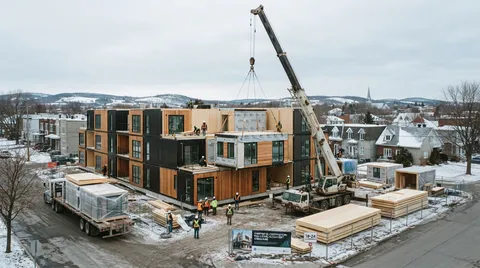
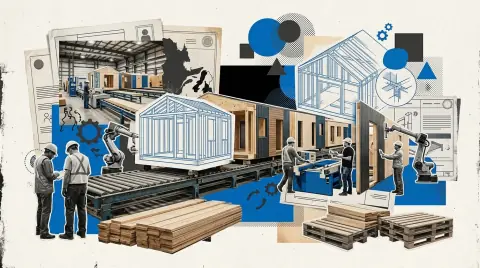
5. Fabrication + site work in parallel. Units are built at the factory while the site and foundation are being prepared — this is the phase that compresses the schedule.
6. Assembly, finishing and commissioning. Module lifting, connections, finishes, inspections, then move-in.
Regulations and quality
A modular community housing building is a regulated building like any other: designed and inspected according to the Quebec Construction Code, subject to a municipal permit and zoning, and built by a builder holding an RBQ licence. The "affordable" designation refers to the financing structure and the project's mandate, not a relaxation of construction standards. To understand clearly what is done in the factory versus on the job site, see our guide on modular, manufactured and prefabricated homes.
In summary
- Modular addresses the two constraints of affordable housing: speed and controlled cost.
- The right indicator is cost per door — always validate what is included.
- Financing (SHQ, CMHC, municipalities) is decisive — and its timelines favour a fast, predictable construction method.
- No reduced standards: it is a building constructed according to the Code, with a permit and an RBQ licence.
Sources: Société d'habitation du Québec (social and affordable housing programs), CMHC — Canada Mortgage and Housing Corporation (affordable housing financing), Régie du bâtiment du Québec. Article written by Jeremy Soares. Last updated: June 24, 2026.

8Module
Modular multi-residential buildings (6 to 24+ units) factory-built in Quebec.
Visit websiteCommercial partnership — we receive compensation. Disclosure
Frequently asked questions
Can modular construction reduce costs for a nonprofit or a cooperative?
Which financing programs apply to an affordable modular project?
Is a modular community housing project faster to deliver?
Does modular lower construction standards to reduce costs?
Can a municipal housing office (OMH) commission modular housing?
Sources
- Housing Assistance Programs (Social and Affordable Housing) — Société d'habitation du Québec (SHQ)
- Affordable Housing Financing Programs — CMHC — Canada Mortgage and Housing Corporation
- Quebec Construction Code — Régie du bâtiment du Québec (RBQ)

Comments
A question or comment on this article? The comments section will be enabled soon.