Commercial · 8 min
Timeline and Schedule for a Commercial Modular Project in Quebec
In short — The timeline for a commercial or multifamily modular project in Quebec is generally shorter than conventional construction, because the foundation is prepared on site while the modules are being built at the factory — two phases that in traditional construction would follow one another. Design and permits take a comparable amount of time either way.
For a developer, the timeline is not a footnote: it is rental income brought forward and carrying costs cut short. It is often the most financially compelling argument for modular — ahead of any construction cost difference. The key is understanding where time is actually saved, and where it is not.
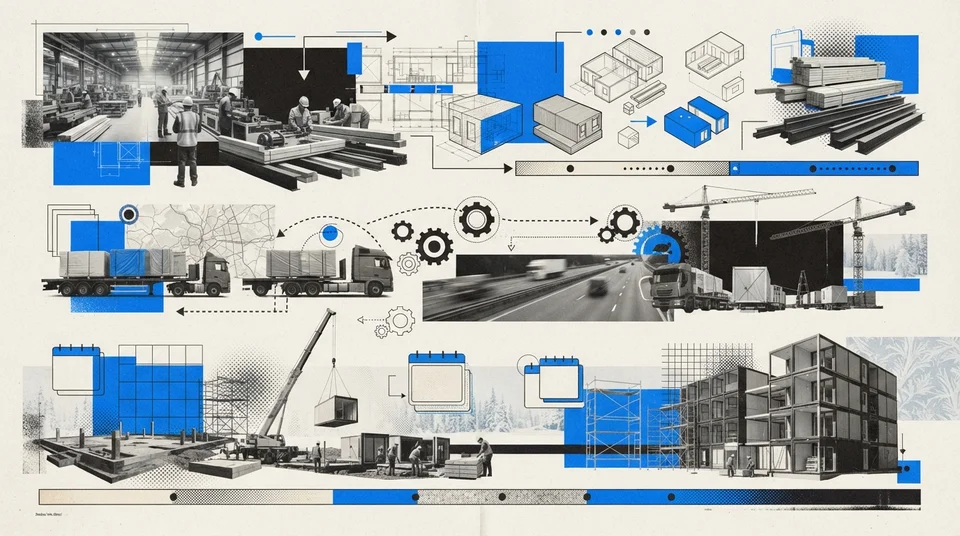
The schedule, step by step
| Phase | What happens | Where time is saved |
|---|---|---|
| 1. Design and plans | Concept, engineering, system selection | Comparable to traditional |
| 2. Permits and approvals | Municipal permit, service connections approved | Comparable (depends on municipality) |
| 3. Foundation and site | Foundation poured, services installed | Runs in parallel with phase 4 |
| 4. Factory production | Modules built, quality-controlled | Runs in parallel with phase 3 |
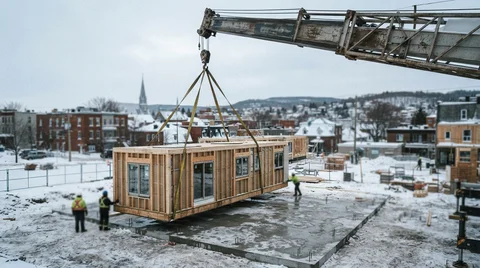
| 5. Transport and crane | Module delivery, crane assembly | Fast (days to weeks) |
| 6. On-site finishes | Connections, hookups, finishes, inspection | Reduced |
| 7. Commissioning | Handover, rental launch | Earlier than conventional |
The core of the saving is the overlap of phases 3 and 4. While the foundation is curing on site, the building is already being assembled at the factory — out of the weather, with a stable workforce. When the modules arrive, the building closes in weeks.
Worth remembering — Modular does not shorten design or permits. It shortens construction, by running the factory and the site at the same time.
What the timeline means for an investor
Bringing the rental launch forward by several months means:
- rental income collected sooner;
- lower carrying costs (the land and financing "sit idle" for less time);
- shorter exposure to site risks (weather, labour).
That is why a serious pro forma includes the schedule, not just the cost per square foot — see modular rental building ROI and price of a commercial or multifamily modular building. The line-by-line comparison is detailed in modular vs. traditional construction.
What causes delays (plan for these)
- Municipal approvals: the most variable item; start early.
- Site access for heavy-haul convoys and the crane, especially in dense urban areas.
- Late client decisions (design changes during production).
- Financing coordination with the disbursement profile specific to modular (advances are paid to the factory before installation).
- Factory availability: a good manufacturer plans its production cadence — which is why committing early matters. See stakeholders in modular construction.
A framework, not a guarantee
Exact durations depend on the project, the manufacturer, and the approvals involved. Best practice: require a contractual schedule from the manufacturer, phase by phase, rather than relying on an average. The building also remains subject to the Quebec Construction Code and municipal inspections for on-site work — see modular construction and the RBQ.
Sources: Régie du bâtiment du Québec (Construction Code). Guide written by Jeremy Soares. Last updated: June 25, 2026. Durations cited are indicative orders of magnitude, not commitments; require a contractual schedule.

8Module
Modular multi-residential buildings (6 to 24+ units) factory-built in Quebec.
Visit websiteCommercial partnership — we receive compensation. Disclosure
Frequently asked questions
Is a modular building really faster to build?
How long does on-site assembly take?
What causes the most delay on a modular project?
Is the schedule saving actually worth money?
Sources
- Code de construction du Québec — Régie du bâtiment du Québec (RBQ)


Comments
A question or comment on this article? The comments section will be enabled soon.