Fundamentals · 6 min
What Nobody Tells You About New Home Prices
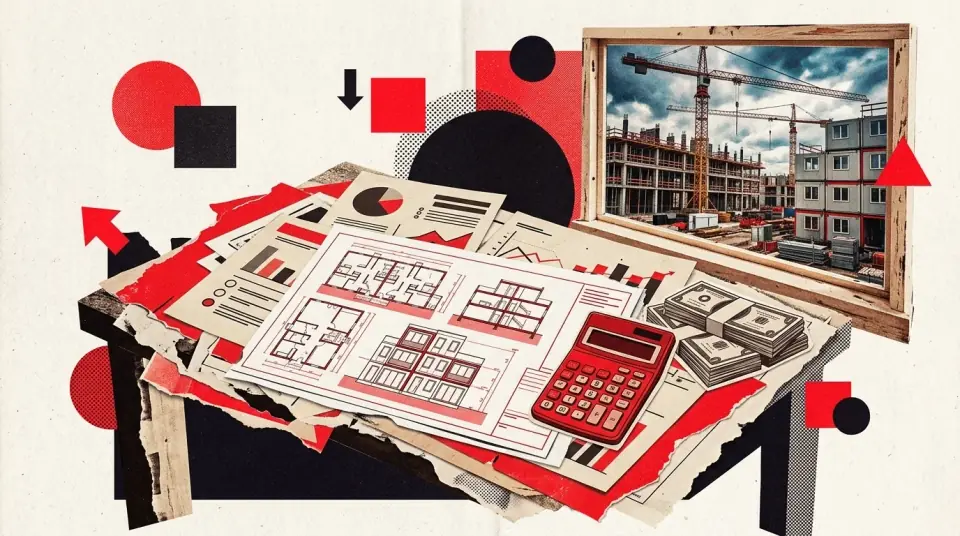
In short — Here is the best-kept secret of the new-home market: factory construction is not automatically cheaper, and anyone promising you "20% guaranteed savings" is reciting a brochure, not a study. Independent research places the direct savings between 0 and 20% depending on the market — the 10 to 20% materializes mainly where labour is scarce and expensive. The reliable gain is elsewhere: a timeline 20 to 50% shorter and a price that does not drift along the way. It is less catchy on a lawn sign. It pays better in your account.
There are two conversations about new home prices in Quebec. The one in the ads, where everything is "affordable" and "turnkey". And the one you will have with your banker twelve months later. Our job is to bring the two together before you sign.
The myth of the automatic discount
Let's start by killing the legend. Yes, McKinsey wrote in 2019 — the global reference, but it has some mileage — that modular can deliver up to 20% savings. The word that matters in that sentence: "can". The study is about optimized players, at scale, on repeatable products. Not about your bungalow.
The more granular analyses — Urban Institute, NIBS — tell a more useful story: direct savings of 10 to 20% in markets where labour is expensive and scarce, and parity, or even a slight premium, elsewhere. In other words: the harder your region struggles to find tradespeople, the more the factory saves you. In a market where contractors are fighting for your work at a good price — apparently that still exists — the advantage melts away.
As for the "20% cheaper" circulating on manufacturer and insurer blogs: that is marketing quoting marketing. We do not repeat it here, and we suggest the same hygiene to you.
Where the real money hides: time
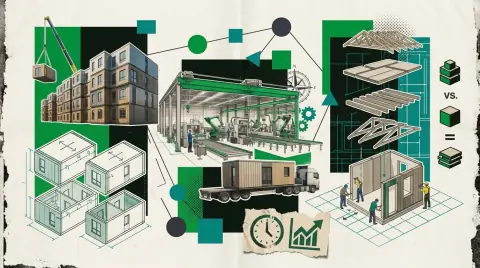
So why is everyone — CMHC, governments, non-profits — so interested in the factory? Because the documented gain is not on the construction invoice, it is on the calendar: 20 to 50% less time according to McKinsey, 25 to 30% measured on more than 50 real buildings by a field study funded by the U.S. Department of Energy.
And in construction, time is literally money: months of rent or bridge financing saved during the work, a construction loan that runs for less time, materials inflation with fewer months to catch up with you. Add the factory's other virtue — a price largely locked before the job site starts, so fewer surprise "extras" — and you understand why informed buyers look at the timeline before the price per square foot. The full line-by-line math is in our article on the real cost of a modular home in 2026.
One cash-flow nuance few sellers mention: the factory gets paid earlier. Modular concentrates the disbursements at the start of the project, while the modules are being manufactured — your financing has to be structured accordingly. It is not a trap, it is a difference; poorly anticipated, it becomes one.
The lines that appear on no brochure
Whatever the construction method, the sticker price is never the price paid. Land, excavation, foundations, connections — water and sewer, or well and septic —, module transport, landscaping: depending on your lot, these items can add tens of thousands of dollars. We review them all in our pieces on the hidden costs of a modular home and on what the "turnkey" price really hides.
And there is the context, which spares no one: in Lanaudière, the median price of a single-family home hovers around half a million according to regional data — roughly $200,000 ten years ago. In the Quebec City region, CMHC forecasts a market that stays under pressure until 2027. No construction method exempts you from land prices or scarcity. The factory optimizes the part it controls; it does not rewrite the market.
The good news in all this? A buyer who asks the right questions — guaranteed timeline? price locked at what stage? what is excluded? — is better protected than by any promised discount. The other received ideas to defuse before signing are in the myths of modular construction.
Shopping around and the quotes contradict each other? That is normal — they do not count the same things. We can help you read them side by side. Shall we take a look?

8Module
Modular multi-residential buildings (6 to 24+ units) factory-built in Quebec.
Visit websiteCommercial partnership — we receive compensation. Disclosure
Frequently asked questions
Does a modular home really cost less than a traditional home?
Why is the sticker price never the final price?
Where does modular actually save you money?
Sources
- Modular construction: From projects to products — McKinsey & Company
- Encouraging modular construction could help address the housing shortage — Urban Institute
- Modular Construction for Multifamily Affordable Housing — NIBS / WSP
- Modular Multi-Family Construction: A Field Study — Modular Building Institute (study funded by the U.S. DOE)
- Rental Market Report 2025 — CMHC — Canada Mortgage and Housing Corporation

Comments
A question or comment on this article? The comments section will be enabled soon.