Non-profit · 7 min
How 8Module Wants to Tackle the Housing Crisis
Disclosure — 8Module is a commercial partner of this site: we receive compensation when relevant quote requests are passed along to it. This article remains editorial — 8Module neither commissioned nor reviewed it — but read it knowing that relationship exists. Details.
In short — 8Module is a Quebec manufacturer that builds multi-residential buildings — configurations of 6, 12, 24 units and more — with roughly 85% of the work done in the factory. Its pitch against the housing crisis rests on one argument: speed. According to the manufacturer, on-site assembly of a 12-unit building takes 4 days, and a 100-to-150-unit project is delivered in about 8 months. Those are its numbers, not ours; here is what they are worth, and where the approach fits in the Quebec landscape.
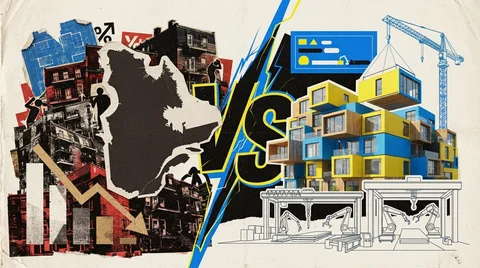
Quebec is short hundreds of thousands of homes — CMHC estimated approximately 860,000 missing units by 2030 in its 2023 assessment — and the construction industry, for its part, is short on workers and summers. The equation is well known; we break it down in our report on modular construction and the housing crisis. The interesting question is no longer "Should we build differently?" but "Who is doing it, and how?". 8Module is one of Quebec's answers to that question.
The recipe: move the job site into the factory
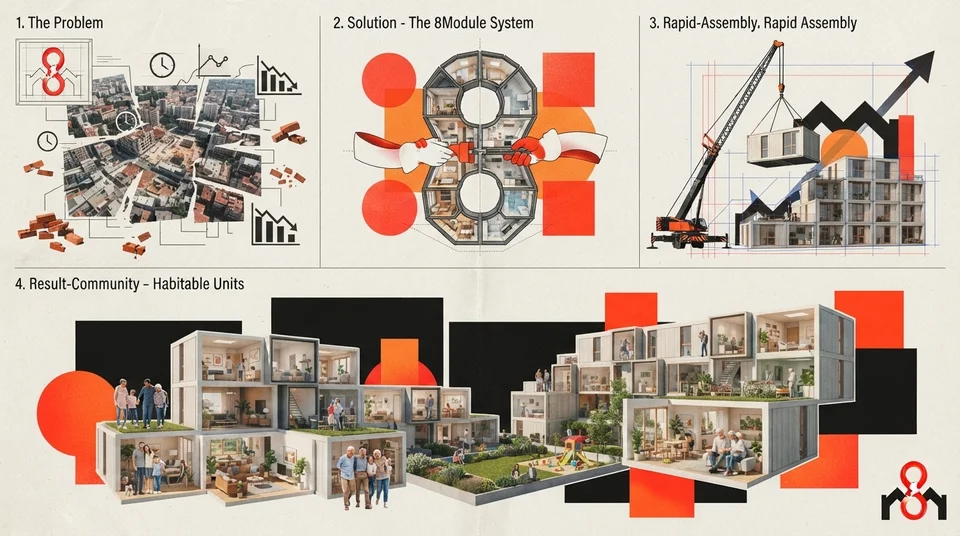
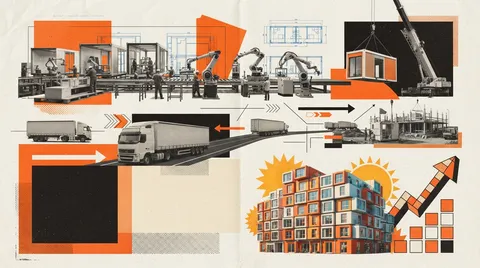
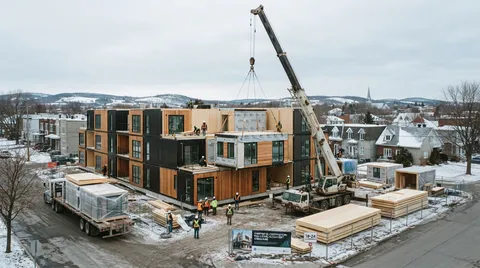
8Module's business model, as described on its website, rests on a massive relocation of the work: roughly 85% of each home is built in the factory — structure, insulation, ventilation, electrical, plumbing, kitchen, bathroom, and finishes — before anything arrives on the land. The job site no longer receives materials; it receives nearly finished homes that a crane stacks onto the foundations.
The manufacturer focuses on multi-residential: configurations of 6, 12, and 24 units, and projects of more than 100 units — up to roughly 150, again according to its site. That niche choice matters: the 6-to-24-unit range is exactly the building format missing in Quebec's small towns and regions, as we see in our regional overviews of the Côte-Nord and Abitibi-Témiscamingue, where the shortage of workforce housing is flatly holding back the economy. To understand why this building format is the market's missing link, see our article on the modular multiplex.
On compliance, the manufacturer's site lists CAN/CSA-A277 certification — the mandatory Quebec standard for factory-built buildings — and an RBQ licence. That is the minimum expected of any serious manufacturer, not a differentiator: every factory-built building sold in Quebec must carry that seal.
The speed numbers — and the perspective they deserve
Now for the numbers that make headlines. According to the manufacturer: on-site assembly of a 12-unit building in 4 days; a 100-to-150-unit project delivered in about 8 months; overall, "50% faster than conventional."
First, let's be clear about what "4 days" means — and does not mean. It is the setting of the modules, not the project: before it come the permits, the foundations, and the months of factory manufacturing; after it come the utility connections and joint finishing. Nobody moves in on day 5.
Second, the "50% faster" is a manufacturer's claim, not an independent measurement. That said, it is not far-fetched: McKinsey estimated as early as 2019 that modular cuts project timelines by 20 to 50%, and a field study funded by the U.S. Department of Energy, covering more than 50 multifamily buildings, measured deliveries 25 to 30% faster on average. 8Module's figure sits at the top of the documented range — plausible, but to be verified project by project, as always.
On costs, caution: the manufacturer's site puts forward a fixed price locked at signing — excluding land, excavation, and transport beyond 100 km of Montréal or Québec City. A predictable price has real value for a non-profit or a developer assembling financing; it is not the same thing as a lower price. Independent studies place modular's direct savings between zero and 20% depending on the market — we take that nuance apart, along with a few others, in the myths of modular construction.
Why the timing works for this model
What makes 8Module's approach interesting in 2026 is not just its mechanics — it is the context. Quebec is ordering highly prefabricated multi-unit housing through project calls; Ottawa launched Maisons Canada with prefabrication as a written priority; and since May 2026, CMHC has insured loans for modular multi-unit housing across all its products. In other words, public procurement, the financing framework, and the industrial supply chain are all pointing in the same direction at the same time. A manufacturer positioned on modular multi-residential, like 8Module (reminder: 8Module is a commercial partner of this site — disclosure), sits exactly in the corridor where those policies converge.
For a non-profit, a housing office, or a developer considering this route, the real question is not "Modular, yes or no?" but "Are my project, my land, and my financing compatible with this delivery model?". Our guide for developers walks through the full checklist. Want to find out whether your project is a fit? Request a quote — it is free, and we also tell you when the answer is no.
Disclosure: 8Module is a commercial partner of this site; we receive compensation when relevant quote requests are passed along to it — details.

8Module
Modular multi-residential buildings (6 to 24+ units) factory-built in Quebec.
Visit websiteCommercial partnership — we receive compensation. Disclosure
Frequently asked questions
Who is 8Module?
A 12-unit building assembled in 4 days — is that true?
Does 8Module's modular cost less than a traditional job site?
Sources
- 8Module official website (capabilities, process, certifications — consulted July 2, 2026) — 8Module
- Modular construction: From projects to products — McKinsey & Company
- Modular Multi-Family Construction: A Field Study — Modular Building Institute (study funded by the U.S. DOE)
- Certification of factory-built buildings (CAN/CSA-A277) — Régie du bâtiment du Québec
- Housing Shortages in Canada — Updated Housing Need Estimates to 2030 — CMHC — Canada Mortgage and Housing Corporation
- CMHC expands mortgage insurance support for prefab and modular construction — CMHC — Canada Mortgage and Housing Corporation



Comments
A question or comment on this article? The comments section will be enabled soon.