Non-profit · 7 min
Housing and Modular Construction on the Côte-Nord: The 2026 Picture
In short — The Côte-Nord landed none of the SHQ's first 11 highly prefabricated housing projects, but it carries one of Quebec's most significant workforce-housing builds: the 72 units the Société d'expansion de Baie-Comeau (SEBC) is dedicating to temporary workers, announced in November 2025 and expected in 2027 — a first, designed to replace traditional work camps. In a region where community groups are calling for 1,000 new affordable units and where the shortage is slowing Sept-Îles' economy, factory-built construction answers the North Shore's constraints point by point.
The housing situation in the region
On the Côte-Nord, the housing crisis is measured less in provincial statistics than in delayed industrial projects. In Sept-Îles, Radio-Canada describes a shortage that has become a direct brake on economic development: employers are hiring, but candidates cannot find anywhere to live. The cost of available units has jumped roughly 31% region-wide, according to figures reported by Radio-Canada — and the affordable supply is so thin that in Baie-Comeau, a 56-unit affordable housing project drew more than a hundred households onto its waiting list.
Community groups put the necessary catch-up at about 1,000 new affordable units for the whole Côte-Nord, according to Ma Côte-Nord. Port-Cartier lives the same North Shore industrial-town reality: a solid employment base, a rental stock that cannot keep up. The mechanism — too few homes where the economy demands them — is the one we take apart in our feature on the housing crisis and modular construction.
A brighter note all the same: the Côte-Nord is among the only areas of Quebec with no private seniors' residence (RPA) closures in 2025, according to the AQRP's review.
Recent projects and announcements
The structuring announcement came from Baie-Comeau in November 2025: the Société d'expansion de Baie-Comeau (SEBC) will build 72 units for temporary workers, with delivery targeted for 2027. Le Nord-Côtier calls it a first: the project is explicitly designed to replace traditional work camps with real housing, integrated into the city. In a region used to "camps" set up on the edge of job sites, it is a change of philosophy as much as a real estate project.
An honest observation is also in order: in the SHQ's first call for highly prefabricated housing projects, whose 11 winners (336 units) were announced on August 22, 2025, no project from the Côte-Nord was selected. Neighbouring Gaspésie landed three. Nothing is settled, though: a second call for 225 units was launched in September 2025, and the total selected had reached 566 prefabricated units by mid-2026 according to SHQ communications. In Montreal, Projet Acadie — 26 modular units from the same program — was installed in under 12 months, permits included: that is the benchmark timeline the region's next applications can aim for.
What modular can change here
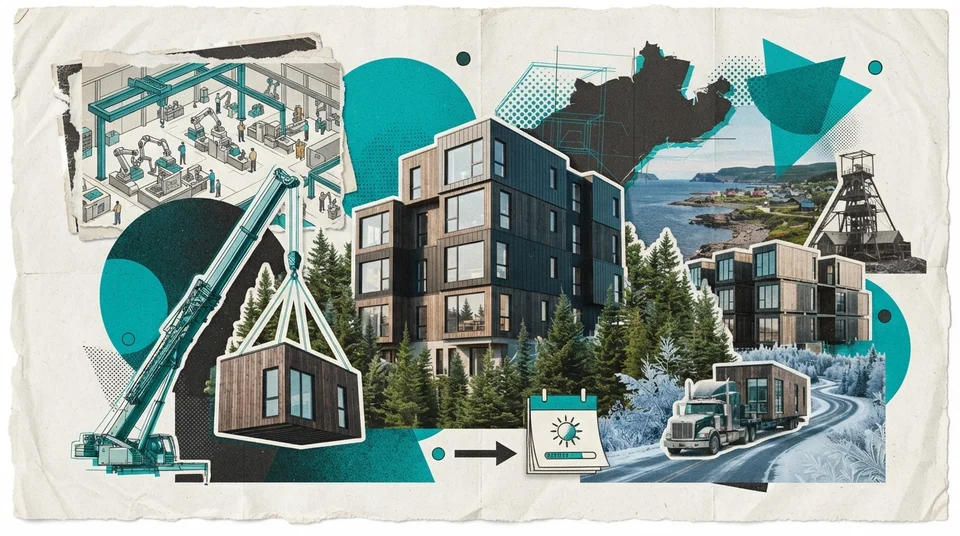
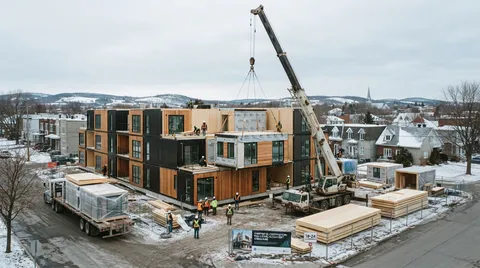
The North Shore's constraints are exactly the ones factory fabrication gets around best. A short construction season, site labour that is scarce and already claimed by major industrial projects, high mobilization costs for any contractor coming from outside: a building built in a factory, delivered and set in a few days, shrinks each of those three obstacles (see our feature on the modular multiplex).
The independent data converges on the main gain: McKinsey puts the reduction in project timelines at 20 to 50%, and a field study funded by the U.S. Department of Energy measured deliveries 25 to 30% faster across more than 50 multi-family buildings. On costs, let's stay clear-eyed: direct savings range from 0 to 20% depending on market and scale, and long-distance transport must be budgeted from the start. The robust gain is time — and fewer weeks of on-site work also means fewer workers to house during construction, precisely the resource that is missing.
The most obvious use case remains workforce housing. The SEBC project shows the region wants out of the camp model; a dedicated rental building, deliverable in months rather than years, follows the same logic. We devoted a full guide to workforce housing in the regions. Municipalities that want to line up a site, zoning and a financing package for the SHQ's next calls will find the step-by-step in our guide for municipalities.
The programs that apply
- SHQ initiative for highly prefabricated multi-unit housing: 500 units in the first call, 225 in the second, funded by the $1.8-billion Canada-Quebec agreement (FACL). No North Shore project selected to date — the next calls are the opportunity to seize.
- PHAQ (Programme d'habitation abordable Québec): the SHQ's flagship program, open to non-profits, co-operatives, housing offices and private developers. The 2026-2027 Quebec budget funds a new round of 1,000 affordable units — the first since 2023.
- CMHC — mortgage loan insurance extended to modular (May 2026): after a pilot of more than 800 units, CMHC now insures modular multi-unit housing across all its products, including APH Select.
- Maisons Canada: the federal agency with $13 billion explicitly prioritizes prefabricated, modular and mass-timber construction.
For the detailed financing structure of a non-profit, co-operative or housing-office project, see our guide to funding affordable modular housing.
Sources: Le Nord-Côtier, Radio-Canada, Ma Côte-Nord, AQRP, Gouvernement du Québec (SHQ), CMHC. Article written by Jeremy Soares. Last updated: July 2, 2026.

8Module
Modular multi-residential buildings (6 to 24+ units) factory-built in Quebec.
Visit websiteCommercial partnership — we receive compensation. Disclosure
Frequently asked questions
Why did the Côte-Nord get no SHQ prefabricated project in 2025?
Will the SEBC's 72 units in Baie-Comeau be modular?
Is modular realistic despite transport distances on the Côte-Nord?
Sources
- Une première à Baie-Comeau : 72 logements pour les travailleurs temporaires — Le Nord-Côtier
- Des logements pour travailleurs temporaires à Baie-Comeau — Radio-Canada
- Taux d'inoccupation et loyers sur la Côte-Nord — Radio-Canada
- Pénurie de logements à Sept-Îles — Radio-Canada
- La Côte-Nord en pleine crise du logement à l'approche du 1er juillet — Ma Côte-Nord
- Construire autrement et plus rapidement : la voie du hautement préfabriqué est maintenant tracée — Gouvernement du Québec





Comments
A question or comment on this article? The comments section will be enabled soon.