Non-profit · 8 min
Housing and Modular Construction in Estrie: The 2026 Picture
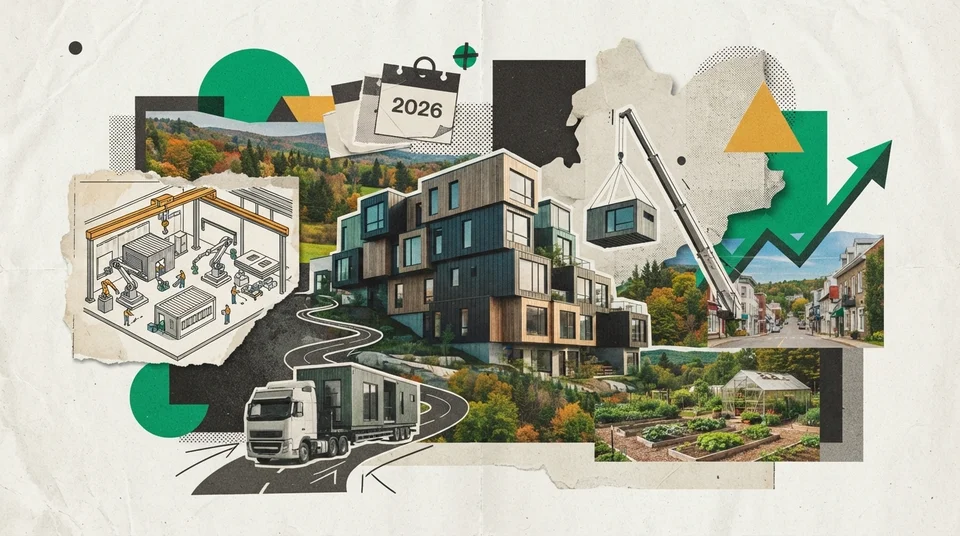
In short — Estrie has a front-row seat to Quebec's prefab turn: two of the 11 projects selected by the SHQ for its highly prefabricated housing are located here — the Quartier du plateau in Coaticook (36 units) and Le Florelle in Granby (24 units) — with deliveries expected in summer 2026. Meanwhile, Sherbrooke rents jumped nearly 10% in 2025, among the steepest increases of Quebec's large cities. The region illustrates both the scale of the crisis and the most concrete answer it has: building in a factory.
Whether you are a housing non-profit, a municipal housing office or a town council in the Eastern Townships, the question is no longer whether modular construction can deliver affordable housing — two Estrie builds are in the middle of proving it. Here is where the region stands in 2026.
The housing situation in Estrie
The Sherbrooke market has eased slightly on the surface: Greater Sherbrooke's vacancy rate went from 1.4% in 2024 to 2.7% in 2025, according to figures reported by La Tribune. That is still below the 3% equilibrium threshold. And the easing has a price: Sherbrooke rents rose roughly 9.8% in 2025, among the steepest increases of Quebec's metropolitan areas.
The regional picture follows the provincial trend documented by CMHC in its 2025 Rental Market Report: an overall vacancy rate back up to 2.9% in centres of 10,000 residents and more, but an affordable segment that remains nearly impossible to find. The easing comes almost entirely from expensive new units. As FRAPRU sums it up: the shortage is easing, but the crisis is getting worse.
This is not an abstract issue: in the November 2025 municipal elections, housing was the top issue for Quebec voters (38%, according to Léger). To understand how we got here — and why factory construction is among the serious answers — see our analysis of the housing crisis and modular construction.
Recent projects and announcements
The structuring event is the Société d'habitation du Québec's call for 500 highly prefabricated housing units, launched in January 2025 and funded by the $1.8-billion Canada-Quebec agreement (FACL). On August 22, 2025, Quebec announced the 11 selected projects — 336 units in total, entrusted to five design-build consortiums backed by Quebec factories: Bonneville, RCM Modulaire, Fabrik, Locusi and RG Solution.
Two of those 11 projects are in Estrie:
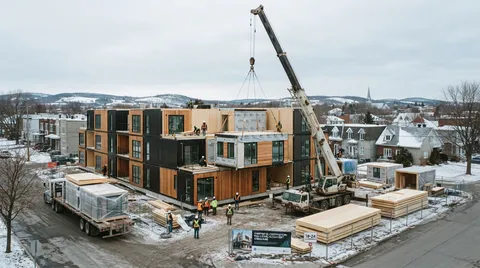
- Coaticook — Quartier du plateau, 36 units. A standardized 2- to 3-storey building (studios, one-bedroom and two-bedroom units), delivery expected in summer 2026. A town of about 9,000 residents that gets a complete multi-unit building in one stroke.
- Granby — Le Florelle, 24 units. Same standardized formula, same delivery horizon, according to the government release of August 22, 2025.
A second call for projects, launched in September 2025, adds 225 prefabricated units — bringing the total selected to 566 according to SHQ communications as of mid-2026.
Elsewhere in the region: Ottawa confirmed federal support in 2026 for the construction of 103 homes in Sherbrooke (CMHC). The non-profit Habitations L'Équerre announced in fall 2025 that it was targeting a minimum of 200 affordable doors in 2026, spread across Sherbrooke, Magog, Stanstead and East Angus — a figure to be confirmed as construction starts.
On the regulatory side, Sherbrooke and Sutton are among the first Quebec municipalities to have authorized accessory dwelling units (ADUs) by simple bylaw, a possibility opened by Bill 31 since March 2024.
What modular can change
Modular's most solid gain is not the price: it is time. The independent data converges — timelines cut by 20 to 50% according to McKinsey (2019), multi-family buildings delivered 25 to 30% faster according to a field study funded by the U.S. Department of Energy (50-plus buildings, published in 2024). In Quebec, Projet Acadie in Montreal — 26 modular units completed in under 12 months, permits included — has just proven it at the provincial scale. On costs, let's be honest: direct savings range from 0 to 20% depending on market and scale. The sure value is the schedule and its predictability.
For Estrie, the most interesting angle lies elsewhere: the SHQ's standardized 24- and 36-unit buildings are tailored for towns that conventional developers ignore. Municipalities like Cowansville, Farnham, Windsor, Lac-Mégantic or Val-des-Sources are exactly in the size range where a project of this format changes the game — enough need to fill the building, not enough volume to attract a conventional 100-door build. Coaticook has just demonstrated that the model works at this scale.
For a municipality that wants to get ready to host such a project, our guide for municipalities details the steps — site, zoning, connections. And to understand the mechanics of a factory-built multi-unit building, see our feature on the modular multiplex.
Applicable programs
Four levers currently fund an affordable modular housing project in Estrie:
- PHAQ (Programme d'habitation abordable Québec). The SHQ's flagship program, open to non-profits, co-operatives, housing offices and private developers. Streams 2 and 4 accept applications at any time, and the 2026-2027 Quebec budget funds a new round of 1,000 affordable units — the first since 2023.
- The Canada-Quebec agreement (FACL). $1.8 billion for roughly 8,000 social and affordable units; it is what funds the highly prefabricated housing in Coaticook and Granby.
- CMHC, on the financing side. Since May 7, 2026, CMHC insures modular multi-unit loans across all its products, including APH Select, after a pilot of more than 800 units. A historic financing obstacle has just fallen.
- Maisons Canada. The federal agency with $13 billion explicitly prioritizes prefabricated, modular and mass-timber construction.
The details of the financing structures — grants, loans, program stacking — are in our guide to funding affordable modular housing. Developers and non-profits will find the full pathway in the developers' guide.
Sources: Gouvernement du Québec (SHQ), La Tribune, CMHC, FRAPRU, Écohabitation, Léger. Article written by Jeremy Soares. Last updated: July 2, 2026.

8Module
Modular multi-residential buildings (6 to 24+ units) factory-built in Quebec.
Visit websiteCommercial partnership — we receive compensation. Disclosure
Frequently asked questions
Which modular housing projects are under way in Estrie?
My municipality is small — is a 24- or 36-unit project realistic?
Which programs can fund an affordable housing project in Estrie?
Sources
- Construire autrement et plus rapidement : la voie du hautement préfabriqué est maintenant tracée — Gouvernement du Québec
- Lancement de l'appel de projets — 500 logements hautement préfabriqués — Gouvernement du Québec
- Vers une année dans la moyenne pour la construction de logements en Estrie — La Tribune
- Federal government supports construction of 103 homes in Sherbrooke — SCHL
- Rapport sur le marché locatif 2025 — SCHL
- De nouveaux règlements et nouvelles lois pour les UHA — Écohabitation

Comments
A question or comment on this article? The comments section will be enabled soon.