Non-profit · 7 min
Housing and Modular Construction in Gaspésie–Îles-de-la-Madeleine: The 2026 Picture
In short — No region came out of the SHQ's first call for highly prefabricated housing better than Gaspésie–Îles-de-la-Madeleine: three of the eleven projects selected in Quebec — Paspébiac, Grande-Vallée and Cap-Chat — are located there, for 84 units expected as early as summer 2026. In a region where employers buy presbyteries and the Islands house seasonal workers in trailers, prefab has gone from plan B to official strategy.
The housing situation in the region
The crisis in the Gaspé Peninsula and the Islands has a particular face: it directly holds back the economy. The CSN documents it bluntly — employers across the region struggle to recruit because candidates simply cannot find a place to live. Radio-Canada has reported improvised solutions that have become routine: employers buying presbyteries and religious buildings to house their workers.
In the Îles-de-la-Madeleine, the situation led to a rare legislative measure: a private bill adopted by the National Assembly allows the Municipality to subsidize builders directly — up to $2M in grants, tax credits and loans, usable until December 2026. Meanwhile, seasonal workers there are being housed in trailers.
On the peninsula, service towns like Gaspé, Sainte-Anne-des-Monts and Chandler concentrate the demand: hospitals, CEGEPs, plants and tourism draw a workforce that finds nothing on the rental market. The mechanism is the same across regional Quebec — we take it apart in our feature on the housing crisis and modular construction.
The one bright spot: the Îles-de-la-Madeleine are among the only areas of Quebec with no private seniors' residence (RPA) closures in 2025, according to the AQRP's review.
Recent projects and announcements
On August 22, 2025, the SHQ announced the 11 projects selected in its first call for highly prefabricated multi-unit housing: 336 units in total, to be delivered as early as summer 2026. Three of those eleven projects are in the Gaspé region — the Quebec record:
- Paspébiac: 24 units;
- Grande-Vallée: 24 units;
- Cap-Chat: 36 units (the "Cmétis" project).
These buildings follow the initiative's standardized format: 24 or 36 units, 2 to 3 storeys, studios and one- or two-bedroom units. Five design-build consortiums were selected province-wide, backed by Quebec factories: Magil-Tisseur (manufacturer Bonneville), Pomerleau (RCM Modulaire), TB4-Ronam (Fabrik), Locusi and LFG Construction (RG Solution).
The provincial demonstration is advancing in parallel: in Montreal, Projet Acadie — 26 modular units from the same program — was installed in under 12 months, permits included, according to the government release of June 2026. That is the benchmark timeline Paspébiac, Grande-Vallée and Cap-Chat can aim for. A second call for 225 units was launched in September 2025, bringing the total selected to 566 prefabricated units by mid-2026.
What modular can change here
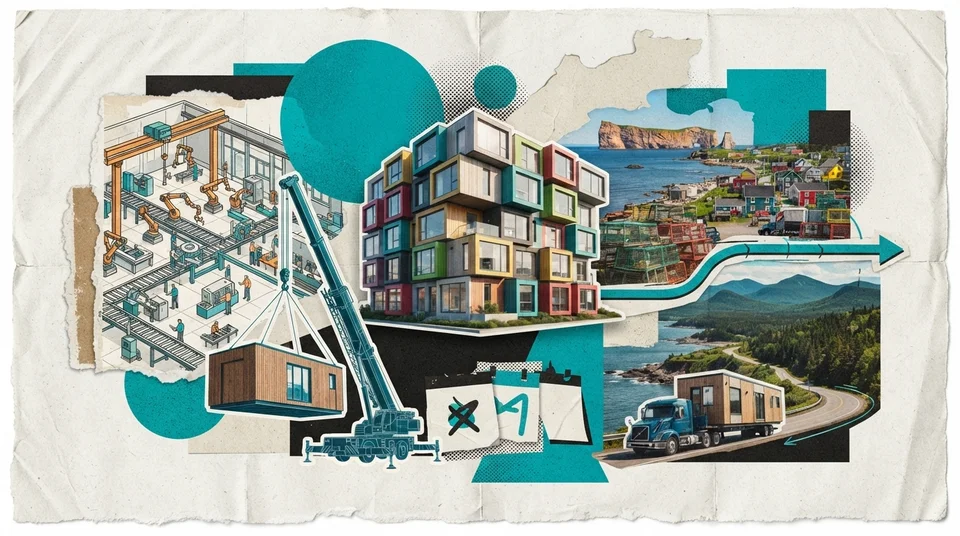
Why did the Gaspé region sweep three projects? Because the model answers its constraints exactly. Villages of a few thousand residents will never attract a major developer for a conventional 24-unit building: a short construction season, scarce site labour, high mobilization costs. A building manufactured in a factory, delivered and set in a few days, gets around all three obstacles at once (see our feature on the modular multiplex).
The labour issue gives modular a second role: workforce housing. When employers are down to buying presbyteries and the Islands are setting up trailers, a rental building dedicated to workers, delivered in a few months, changes the game from one season to the next. We devoted a full guide to workforce housing in the regions.
The honest nuance: modular is no island magic wand. Marine transport to the Islands, cranes and the weather window remain real constraints, and cost savings (0 to 20% according to independent studies) depend on context. The robust, documented gain is the timeline: 20 to 50% shorter according to McKinsey, 25 to 30% according to a field study funded by the U.S. Department of Energy.
The programs that apply
- SHQ initiative for highly prefabricated multi-unit housing: the region has proven it knows how to win these calls. The next rounds rest on the $1.8-billion Canada-Quebec agreement (FACL).
- PHAQ: the SHQ's regular program, relaunched by the 2026-2027 budget with a round of 1,000 affordable units — open to non-profits, co-operatives, housing offices and developers.
- Îles-de-la-Madeleine private bill: direct municipal subsidies to builders (up to $2M, expiring December 2026) — a local lever unique in Quebec.
- CMHC — mortgage loan insurance extended to modular (May 2026): modular multi-unit housing is now insurable across all CMHC products, including APH Select.
To structure a non-profit or co-operative financing package, see our guide to funding affordable modular housing; to get your municipality ready to host a project, our guide for municipalities.
Sources: Gouvernement du Québec (SHQ), Radio-Canada, CSN, AQRP, CMHC. Article written by Jeremy Soares. Last updated: July 2, 2026.

8Module
Modular multi-residential buildings (6 to 24+ units) factory-built in Quebec.
Visit websiteCommercial partnership — we receive compensation. Disclosure
Frequently asked questions
Why did the Gaspé region get three of the eleven SHQ prefabricated projects?
When will the Paspébiac, Grande-Vallée and Cap-Chat units be ready?
Does modular work in the Îles-de-la-Madeleine despite marine transport?
Sources
- Construire autrement et plus rapidement : la voie du hautement préfabriqué est maintenant tracée — Gouvernement du Québec
- Un projet de loi pour contrer la pénurie de logements aux Îles-de-la-Madeleine — Radio-Canada
- Des roulottes pour héberger les travailleurs saisonniers aux Îles-de-la-Madeleine — Radio-Canada
- Pénurie de logements en Gaspésie : des solutions improvisées — Radio-Canada
- Crise du logement en Gaspésie et aux Îles-de-la-Madeleine — CSN



Comments
A question or comment on this article? The comments section will be enabled soon.