Non-profit · 8 min
Housing and Modular Construction in the Laurentides: The 2026 Picture
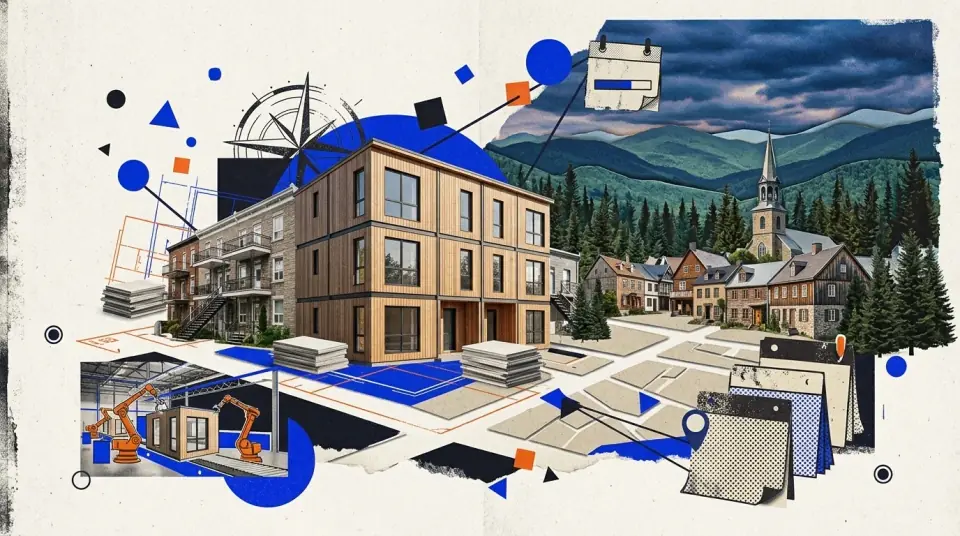
In short — In the Laurentides, the housing crisis has a precise face: the tourism-economy workers who can no longer find housing where they work. Quebec's most original regional answer was born here — a social utility trust created by the MRC des Laurentides, with a first 68-unit building in Mont-Tremblant and a target of 150 units in five years. Modular construction, for its part, offers exactly what these projects are looking for: short timelines and predictable costs.
From the valleys of Saint-Sauveur and Sainte-Adèle up to Mont-Laurier, the region lives under double pressure: resort living and remote work have driven up prices, while employers — hotels, resorts, restaurants, health services — struggle to recruit for lack of housing. Here is the 2026 picture, sourced figures in hand.
The housing situation in the Laurentides
At the Quebec scale, the rental market is easing on the surface: according to the CMHC 2025 Rental Market Report (October 2025 data), the vacancy rate in urban centres rose back to about 2.9%. But that average hides what matters: the most affordable rent segment remains nearly impossible to find across the province, and it is precisely the segment the Laurentides' workers depend on.
In the tourism hubs, the problem is structural. La Presse devoted an entire series to "tourist regions, housing in crisis": the jobs are there, the homes are not. A seasonal or resort worker is not just competing with residents — they are competing with short-term rentals and second-home buyers. The phenomenon hits the resort core (Mont-Tremblant, Val-David, Sainte-Agathe-des-Monts) but is spreading to the outer rings, from Prévost and Lachute to Deux-Montagnes, where metropolitan pressure piles onto tourism pressure.
The projects moving: the MRC des Laurentides trust
The most talked-about answer is a Quebec first. The MRC des Laurentides created a social utility trust dedicated to housing workers and students — a legal vehicle that permanently removes land and buildings from the speculative market (La Presse, August 2025).
Its first project is concrete: 68 units on rue Labelle, in Mont-Tremblant, with a rarity in Quebec — leases signed directly with local employers, and a floor of student rooms developed with the Centre collégial de Mont-Tremblant (Cégep de Saint-Jérôme), according to L'Info du Nord. The next sites are already identified: Mont-Blanc, Sainte-Agathe-des-Monts and Brébeuf. The stated goal: 150 units in five years, with a first move-in-ready building in 2026.
The private sector is moving too. The Campus Habitations project in Mont-Tremblant — more than $35 million, 102 rental units totalling 252 suites intended for workers, at reported rents of $850 to $1,250 per month per person — targeted delivery in summer 2025, and a Sainte-Agathe-des-Monts phase (85 units, about 200 rooms) is announced for July 2026, according to regional media (Nouvelles Laurentides). Those figures come from secondary sources: they give the order of magnitude, not the final tally.
What modular changes for this type of project
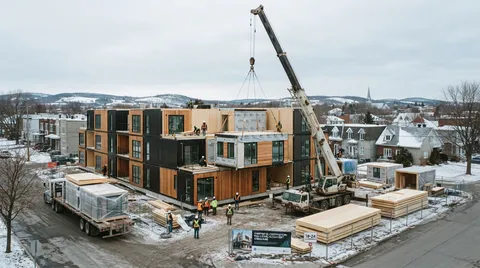
A trust promising 150 units in five years, employers signing leases to house staff for the very next season: in both cases, the critical variable is time. That is exactly modular construction's home turf — independent studies measure timelines cut by 20 to 50% compared with traditional builds, as we detail in our feature on the housing crisis and modular construction.
The most telling Quebec precedent comes from another region: the 155 modular student housing units delivered in about ten months in Rimouski by the non-profit UTILE. Same clientele logic (students, workers), same schedule urgency, same non-profit structure — the parallel with the rue Labelle project is direct.
Worth noting: no Laurentides project is among the 11 winners of the SHQ's first call for 500 highly prefabricated housing units (official list of August 22, 2025). A second call for 225 units was launched in September 2025. For an MRC that already holds land in trust, the prefab supply chain — standardized 24- or 36-unit buildings, assembly in a few weeks, a build barely sensitive to the Quebec winter — checks just about every box. Our guide for municipalities details how to structure this kind of file.
The programs available in 2026
Three main levers are open to the region's non-profits, housing offices and municipalities:
- PHAQ (Programme d'habitation abordable Québec). The 2026-2027 budget funds a new call for 1,000 affordable units — the first regular call since 2023 (Québec.ca).
- The SHQ "highly prefabricated" calls. 566 units selected to date across two calls; the next cycles are the regional opportunity to watch.
- CMHC mortgage loan insurance extended to modular (May 2026), which eases the financing of prefabricated multi-unit buildings — we break it all down in our guide to funding affordable modular housing.
For employers considering housing their own workforce, see also our feature on workforce housing in the regions and the modular multiplex formats.
Sources: CMHC, Gouvernement du Québec, La Presse, L'Info du Nord, CDE MRC des Laurentides, Nouvelles Laurentides. Article written by Jeremy Soares. Last updated: July 2, 2026.

8Module
Modular multi-residential buildings (6 to 24+ units) factory-built in Quebec.
Visit websiteCommercial partnership — we receive compensation. Disclosure
Frequently asked questions
What is the MRC des Laurentides housing trust?
Are there SHQ-funded modular projects in the Laurentides?
Why is modular relevant for workforce housing in tourist areas?
Sources
- Premier projet d'habitation pour la Fiducie en habitation abordable de la MRC des Laurentides — L'Info du Nord Tremblant
- MRC des Laurentides : une fiducie pour protéger le logement abordable — La Presse
- La Fiducie en habitation abordable de la MRC des Laurentides — premier projet — CDE MRC des Laurentides
- Campus Habitations : un projet de 35 millions à Mont-Tremblant — Nouvelles Laurentides
- Rapport sur le marché locatif 2025 — SCHL
- Budget 2026-2027 — plus de 3,6 G$ pour appuyer les Québécois — Gouvernement du Québec
- Construire autrement et plus rapidement : la voie du hautement préfabriqué est maintenant tracée — Gouvernement du Québec


Comments
A question or comment on this article? The comments section will be enabled soon.