Non-profit · 7 min
The Municipal Rules That Block Housing (and How That Is Changing)
In short — The number-one brake on a housing project in Quebec is often neither money nor construction: it is the rulebook — zoning from another era, a variance that takes months, a second dwelling banned on a 10,000-square-foot lot. But the lock is changing: since March 2024, Bill 31 has allowed any municipality to authorize accessory dwelling units by simple bylaw, and cities like Québec City, Sherbrooke, Trois-Rivières, and Victoriaville have already done it. The revolution is quiet, but it is real.
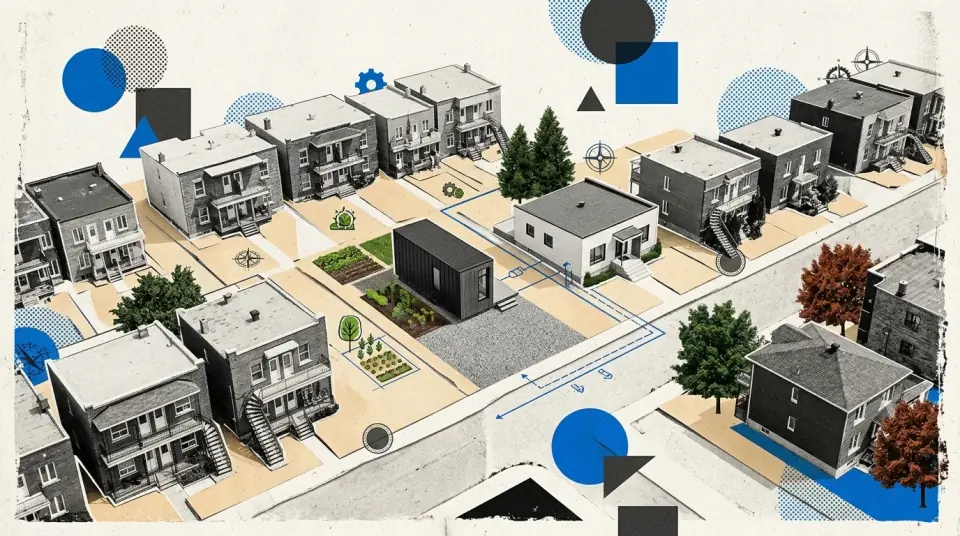
Picture the scene, lived a thousand times: a homeowner wants to build a small dwelling for his mother in his backyard. The lot is big, the plans are drawn, the money is there. City hall's answer: the zoning does not allow it. Next step: a variance application, months of waiting, a consultation where three neighbours will decide whether his mother has the right to exist within 30 metres of them.
Multiply by thousands of lots, and you get a very concrete piece of the housing crisis: homes that are legally impossible on lots perfectly capable of hosting them.
The regulatory wall, brick by brick
The wall has three main bricks. Zoning first: entire neighbourhoods frozen in detached single-family since the 1960s, where any addition — a second dwelling, a small multiplex — requires amending the bylaw. Procedures next: minor variances, referendum approvals, review delays that turn a 12-month project into a 36-month odyssey. Standards last: minimum parking, setbacks, minimum lot areas, which make the small affordable home mathematically impossible even where it is theoretically permitted.
None of these rules was written to block housing. Each had its era's logic. But their cumulative effect, in the middle of a shortage, is exactly that — and for a modular project, whose manufacturing is counted in weeks, spending 18 months in the permit machine is particularly absurd: the building waits longer than its construction took. Our guide to permits for modular helps you navigate the machine while it changes.
The key that turns: Bill 31 and ADUs
The most concrete change went almost unnoticed: since March 25, 2024, a provision of Bill 31 allows any Quebec municipality to authorize accessory dwelling units — the backyard cottage, the apartment above the garage — by simple bylaw, without rewriting its entire urban plan. Gentle densification, unlocked in a single council vote.
And councils are voting: Québec City, Victoriaville, Longueuil, Sainte-Catherine, Sherbrooke, Baie-Saint-Paul, Nicolet, Trois-Rivières, and Sutton adopted ADU bylaws in 2024-2025. For the homeowner, the equation gets interesting: a small factory-built dwelling, delivered and set in the backyard in a few days, in a city where it is now a right and not a battle. We explain the format in our piece on modular tiny homes and ADUs, and the state of the regulations, city by city, in our article on tiny homes and municipal bylaws.
The cities speeding up (and why)
Bill 31 contains other keys besides ADUs. Québec City used it to authorize projects denser than its zoning without going through the full procedure — dozens of fast-tracked projects, as we tell it in our Capitale-Nationale overview. Saguenay drew its housing "superpowers" the same year — the detail is in our Saguenay–Lac-Saint-Jean page. In Montreal, the new administration replaced the Règlement pour une métropole mixte with a single requirement of 20% non-market housing and offered 80 municipal lots to non-profits — a reform applauded by some as a simplification, criticized by others as a retreat on social housing. We will let you judge; both readings exist.
Why the sudden thaw? Look at the calendar: in the November 2025 municipal elections, housing was the number-one issue for 38% of voters according to Léger. Municipal councils did the math that bylaws, for their part, do not vote. The overall movement — which cities are easing what — is mapped in our article on the municipalities becoming housing heroes, and our guide for municipalities gives the playbook to those that want in.
Proof that the machine can run fast when everyone wants it to? The Projet Acadie, in Montreal: under 12 months, permits included. The rulebook is not destiny; it is a choice, renewable at every municipal council.
Is your municipality studying an ADU bylaw, or do you have a project sleeping in a pile of variances? We can help you document the file. Shall we talk?

8Module
Modular multi-residential buildings (6 to 24+ units) factory-built in Quebec.
Visit websiteCommercial partnership — we receive compensation. Disclosure
Frequently asked questions
What is an accessory dwelling unit (ADU)?
Why do people say municipal rules block housing?
What does Bill 31 change concretely?
Sources
- De nouveaux règlements et nouvelles lois pour les UHA — Écohabitation
- Muni-Express no 16 — 4 juillet 2025 (UHA) — MAMH
- Unités d'habitation accessoires : la densification douce rendue possible — La Presse
- La Ville de Québec utilise la loi 31 pour accélérer des projets denses — Radio-Canada
- Saguenay utilise ses superpouvoirs en habitation — Le Quotidien
- 10 actions en 100 jours : la mairesse de Montréal présente une nouvelle approche — Ville de Montréal / CNW
- Élections municipales 2025 : le logement, enjeu no 1 — Léger



Comments
A question or comment on this article? The comments section will be enabled soon.