Non-profit · 7 min
Abitibi, Saint-Lazare, Quebec City, Montreal: The Affordable Housing Pipeline Points to 2028
In short — 242 units in Abitibi-Témiscamingue, 45 in Saint-Lazare, 222 in a converted office tower in Quebec City, more than 200 under development in Montreal: Quebec's affordable housing pipeline is well stocked. But look at the delivery dates: 2028, everywhere. Three years of waiting for households looking for housing now.
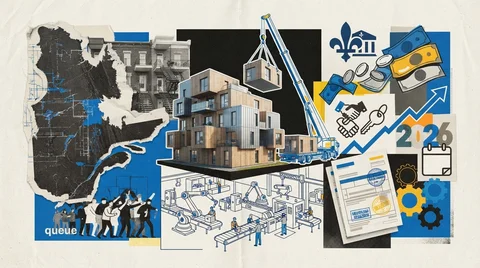
Taken on its own, each of these announcements is good news. Laid end to end, they tell two stories at once: Quebec is funding affordable housing in every one of its regions — and almost nothing just announced will be liveable before 2028. Let's do the tour, numbers in hand, before talking about the calendar.
Abitibi-Témiscamingue: 242 units in Malartic, Val-d'Or, and La Sarre
On July 3, Ottawa and Quebec confirmed three projects totalling 242 affordable housing units in Abitibi-Témiscamingue, for a combined investment of about $44M according to the announcement. The breakdown:
- Malartic: 108 units led by Accès Patrimmo for families, single people, and seniors — a $35.5M project, including $10.26M from the federal Maisons Canada (Build Canada Homes) program;
- Val-d'Or (rue Giguère): 110 Accès Patrimmo units, financed by $24.51M from the federal Affordable Housing Fund, $10M from the SHQ, $1.10M from the organization, and a 50-year municipal tax credit;
- La Sarre: 24 units from the Pavillon Lasarrois, with $1.63M from the federal government, $5.44M from Quebec, and $1.75M from the City.
For a mining region where the housing shortage is literally holding back recruitment, these 242 doors count double — the full context is in our page on modular housing in Abitibi-Témiscamingue.
Saint-Lazare: Desjardins adds 45 units to its column
In the Montérégie, the June 29 release details a 45-unit affordable housing project in two buildings on chemin Sainte-Angélique in Saint-Lazare, including 15 adapted for people with reduced mobility. Total cost: about $17.9M, assembled between Ottawa, Quebec, the City (land and a contribution of about $3.5M), and the Desjardins Affordable Housing Initiative. The first tenants are expected... in fall 2028.
Desjardins' dashboard shows the scale of the movement: as of May 31, 2026, 1,852 units in operation, 891 under construction, and 497 in approval — 3,240 units across 15 Quebec regions, with a commitment raised to more than 10,000 by 2028. The regional picture is in our page on modular housing in the Montérégie.
Quebec City: an office tower becomes 222 homes
In Quebec City, according to media reports, the Catherine-de-Longpré office tower — 15 storeys at 1075 chemin Sainte-Foy — will be converted into 222 social and affordable housing units, with a new 12-storey residential building constructed on the same site. Reported investment: more than $79M, led by Socialim with all three orders of government. Planned delivery, here again: fall 2028. A conversion of this size in the Haute-Ville, near the future tramway, is a strong signal for the Capitale-Nationale.
Montreal: more than 200 units "under development"
In Montreal, CTV News reported in early June that more than 200 affordable housing units are under development in the metropolis. The phrase to remember is "under development": between a unit under development and a tenant moving in, there are years — and in Montreal, the waiting list is not getting shorter, as our page on modular housing in Montreal shows.
The real issue: why does everything point to 2028?
Add it up: more than 500 units announced in a few weeks, hundreds of millions mobilized, four regions covered. And one constant that should raise an eyebrow: the deliveries converge on 2028. Not because developers are dragging their feet — because that is the normal pace of conventional construction once you stack the financial structuring, the permits, the tender calls, and two winters of job-site work.
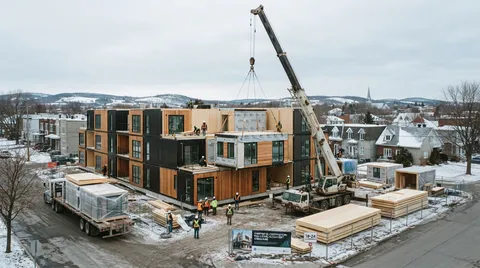
This is where the comparison gets uncomfortable: while these projects aim for 2028, factory construction delivers buildings in months — the Projet Acadie in Montreal was put up in under 12 months, permits included. The mechanics of that speed are documented in our analysis of modular project timelines, and for small buildings, our report on the modular multiplex shows how 6, 12, or 24 units can come out of the ground in a single season. None of the announcements above mentions prefabrication; that is precisely what strikes us.
Let's be fair: a 15-storey tower conversion cannot be prefabricated, and 2028 beats never. But for projects of 24, 45, or 108 units in the regions, the gap between "a few months" and "three years" is no longer a technical detail. It is a choice of method — and it is funded by the same programs, as our guide to funding affordable modular housing explains.
Does your organization or municipality have a project that cannot wait until 2028? We can prepare a quote together — and our analysis of modular project timelines will tell you what a realistic schedule looks like.

8Module
Modular multi-residential buildings (6 to 24+ units) factory-built in Quebec.
Visit websiteCommercial partnership — we receive compensation. Disclosure
Frequently asked questions
Which affordable housing projects were announced in Quebec in summer 2026?
Why are almost all the deliveries planned for 2028?
Who is funding these projects?
Sources
- The governments of Canada and Quebec support the construction of housing units in Abitibi-Témiscamingue — Canada Newswire (CNW)
- Desjardins Affordable Housing Initiative: a 45-unit affordable housing project to be built in Saint-Lazare — Canada Newswire (CNW)
- Quebec City office tower to be converted into affordable housing — Connect CRE Canada
- Montreal advances affordable housing with more than 200 units under development — CTV News Montreal
Comments
A question or comment on this article? The comments section will be enabled soon.