Non-profit · 7 min
72 Modular Affordable Homes Across 12 Témiscouata Municipalities: The Blueprint That Changes the Equation
In short — On July 14, 2026, the Fréchette government announced more than $3.9M from the SHQ to build 72 prefabricated affordable housing units across 12 municipalities in the MRC de Témiscouata, in the Bas-Saint-Laurent. The project — 12 identical six-unit buildings, one per municipality — is carried by the non-profit Les Habitations entre lacs et forêts du Témiscouata and built by Batitech. Total project value: $19.6M. First deliveries: summer 2027.
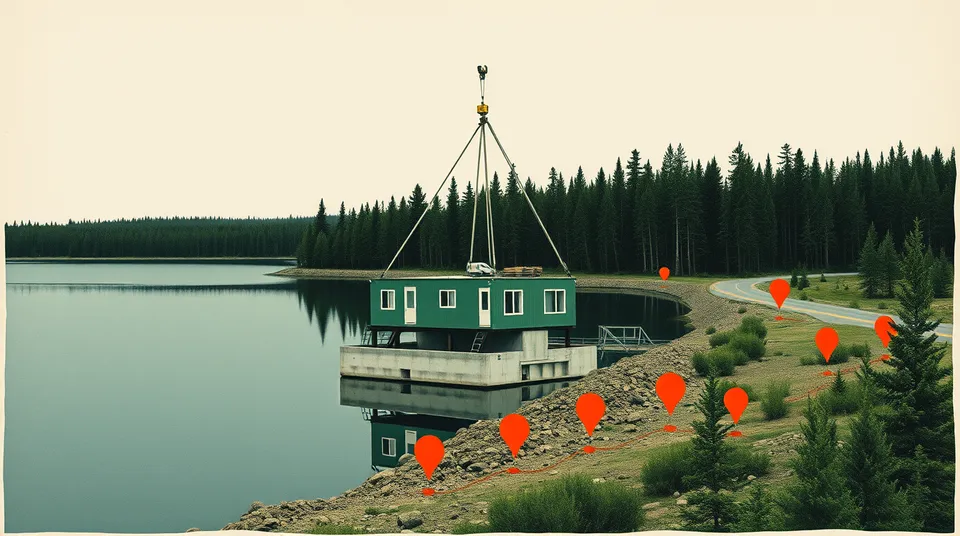
The Témiscouata has found an answer to a question most regions haven't solved yet: how do you deliver affordable housing across dozens of small, dispersed municipalities when none of them has the density to justify a standalone project?
The answer, announced July 14, 2026 by Karine Boivin Roy, Minister responsible for Housing, comes down to one idea: one six-unit building design, repeated 12 times, in 12 different villages. It is not a logistical compromise. It is a deliberate strategy — and it is precisely what modular construction makes possible.
Why 12 Identical Buildings Instead of One Complex
The MRC de Témiscouata is not a suburban ring. It is an archipelago of villages — Dégelis, Auclair, Biencourt, Pohénégamook, Saint-Eusèbe and their neighbours — separated by boreal forest and lakes, many of them home to only a few hundred residents. Building a single 72-unit complex in one location would have solved the problem for a handful of households and ignored everyone else.
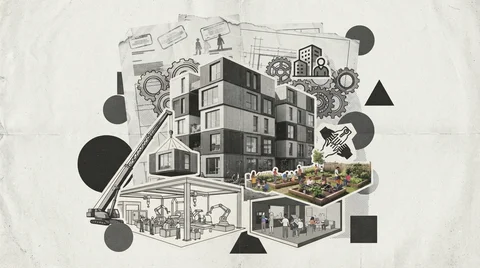
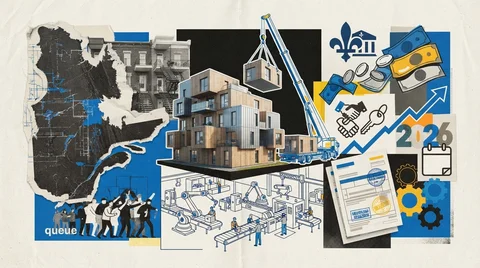
The approach taken — 12 buildings of 6 units, one per participating municipality — puts supply where the need is. It works because modular construction changes the cost logic of repetition: once a builder has mastered a building template, replicating it costs less than starting from scratch each time. Factory production centralizes quality control, reduces on-site unpredictability and compresses timelines. What this means in practice on a regional construction site, our article on the four-day modular house myth covers without shortcuts.
A project like this one — 12 dispersed sites, each too small to attract a private developer on its own — only holds together when the model repeats. That is the principle our modular construction guide for municipalities advocates: think at the scale of the MRC, not the individual lot.
Batitech and the Repetitive Model
The builder is Batitech, a modular manufacturer rooted in the region. Batitech also acts as guarantor for the commitments of Les Habitations Témiscouata S.E.C. to the SHQ — a structure that gives the non-profit the financial credibility it needs while anchoring delivery responsibility with the builder.
According to Batitech, the repetitive character of the project is precisely what makes it financially viable in such a dispersed market. Manufacturing the same building 12 times in the same plant amortizes design, tooling and training costs across sufficient volume. Delivering 12 sequential job sites with the same crew and equipment means not starting over on each location.
The total project value is $19.6M — a figure that reflects the real complexity of building across 12 municipalities simultaneously, each with its own foundation, service connections and site access. For the typical timeline risks of a multi-site modular project, our article on modular project timelines and schedules sets the practical benchmarks.
The Financing Mechanics: Grant + Patient Loan
The more than $3.9M in SHQ assistance under the PHAQ (Programme d'habitation abordable Québec) breaks down into two instruments:
- a non-repayable grant of up to $1,190,836 — money that directly improves project feasibility by reducing the non-profit's long-term debt load;
- an interest-free patient loan of up to $2,735,540 — repayable over the long term, designed precisely for non-profit organizations that cannot service debt at market rates.
This is the PHAQ's standard model for affordable housing carried by community organizations. Housing co-operatives that have used similar structures know this two-speed mechanism well: the patient loan sustains long-term operational viability; the grant locks in the lowest rents over time.
For a full picture of how these instruments fit together — PHAQ, federal funds, Canada-Quebec agreements — our guide to funding affordable modular housing traces the circuit without jargon.
48 + 24: Two Tiers of Affordability
The project does not deliver 72 units at the same rent. It distinguishes two categories:
- 48 affordable units — units with rents meeting PHAQ's strictest ceiling, targeting low-income households;
- 24 intermediate affordable units — units at a moderate rent, above the lowest tier but well below market rates.
This distinction reflects the diversity of need across Témiscouata's small municipalities. A retired person on a fixed pension, a single-parent family, a seasonal worker: three profiles, three different capacities to pay. A project offering only one rent level serves only one profile. This one serves several.
It also distinguishes this project from a conventional social housing announcement and aligns it with the model the SHQ is scaling across Quebec. The 336 prefabricated units expected this summer reflect the same wave of PHAQ-funded deliveries.
The 12 Participating Municipalities
The buildings will be constructed in: Dégelis, Saint-Michel-du-Squatec, Rivière-Bleue, Biencourt, Témiscouata-sur-le-Lac, Packington, Saint-Marc-du-Lac-Long, Saint-Elzéar-de-Témiscouata, Saint-Eusèbe, Pohénégamook, Auclair and Saint-Honoré-de-Témiscouata.
That list is worth pausing on. Several of these villages have fewer than 1,000 residents. Six affordable housing units in a village of 800 people is not a marginal addition — it is a visible transformation of local supply. And because each building is factory-built to a standard template, it does not require the critical mass a conventional developer would demand before travelling to the site.
For regional context, our page on modular housing in the Bas-Saint-Laurent puts this project alongside the other recent deliveries in the region — including the completed projects in Rimouski and Matane that show what these buildings look like once occupied.
Timeline: Summer 2027, Then End of 2028
The first units will be available in summer 2027. All 12 buildings across the MRC will be completed by end of 2028 — an 18-to-30-month horizon from the announcement date, depending on the site.
That timeline accounts for sequential factory fabrication of modules, preparation of 12 separate foundations across as many municipalities, and the winter construction constraints specific to the Bas-Saint-Laurent. According to the Ministry of Housing, the predictable delivery schedule is itself part of the case for prefabrication in this context: a builder working from a mastered template, producing in a controlled environment, carries fewer schedule risks than a conventional regional job site.
8Module
Modular multi-residential buildings (6 to 24+ units) factory-built in Quebec.
Visit websiteCommercial partnership — we receive compensation. Disclosure
Frequently asked questions
What is the PHAQ, and why is it used here?
Why prefabricated construction for a project scattered across 12 villages?
When will the units be available?
Who will be eligible to rent these units?
Sources
- Québec accorde plus de 3,9 M$ pour construire 72 logements abordables au Témiscouata — Mon Témiscouata
- Plus de 70 logements abordables seront construits au Témiscouata — Radio-Canada
- Le gouvernement Fréchette accorde plus de 3,9 M$ pour la construction de 72 logements abordables dans 12 municipalités du Témiscouata — Gouvernement du Québec

Comments
A question or comment on this article? The comments section will be enabled soon.