Fundamentals · 6 min
A House Assembled in 4 Days: Myth or Reality?
In short — Both. Reality: setting a building's modules on its foundations can indeed take a few days — Quebec manufacturers target several modules per day, and it is filmed, documented, verifiable. Myth: believing the project takes four days. Before the crane come the permits, the foundations, and months of factory manufacturing; after it, the connections and the finishes. The real gain, measured by independent studies, is 20 to 50% less project time — enormous, but not magic.
You have seen the video. Everyone has seen the video: a crane, wooden boxes descending from the sky, and in time-lapse, a building growing like Lego between Monday and Thursday. Comment under the video: "why don't we just do this everywhere??"
Good question. Answer in two parts — what is true, then the blur the video edit skips over.
What is true (and honestly spectacular)
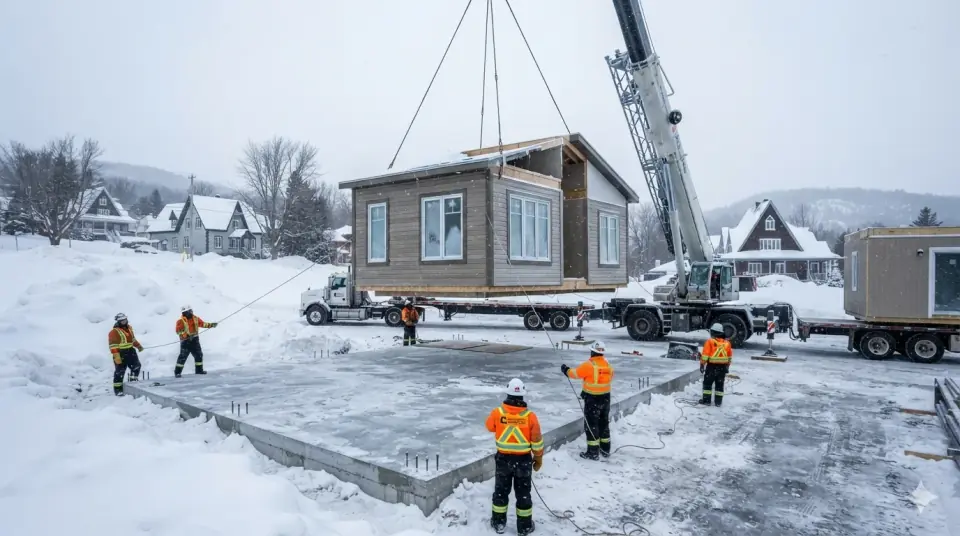
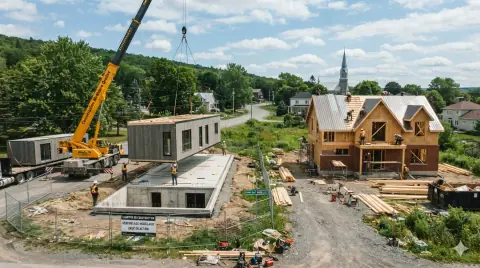
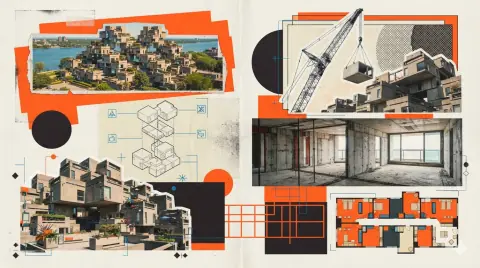
The setting really is like that. A module arrives with its kitchen, bathroom, plumbing, and windows already installed; the crane lowers it, the crew fastens it, next. At the UTILE job site in Rimouski, the manufacturer was targeting about eight modules set per day — a manufacturer's figure, reported by Radio-Canada, but the overall calendar is public: assembly began January 14, 2025, in the dead of winter, for a 155-unit student housing building. The full case study is in our piece on modular student housing in Rimouski.
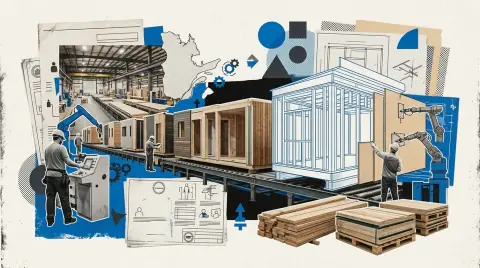
In the factory, the pace is dizzying too: according to the manufacturer Industries Bonneville, visited by La Presse, a module containing two housing units comes off the line in about 32 hours of work. Thirty-two hours for two homes. On a conventional job site, in 32 hours, you have put up the fence and lost a delivery driver.
What the video does not show
Now let's rewind what the time-lapse cut. Before the crane: the financial structuring, the zoning, the permit, the excavation, the foundations — and the months during which the modules are built in the factory. After the crane: the joints between modules, the electrical and mechanical connections, the corridors, the inspection. Nobody gets their keys on day 5. Anyone who lets you believe otherwise is selling you a time-lapse, not a building.
Here are the serious numbers. McKinsey estimated as early as 2019 — the figure is dated, but it remains the global reference — that modular cuts project timelines by 20 to 50%. A field study funded by the U.S. Department of Energy, covering more than 50 real multifamily buildings, measured 25 to 30% faster on average. And CMHC's star Canadian case, 605 Studio West in Calgary: 84 affordable units built and occupied in under a year, versus nearly two years for a comparable project in the same neighbourhood.
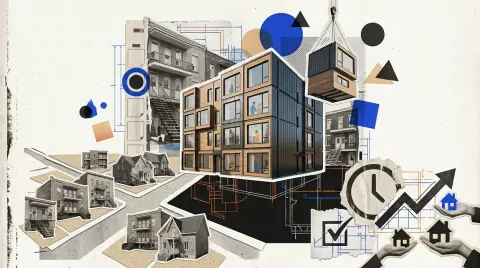
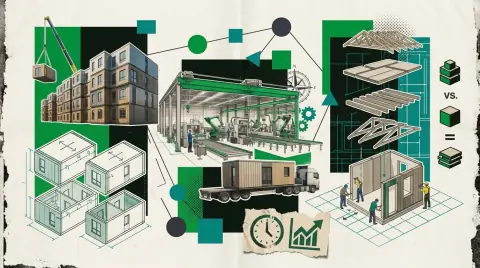
The thing to understand: the gain does not come from the speed of the crane. It comes from the parallel. While the site is being prepared, the homes are being manufactured — two clocks running at the same time instead of one after the other. That is the whole difference between modular and traditional, which we put side by side in modular vs. traditional: the real comparison.
And when it goes off the rails? It is rarely the factory's fault
One last piece of honesty, because it is our trademark: modular can be late too. Montreal knows something about it — its transitional modular housing racked up well-documented delays in 2025. But look at where it jammed: land, permits, site preparation. Not the manufacturing. The lesson holds for every project sponsor: the factory keeps its deadlines; it is the municipal side of the file you have to armour-plate. The counter-example is the Projet Acadie, wrapped up in under 12 months permits included — proof that when the city keeps up, the total keeps up.
This kind of nuance is exactly what separates information from marketing — we run the same exercise on every received idea in the myths of modular construction. And if you want to see what the speed changes concretely in a region that needs it, our regional overviews of the Bas-Saint-Laurent and Montreal show the before-and-after.
Next time the video crosses your feed, you will know what to reply to the comment. And if it is your project that deserves two clocks instead of one — shall we take a look?

8Module
Modular multi-residential buildings (6 to 24+ units) factory-built in Quebec.
Visit websiteCommercial partnership — we receive compensation. Disclosure
Frequently asked questions
Can a building really be assembled in a few days?
What is modular's real time saving?
Can modular still run late?
Sources
- Modular construction: From projects to products — McKinsey & Company
- Modular Multi-Family Construction: A Field Study — Modular Building Institute (study funded by the U.S. DOE)
- Des logements construits en 32 heures — La Presse
- Logement étudiant : le chantier UTILE à Rimouski — Radio-Canada
- CMHC expands mortgage insurance support for prefab and modular construction (605 Studio West case, Calgary) — CMHC — Canada Mortgage and Housing Corporation
- Les logements modulaires accusent du retard — La Presse

Comments
A question or comment on this article? The comments section will be enabled soon.