Fundamentals · 6 min
While the Job Sites Freeze, Quebec's Factories Keep Building
In short — Quebec has one of the worst construction climates in the industrialized world — and that is precisely why factory construction makes more sense here than elsewhere. In a heated factory, January is a production month like any other: the modules for Quebec's biggest modular student housing project were manufactured in the fall and assembled in Rimouski starting January 14, in the dead of winter, for tenants moved in by July 1. The freeze does not negotiate; you can only build where it cannot get in.
Every fall, the same ritual: Quebec job sites begin their race against the thermometer. Pour the foundations before the freeze, close the envelope before the snow, and cross your fingers. Every winter, the same bill: temporary shelters, job-site heating, winter concreting, lost days, schedules sliding into an already overloaded spring.
We ended up finding that normal. It is not. It is just old.
The factory does not check the weather
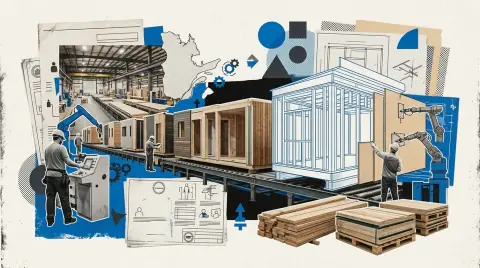
While the job site hibernates, the factory produces. Controlled temperature, dry materials, fixed workstations, regular shifts — the manufacturing of a home advances on January 15 exactly as it does on June 15. At one large Quebec manufacturer, a module containing two housing units comes off the line in about 32 hours of work, according to the manufacturer, whose Belœil plant was visited by La Presse. Not 32 summer hours: 32 hours, period.
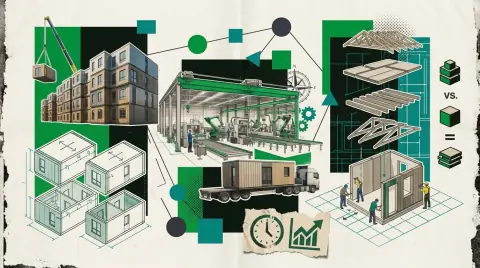
CMHC puts it soberly in its Canada-wide lessons on modular: factory manufacturing reduces weather exposure, material waste, and time spent on site. Behind the phrasing, a very concrete reality: lumber that never soaks in the rain, insulation installed dry, finishes done standing up in a heated building rather than kneeling in a February wind. The field study funded by the U.S. Department of Energy also measured, across more than 50 multifamily buildings, energy performance equal or superior to site-built comparables — the factory is not just faster, it is not worse.
Rimouski, January 14: the full-scale demonstration
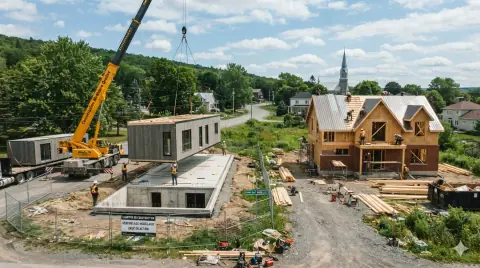
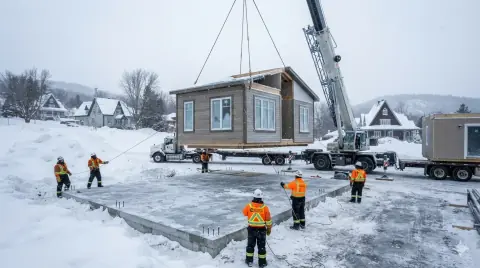
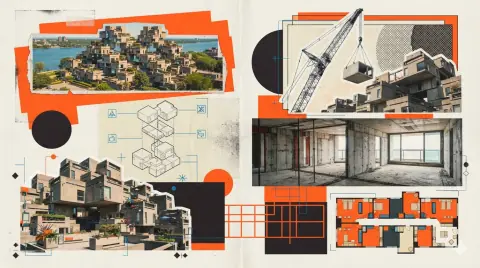
Quebec's best answer to winter skepticism has a date: January 14, 2025. That day, in the heart of the Lower St. Lawrence winter, assembly began on UTILE's 155 student housing units in Rimouski — modules manufactured in the warmth over the fall. First tenants: July 1, 2025. A complete building, designed, manufactured, assembled, and delivered in about ten months, straddling a full winter. The detailed case study is in our piece on modular student housing in Rimouski, and the regional context in our Bas-Saint-Laurent overview.
Flip the logic around: in conventional construction, winter is a hole in the calendar. In modular, it is a production season — and the setting, for its part, is planned in windows of a few days or weeks, manageable even in the cold season. What lightning-fast assembly means and does not mean is taken apart in a house assembled in 4 days: myth or reality?.
Why this matters more than a job-site anecdote
Because Quebec cannot afford to waste months. In 2024, the province recorded about 48,700 housing starts — a record year, up 26% — and according to APCHQ, that pace would need to roughly quadruple to close the deficit by 2030. You do not quadruple an industry that leaves its production tool outdoors four months a year. Reclaiming winter means structurally increasing construction capacity without adding a single worker — in regions like the Saguenay–Lac-Saint-Jean, where vacancy grazes zero and the job-site season is even shorter, the argument speaks for itself.
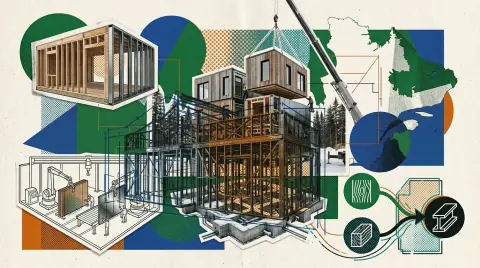
Let's be rigorous about the limits, as always: modular does not abolish winter. Foundations must be poured before the freeze or with costly protections, cranes do not lift in a storm, and outdoor connections remain hostage to the season. The difference is the proportion: instead of exposing twelve months of work to the weather, you expose a few weeks. The line-by-line comparison with the traditional job site is in modular vs. traditional, and our advice for cold-season site work is in our article on building in winter in Quebec.
Winter is coming — it always is. The real question: will your next project endure it or put it to work?

8Module
Modular multi-residential buildings (6 to 24+ units) factory-built in Quebec.
Visit websiteCommercial partnership — we receive compensation. Disclosure
Frequently asked questions
Can you really build a house in Quebec in the middle of winter?
Is the quality of a home factory-built in winter equivalent?
Why is winter an economic argument for modular?
Sources
- Building housing quickly, when it matters most — CMHC — Canada Mortgage and Housing Corporation
- Key lessons from modular housing across Canada — CMHC — Canada Mortgage and Housing Corporation
- Logement étudiant : le chantier UTILE à Rimouski — Radio-Canada
- Des logements construits en 32 heures — La Presse
- Modular Multi-Family Construction: A Field Study — Modular Building Institute (study funded by the U.S. DOE)
- Mises en chantier 2024 : une année pleine de rebondissements — APCHQ / Québec habitation
Comments
A question or comment on this article? The comments section will be enabled soon.