
Fundamentals · 11 min
Modular Construction Around the World: Projects That Inspire
In short — Modular construction is not a Quebec fad: it is a worldwide movement that has already produced some of the most striking buildings of the past half-century. From Habitat 67 in Montreal to Tokyo's capsule towers, from New York's stacked hotels to London's "demountable" affordable housing, the same principles show up everywhere — build in a factory, assemble fast, control quality better.
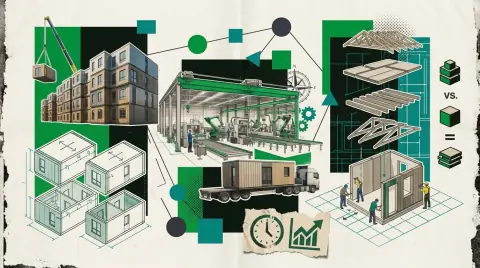
Modular is often presented as a novelty. It is not. For more than fifty years, some of the most respected architects on the planet have used it to answer a question that never ages: how do you house more people, faster, without sacrificing quality? The tour that follows is not a ranking — it is a demonstration. Each of these projects proves that a module built away from the weather can become anything: an apartment with a terrace, a hotel room, social housing, a school.
Why the world builds in modules
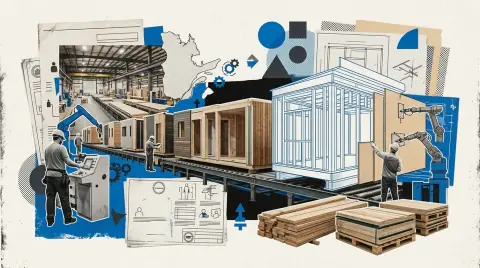
Three forces are pushing prefabrication everywhere at once. The shortage of skilled labour makes the factory — where a stable team works year-round — more reliable than the job site. The housing crisis rewards speed: a module delivered finished means months gained. And the climate: building indoors, in a factory, removes the dependence on weather — an argument as true in Stockholm as in Amqui.
The basic principle does not change from one country to another. To understand the vocabulary (module, volumetric, panel, 3D vs 2D), start with our definition of modular construction.
Habitat 67 — Montreal, the manifesto
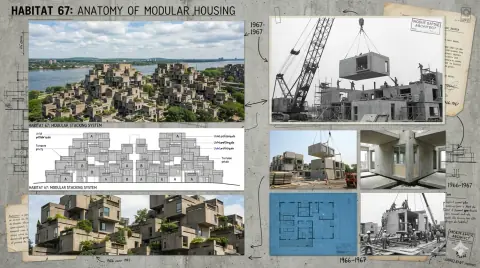
Impossible to start anywhere else. Designed by Moshe Safdie for the 1967 World's Fair, Habitat 67 stacks 354 prefabricated concrete modules to create 148 apartments, each with its own private terrace. It is the most cited project in the world when people talk about modular — and it is still lived in, more than fifty years later. Its lesson fits in one sentence: stacking identical modules can produce singular architecture, not repetitive architecture.
Nakagin Capsule Tower — Tokyo, the Metabolist dream
In 1972, architect Kisho Kurokawa raised a tower in Tokyo made of prefabricated dwelling capsules, bolted one by one onto two concrete cores. Each capsule — a complete studio delivered furnished — was meant to be replaceable individually, like a watch part. The building became the icon of the Metabolist movement. It was dismantled in 2022, but several capsules were preserved by museums: proof that a module can be designed as a durable object, not a disposable one.
Volumetric hotels — the commercial frontier
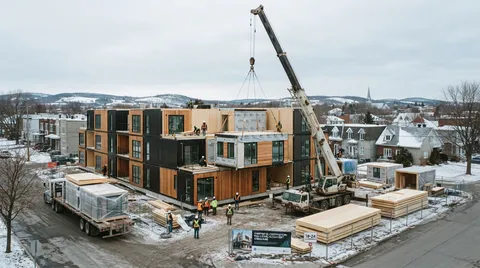
Hospitality is where modular is moving fastest today. Chains build entire rooms in factories — plumbing, bathroom, furniture included — then stack them on site in a few weeks. The result: towers dozens of storeys tall delivered in a fraction of the time of a traditional build, with a cleaner, quieter job site for the neighbours. The same logic applies to student residences and multifamily buildings.
BoKlok — the industrial approach to affordable housing
In Scandinavia, a joint venture born of a well-known furniture manufacturer and a major builder has been producing serial housing since the 1990s, designed to be genuinely affordable. The method: standardize without making everything uniform, build in a factory, and target a price within reach of middle-income households. It is a reminder that modular is not just about design — it is also a housing-policy tool.
London — social housing that moves
In London, leading architects have designed demountable social housing developments: modular buildings installed on land awaiting development, planned to be taken apart and reinstalled elsewhere later. The idea turns an urban constraint — temporarily vacant lots — into very real housing, without pouring anything permanently into concrete. The module becomes mobile.
Vancouver — wood prefabrication, at height
Closer to home, Western Canada has shown that prefabrication and wood get along at height: residential towers with mass-timber structures, their elements built in a factory then assembled on site, have broken height records for the material. For the wood-versus-steel debate in a modular context, see our comparison of structures and materials.
Living on a slope — terraced modular
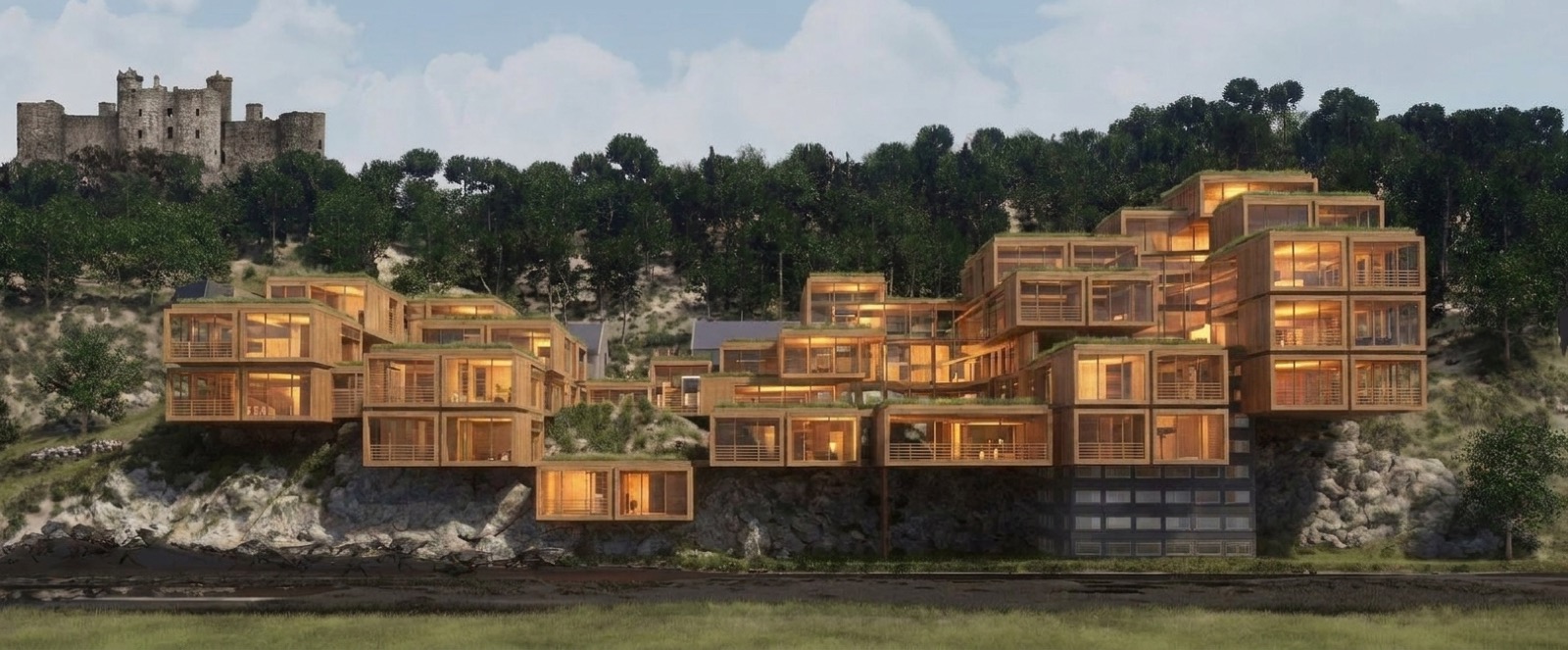
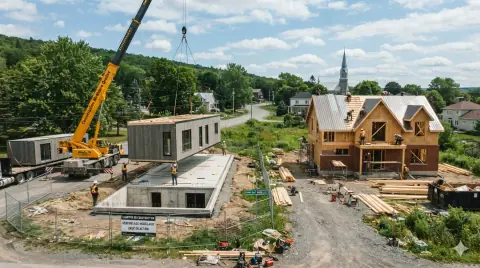
The renders that open this article illustrate one last avenue: modular for difficult lots. On a slope, the staggered stacking of factory-built volumes naturally creates terraces — one unit's roof becomes the next one's garden, exactly as at Habitat 67, but on a hillside. It is precisely the kind of site where prefab shines: less formwork on rough terrain, modules set by crane, a smaller job site.
Landmark projects at a glance
| Project | Place | Year | What it demonstrates |
|---|---|---|---|
| Habitat 67 | Montreal | 1967 | Identical modules, unique architecture |
| Nakagin Capsule Tower | Tokyo | 1972 | The capsule as a replaceable object |
| Volumetric hotels | New York, Europe | 2010s– | Height delivered in weeks |
| Industrialized housing | Scandinavia | 1990s– | Affordability through series production |
| Demountable social housing | London | 2010s– | The mobile, reinstallable module |
| Prefabricated mass timber | Vancouver | 2010s– | Prefabrication at height |
(Facts and dates to be confirmed in production — see editorial note.)
What Quebec can take from this
The common lesson of these projects is not "modular costs less." It is that at equivalent finish, building in a factory shifts the risk: fewer weather hazards, more predictable schedules, controlled quality. For a Quebec project — a house on a private rural lot, a multiplex, community housing — those are exactly the benefits that matter.
What remains is to weigh them for your own case. Balance the pros and cons with our guide to the advantages and drawbacks, then estimate your budget with the price calculator.

8Module
Modular multi-residential buildings (6 to 24+ units) factory-built in Quebec.
Visit websiteCommercial partnership — we receive compensation. Disclosure
Frequently asked questions
Is modular construction really used for large buildings?
What is the difference between "modular" and "prefab"?
Can these international projects be transposed to Quebec?
Sources
- Habitat 67 — Safdie Architects
- Nakagin Capsule Tower — The Museum of Modern Art (MoMA)
- Modular architecture and design — Dezeen
- Prefabricated architecture — ArchDaily
Comments
A question or comment on this article? The comments section will be enabled soon.