Fundamentals · 8 min
Types of Prefabricated Homes in Quebec
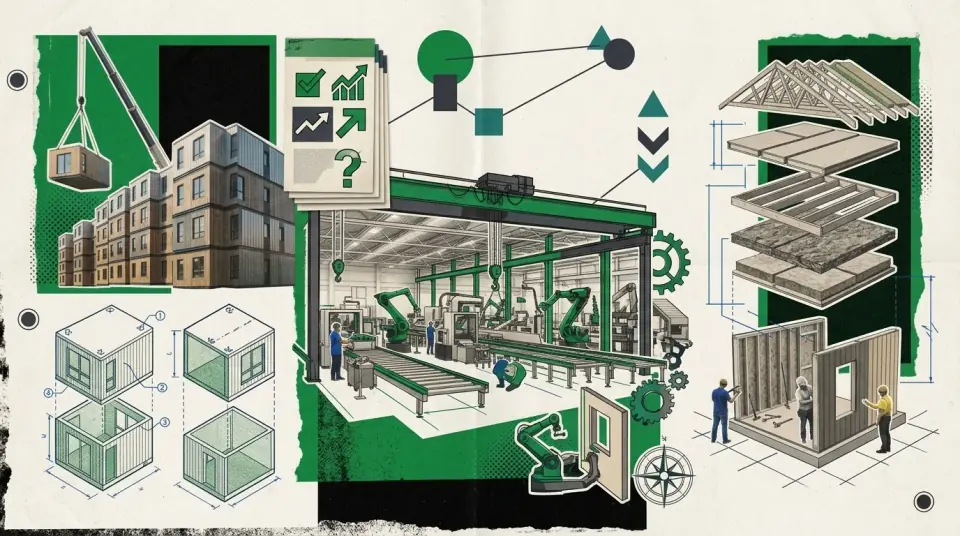
In short — In Quebec, "prefab" covers four main families: the modular home (finished 3D volumes, delivered and stacked), the panel home (or panelized — walls and floors manufactured flat, assembled on site), the pre-cut home (a kit of cut materials to be assembled on site) and the mobile home (on a chassis, CSA Z240 standard). "Maison usinée" is the common Quebec term for factory-built homes, most often modular or panelized.
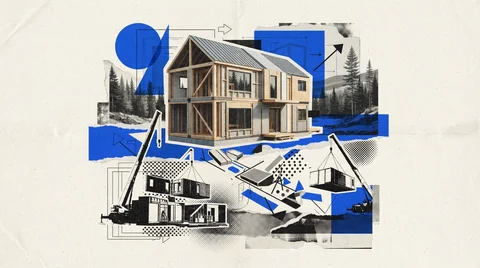
Before comparing prices or builders, you need to know which type of prefab you are talking about — because the degree of prefabrication changes the timeline, the on-site cost and even financing. Here are the families, from the most "finished in the factory" to the most "assembled on site."
The four main families
| Type | What is done in the factory | On-site assembly |
|---|---|---|
| Modular (volumetric) | Complete 3D volumes (walls, floors, roof, often finishes) | Crane placement, connections |
| Panel (panelized) | 2D panels (walls, floors) manufactured flat | Panels are erected and assembled |
| Pre-cut (kit) | Cut and numbered materials | Full assembly on site |
| Mobile / manufactured | A home on a chassis (CSA Z240) | Placed, sometimes in a park |
The higher you go in the table, the more work is done in the factory and the shorter the on-site phase. For the basic vocabulary, see our definition of modular construction.
Modular (volumetric)
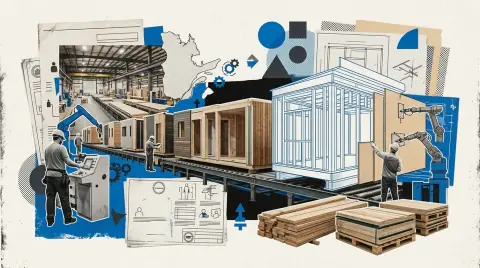
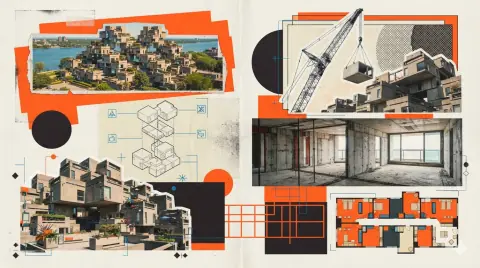
The most advanced degree: three-dimensional modules are manufactured in the factory, often with a large share of the finishes included, then delivered and assembled on a foundation. This is the approach that most reduces on-site work — at the cost of transport constraints (module dimensions, site access).
Panel (panelized)
Walls, floors and sometimes the roof are manufactured flat in the factory, then transported and erected on site. Less bulky to transport than complete volumes, this system leaves more finishing work on site but offers great design flexibility. The structure (wood or steel) influences the result — see our comparison of wood and steel.
Pre-cut (kit)
Here, the factory supplies a set of cut and numbered materials to be assembled entirely on site. Prefabrication covers the cutting and planning, not the assembly. This is the type closest to traditional construction.
Mobile home (manufactured)
Built on a chassis according to the CSA Z240 standard, it is designed to be moved and follows a distinct economic logic — it is a separate category, often confused with the factory-built home. The distinction is crucial for value and financing: we have dedicated a full guide to the factory-built home vs mobile home topic.
Which type for which project?
The "best" type depends on the site, the budget and the schedule. Modular minimizes on-site work (ideal for remote locations or a tight timeline); panelized offers design flexibility; the kit suits supervised self-builds. To situate the costs of each, use our price calculator and our price guide. Two special cases have their own guides: the container home and the prefab chalet.

8Module
Modular multi-residential buildings (6 to 24+ units) factory-built in Quebec.
Visit websiteCommercial partnership — we receive compensation. Disclosure
Frequently asked questions
What is the difference between a modular home and a panelized home?
Are "maison usinée" and "prefab home" the same thing?
Which type is fastest to build?
Sources
- Normes de construction préfabriquée (CSA A277, CSA Z240) — Groupe CSA
- Code de construction du Québec — Régie du bâtiment du Québec (RBQ)
- Construction préfabriquée — Écohabitation
Comments
A question or comment on this article? The comments section will be enabled soon.