Non-profit · 8 min
$13 Billion for Housing: Where Does the Money Actually Go?
In short — The "$13 billion" is the initial envelope of Maisons Canada, the new federal agency that prioritizes prefab — and it comes on top of the $1.8-billion Canada-Quebec agreement (FACL), the SHQ's programs, and the roughly $740 million in the latest Quebec budget. Lots of numbers, one paradox: while the announcements rain down, shovel-ready projects are still waiting for their financing. Here is the map of the money — where it starts, where it flows, and where it gets lost along the way.
Following housing money in Quebec is like following a river through a delta: a big flow at the inlet, dozens of branches at the outlet, and quite a bit of evaporation in between. Let's take the map and work our way upstream.
The big federal piece: Maisons Canada and its $13 billion
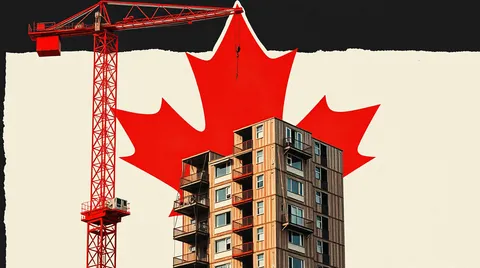
Launched in September 2025, Maisons Canada is an agency — not a grant program — with an initial envelope of $13 billion. Its distinguishing feature: it builds on federal land itself, and its written instruction is to prioritize prefab, modular, and mass timber. First wave: about 4,000 homes on six sites, only one of them in Quebec — the Pointe-de-Longueuil, a riverside project dubbed Longue-Rive with 1,055 units, 40% of them non-market, with a qualification call launched in December 2025.
Before you get carried away: the Parliamentary Budget Officer forecasts about 26,000 units by 2029-2030 for the entire country. Against a Quebec deficit that CMHC put at roughly 860,000 units in 2023, the lion's share remains to be delivered by others. The full Longueuil file is in our regional overview of the Montérégie.
The Canada-Quebec pipe: the FACL and its $1.8 billion
Second branch of the river: the agreement concluded in late 2023 around the Housing Accelerator Fund — $900 million from Ottawa, $900 million from Quebec, $1.8 billion in total for roughly 8,000 social and affordable housing units, including 500 for people experiencing homelessness.
This is the envelope behind the initiative most interesting to this site: the SHQ's highly prefabricated multi-unit housing — 566 units selected through two project calls, with deliveries starting in 2026. The town-by-town list is worth the detour: the winners are mostly small municipalities.
The Quebec tap: the SQH, the PHAQ, and the 2026-2027 budget
On the Quebec side, the backdrop is called the Stratégie québécoise en habitation: $6.3 billion invested since 2018, a target of 560,000 new homes by 2034, and a commitment of 23,000 social and affordable units. The main delivery tool is the PHAQ — the Programme d'habitation abordable Québec — whose 2026-2027 budget funded a new round: about $740 million over three years for housing, including 1,000 affordable units. It was, notably, the PHAQ's first regular call since 2023.
A thousand units is a lot of money and few doors: FRAPRU was demanding 10,000 and called the effort "too little". With an election year in play — Quebecers vote in fall 2026 — expect every camp to brandish its own reading of these numbers. We stick to the calculator.
Where the river gets lost: the last-mile paradox
And here is the paradox that deserves more room in the debate: the money exists, and projects die anyway. In September 2025, La Presse documented advanced affordable projects — land acquired, plans drawn — in peril in Longueuil, a few kilometres from the federal megasite and its billions. How? Because envelopes do not turn themselves into construction mortgages: between the announcement and the shovel, there are program criteria that change, costs that rise faster than standardized subsidies, and approval delays that outlast purchase options.
That is the lesson every non-profit, co-operative, and municipality should frame on the wall: a project's success does not depend on the size of the national envelopes, but on the ability to assemble three or four sources — PHAQ, FACL, CMHC financing, municipal contribution — in the right order and before the options expire. Our guide to funding affordable modular housing explains the plumbing program by program, and our page on modular housing co-operatives shows the structure from the co-op side. For the Montreal context — where the new municipal administration has reshuffled its own rules — see our Montreal overview.
Where does prefab fit into all this? Everywhere time costs money: the faster a project delivers, the less inflation and carrying costs eat into the subsidy. That is one of the arguments that convinced Quebec and Ottawa to bet on the factory.
Does your organization have a project and program vertigo? That is precisely the kind of puzzle we like to untangle. Shall we get started?

8Module
Modular multi-residential buildings (6 to 24+ units) factory-built in Quebec.
Visit websiteCommercial partnership — we receive compensation. Disclosure
Frequently asked questions
Where do the "$13 billion for housing" come from?
How many homes will these billions actually produce?
Why do projects run out of money while the billions pile up?
Sources
- Prime Minister Carney launches Build Canada Homes — Office of the Prime Minister of Canada
- Build Canada Homes accelerates affordable housing in Longueuil — Government of Canada
- Build Canada Homes forecast to build 26,000 units — Parliamentary Budget Officer
- Le Canada et le Québec annoncent la conclusion d'une importante entente (FACL) — Gouvernement du Québec
- Budget 2026-2027 — communiqué no 2 : plus de 3,6 G$ pour appuyer les Québécois — Gouvernement du Québec
- Réaction au budget 2026-2027 — FRAPRU
- Les milliards pleuvent, mais des projets avancés sont en péril à Longueuil — La Presse
- Stratégie québécoise en habitation — Gouvernement du Québec

Comments
A question or comment on this article? The comments section will be enabled soon.