Non-profit · 7 min
500 Homes Straight Out of the Factory: Quebec's Bet, Town by Town
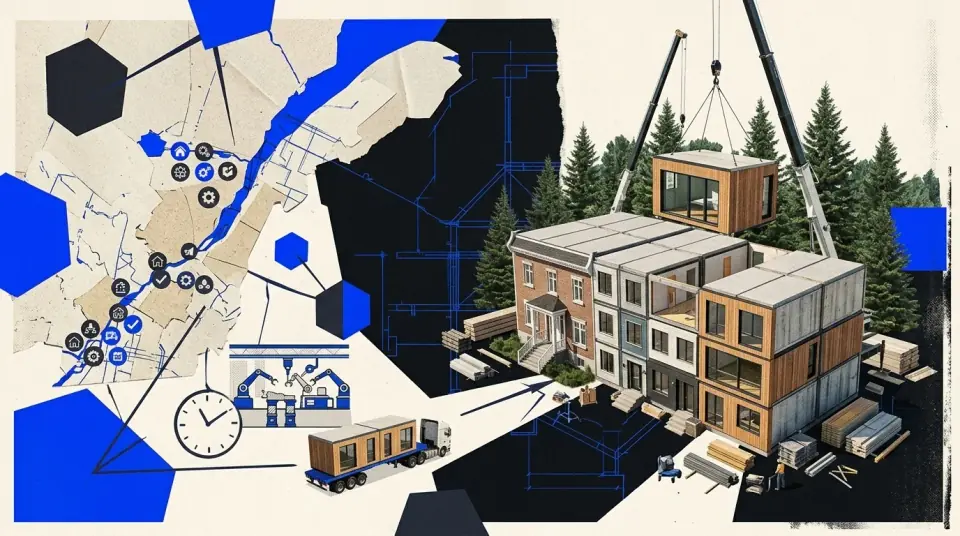
In short — In January 2025, the Société d'habitation du Québec launched an unprecedented project call: 500 highly prefabricated affordable housing units, in standardized buildings of 24 or 36 units. The result, announced in August 2025: 11 projects, 336 units, 5 consortiums, delivery targeted for summer 2026 — and a second call for 225 units launched right behind it, for a total of 566 selected units. The most interesting part is not the total: it is the map. The big winners are villages.
When a government announces housing, you expect Montreal, Quebec City, maybe Gatineau. Open the list of the SHQ's first 11 prefab projects and you land on L'Isle-aux-Allumettes, Grande-Vallée, Cap-Chat, Saint-Léonard-d'Aston. Municipalities that conventional developers almost never visit — and that is exactly the point.
The list, town by town
The 11 projects selected in the first call, according to the August 2025 announcement (unit counts to be reconfirmed project by project before publication):
| Municipality | Region | Project | Units |
|---|---|---|---|
| L'Isle-aux-Allumettes | Outaouais | Habitations L'Isle-aux-Allumettes | 24 |
| Paspébiac | Gaspésie–Îles-de-la-Madeleine | — | 24 |
| Grande-Vallée | Gaspésie–Îles-de-la-Madeleine | — | 24 |
| Cap-Chat | Gaspésie–Îles-de-la-Madeleine | Cmétis | 36 |
| Princeville | Centre-du-Québec | Faubourg des Prés | 36 |
| Saint-Léonard-d'Aston | Centre-du-Québec | — | 24 |
| Coaticook | Estrie | Quartier du plateau | 36 |
| Granby | Estrie | Le Florelle | 24 |
| Lévis | Chaudière-Appalaches | SILA | 48 |
| Laval | Laval | Habitation Havre du Renouveau | 36 |
| Montréal | Montréal | Projet Acadie | 26 |
Five design-build consortiums were qualified to deliver all of it, each backed by a Quebec factory: Magil-Tisseur (modules by Industries Bonneville), Pomerleau (RCM Modulaire), TB4-Ronam (Fabrik), Locusi, and LFG Construction (RG Solution). In other words, the program is not just ordering housing: it is structuring an industrial sector.
Why villages? Because that is where the model is unbeatable
Look at the distribution: the Gaspésie and the Îles-de-la-Madeleine alone land three projects — Paspébiac, Grande-Vallée, Cap-Chat. Our Gaspésie regional overview explains why the region needed them urgently. The Centre-du-Québec takes two, in municipalities — Princeville, Saint-Léonard-d'Aston — that we detail in our Centre-du-Québec portrait.
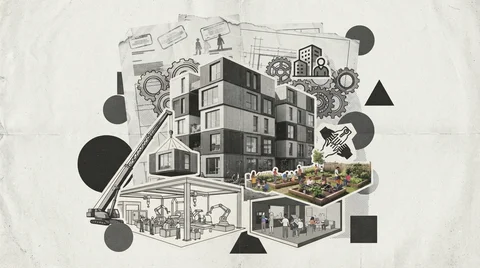
The logic is airtight. In a municipality of 1,300 residents like L'Isle-aux-Allumettes, no conventional developer mobilizes a two-year job site for 24 units: too small, too far, too risky. But a standardized building, factory-built and assembled in a few weeks, changes the math — the bulk of the work happens where the workers already are, and the village receives a finished product. The same reasoning led to projects in the Estrie (Coaticook, Granby) and the Outaouais.
Standardization is the other half of the bet: 24 or 36 units, two or three storeys, studios to two-bedrooms. No architecture reinvented for every village — a repeatable product, so a factory that learns, so costs that come down with volume. In theory. That is precisely what summer 2026 is going to test.
The money: where the millions come from
The program is funded by the Canada-Quebec agreement built around the Housing Accelerator Fund: $900 million federal, $900 million from Quebec, $1.8 billion in total for roughly 8,000 social and affordable housing units — including this prefab envelope. Who pays for what, how a non-profit plugs in, which programs stack: our guide to funding affordable modular housing covers it all.
The report card arrives in the fall
Let's stay clear-eyed: 566 selected units is less than a tenth of one percent of Quebec's deficit. The SHQ's bet is not measured in doors delivered; it is measured in proof. The first verdict is already in — the Projet Acadie, put up in Montreal in under 12 months permits included — and the ten other first-call projects are aiming for summer 2026. If Cap-Chat, Princeville, and Coaticook welcome their tenants on time, Quebec will have demonstrated something no report could: that affordable housing can be delivered, fast, where nobody builds. The broader context of the Quebec test is in our article on factory-built homes.
Would your municipality or non-profit like to be on the next list? We can look together at what a solid application requires.

8Module
Modular multi-residential buildings (6 to 24+ units) factory-built in Quebec.
Visit websiteCommercial partnership — we receive compensation. Disclosure
Frequently asked questions
Which towns were selected for the SHQ's 500 prefab housing units?
Why so many small municipalities on the list?
Who is building these buildings?
Sources
- Lancement de l'appel de projets — 500 logements hautement préfabriqués — Gouvernement du Québec
- Construire autrement et plus rapidement : la voie du hautement préfabriqué est maintenant tracée — Gouvernement du Québec
- Initiative de multilogements hautement préfabriqués : un 2e appel de projets est lancé — Gouvernement du Québec
- Projet Acadie : les 26 logements modulaires hautement préfabriqués sont déjà installés — Gouvernement du Québec
- Le Canada et le Québec annoncent la conclusion d'une importante entente (FACL) — Gouvernement du Québec
Comments
A question or comment on this article? The comments section will be enabled soon.