Non-profit · 7 min
A Billion Dollars for Prefab Home Neighbourhoods: What Quebec Just Launched
In short — On July 2, 2026, Premier Christine Fréchette launched a new stream of the FIERH program worth nearly $1 billion: Quebec will pay for the water and sewer infrastructure of municipalities that create neighbourhoods of prefabricated homes sold under $350,000. Municipalities have until September 18, 2026 to submit a project. Here is what it changes, and for whom.
Some government announcements pass through the news cycle without leaving a trace. This one is not among them: it is the first time a Quebec government has built a homeownership program explicitly around the prefabricated home — and it is putting nearly a billion dollars into it.
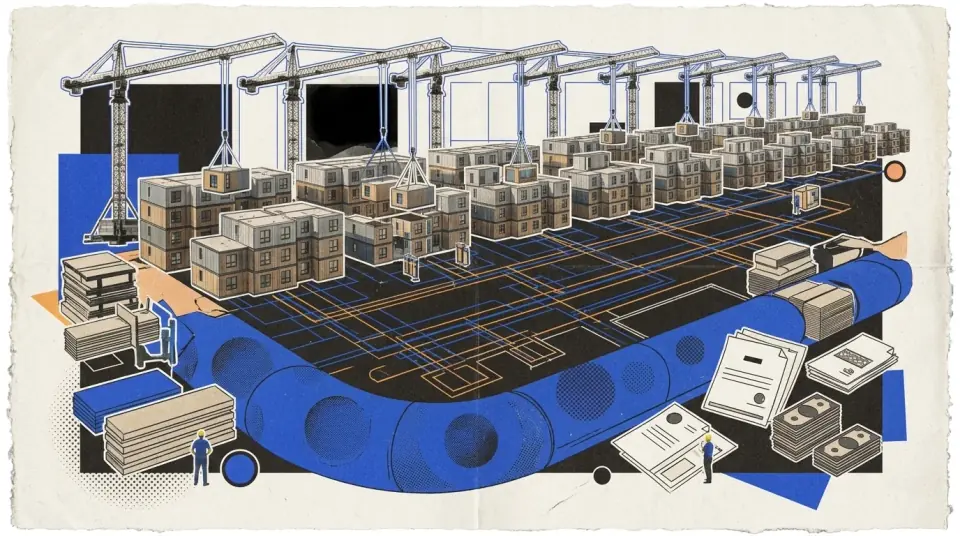
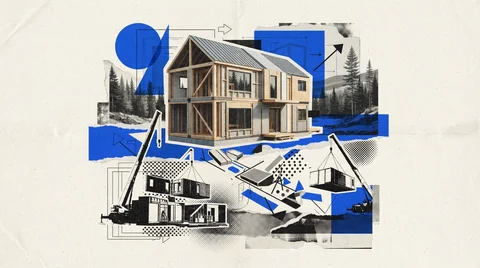
On July 2, Premier Christine Fréchette announced a new stream of the Financement d'infrastructures en eau pour la réalisation d'habitations (FIERH) program. According to media reports, the announcement was made right on a factory floor, at Locusi in Saint-Narcisse, in the Mauricie — a manufacturer of prefabricated multi-residential buildings. The symbolism was lost on no one: Quebec is not just funding houses, it is pointing at a construction method. We cover the regional context of this sector in our page on modular housing in the Mauricie.
What the billion actually pays for
An important clarification: the program does not subsidize home purchases. It funds the thing that, in many municipalities, blocks everything else — the municipal water and sewer infrastructure needed to open new residential neighbourhoods.
It is a targeted choice. In small and mid-sized municipalities, the number-one brake on development is often neither land nor demand: it is the cost of extending services. A water main runs into the millions, and few municipal councils can absorb that for a neighbourhood that does not yet exist. By picking up that bill, Quebec removes the first domino. Our modular construction guide for municipalities explains precisely how a project moves from the urban plan to the excavator.
In return, participating municipalities will have to spread the payment of transfer duties — the infamous "welcome tax" — over at least three years, one more boost for first-time buyers.
The conditions: $350,000, two bedrooms, 75%
For a neighbourhood to qualify, the announced rules are clear-cut:
- homes must sell for under $350,000;
- they must have at least two bedrooms;
- at least 75% of the residential units in the neighbourhood must respect the $350,000 threshold.
That last figure is the program's lock: no slipping three "affordable" homes into a high-end development and pocketing the aid. The whole neighbourhood has to aim at the first-time buyer.
Is a $350,000 threshold realistic for a new home with two or more bedrooms? In conventional construction, in many markets, barely. That is precisely where prefab comes in: standardization and factory manufacturing are just about the only known levers for delivering new construction at that price. Our analysis of modular home prices details what fits — and what does not — inside an envelope like that.
September 18: the clock is ticking for municipalities
The project call is open to every region of Quebec, and the submission deadline is September 18, 2026. For a municipal council, that is short: two and a half months, in the middle of summer, to identify a site, validate network capacity, assemble a file, and adopt the necessary resolutions.
Municipalities that move fast have a head start — and some have been in the race since spring. Those still hesitating will find, in our article on the municipalities becoming housing heroes, examples of councils that got ahead of the pack, and what it earned them.
A trial balloon floated in the Beauce back in May
The July 2 announcement did not come out of nowhere. As early as May 25, the Minister of Municipal Affairs and MNA for Beauce-Sud, Samuel Poulin, was sketching its outline: neighbourhoods of affordable prefabricated homes under $350,000, minimum two bedrooms, with a program that would fund water infrastructure. "In the Beauce, we've been around prefab for a long time. We know these are quality homes," he argued at the time.
The minister also raised a speed argument: a prefabricated home takes four to six weeks to build in the factory. (Exactly what those weeks cover — and what remains to be done on site — is something we take apart in our article on the myth of the house built in four days.)
Above all, municipalities were already raising their hands before the official launch: Saint-Gédéon-de-Beauce and La Guadeloupe, in Chaudière-Appalaches, along with others in Lanaudière, the Laurentides, the Estrie, and the Quebec City region. In other words, the program is landing in a market that was waiting for it.
Prefab makes the evening news
One last signal, and not the least: on the evening of the announcement, Radio-Canada's Téléjournal Québec ran the headline "Feu vert aux quartiers de maisons préfabriquées" — green light for prefab home neighbourhoods. When the factory-built home leads the public broadcaster's prime-time newscast — not as a curiosity, but as public policy — the subject has changed status.
For organizations, developers, and municipalities, this funding mechanism joins a toolbox that is growing fast: PHAQ, federal funds, Canada-Quebec agreements. Who pays for what and how the programs stack is summed up, jargon-free, in our guide to funding affordable modular housing.
Is your municipality staring at the September 18 deadline wondering where to start — or would your organization like to price out a prefab neighbourhood project? We can prepare a quote together, and the municipalities guide gives you a solid head start.
8Module
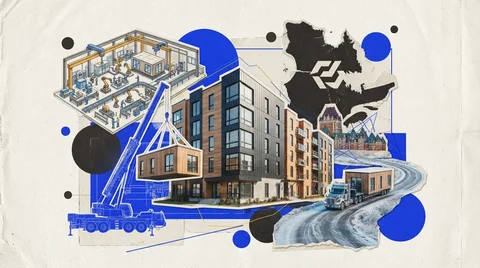
Modular multi-residential buildings (6 to 24+ units) factory-built in Quebec.
Visit websiteCommercial partnership — we receive compensation. Disclosure
Comments
A question or comment on this article? The comments section will be enabled soon.