Non-profit · 7 min
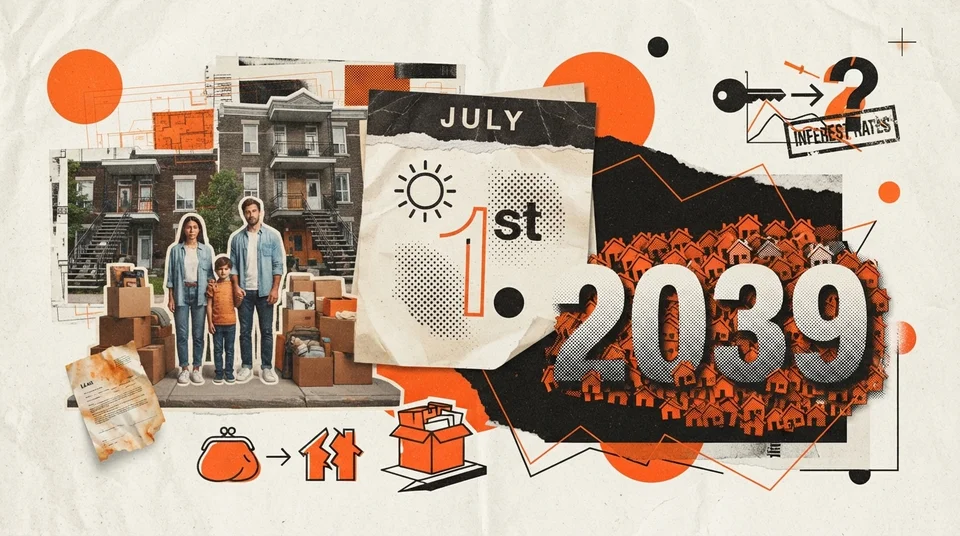
2,039 Households Without a Lease on July 1: The Crisis Changes Face
In short — The day after July 1, 2,039 tenant households were still without a lease and being assisted by support services, according to SHQ data reported by the media — more than last year, even as the vacancy rate climbs back up. Meanwhile, nearly a third of the social housing stock is reportedly rundown, and the political parties are no longer talking about a shortage, but about affordability. Portrait of a crisis changing its face, without changing its victims.
Every year, July 1 serves as a thermometer for Quebec's housing crisis. The 2026 verdict comes down to two numbers that, in theory, should not coexist: more vacant units — and more households without housing.
The 2026 moving-day paradox
According to Société d'habitation du Québec data reported by the media, 2,039 tenant households were being assisted by housing-search support services the day after moving day — versus 1,899 at the same point last year. An increase, then, even as the vacancy rate recovers: according to the same reports, it reached 2.9% in the Montréal metropolitan area in 2025 (versus 2.1% in 2024) and 2.4% in the Quebec City area.
The market is easing and the line is getting longer: that is the paradox. The explanation, housing-assistance groups keep repeating, is that building apartments does not fix affordability when almost everything new rents above the means of the households doing the searching. The vacant units exist; they are just not in the right price ranges. We broke down this quartile mechanism in the housing crisis explained simply, and the numbers dashboard is in the 5 numbers of the housing crisis in 2026.
The other crisis: the stock we already own is falling apart
While we count the homes yet to be built, a quieter file is advancing: the state of the ones we have. According to media reports, nearly a third of Quebec's social housing stock — in the order of 21,500 units — is rundown. Mould, water damage, boarded-up units in Montréal public housing: the picture being reported is not that of an aging stock, but of a stock left to decline.
Governments are not ignoring the problem: Quebec and Ottawa have reportedly set aside $3.6 billion to repair the social housing stock by 2028, including more than $1.3 billion already allocated or spent, and the SHQ says it can cover the billion-plus in renovations needed to bring the whole stock up to standard. Tenant groups, for their part, fear inflation will eat away at those budgets — and the federal agreements funding these buildings' operations expire by 2028. For units rented at 25% of household income, every condemned door is a door no private market will replace. Where all this public money goes, and why more housing does not come out of it: our report on the housing billions and where the money goes follows the trail.
The parties are changing their vocabulary
The third shift is political. The Quebec Liberal Party now argues that the housing crisis has morphed into an affordability crisis: housing exists, but units labelled "affordable" rent for more than $1,600 per month. The party is putting forward numbered commitments — build 100,000 homes per year, rebate the QST on new homes, simplify regulation and shorten approval timelines, hold a summit on homelessness. Its leader, Charles Milliard, sums it up by saying a home is first and foremost the chance to build a life; its housing critic, Virginie Dufour, insists the crisis is not behind us.
Let's be clear about what needs to be: these are the positions of an opposition party, not neutral data, and the government is hardly standing still — it just launched its own big build, a nearly $1B stream for prefab home neighbourhoods. What stands out is the convergence: no one disputes the crisis anymore, and everyone is promising volume.
The reality test: 100,000 homes a year — how?
And this is where vocabulary meets construction. Promising 100,000 homes per year — roughly double the record pace of recent years — is not a policy until you say how. With conventional methods, the available labour force, and our winters, the arithmetic does not work; we showed it figure by figure in our report on modular construction and the housing crisis.
Whichever party is in power, every volume promise will eventually run into the same question: where are the workers and the job-site months? Factory construction is not a magic wand — it does not repair rundown public housing and does not cap rents — but it is one of the few documented levers for producing more housing with the same workforce, as we explain in solving the crisis with factory-built homes. And nowhere is the need more acute than in Montreal, where the full picture is in our page on modular housing in Montreal.
Does your organization or municipality want to turn these findings into a concrete project? We can prepare a quote together — and our report on modular construction and the housing crisis gives you the straight goods on what the method can deliver, and what it cannot.

8Module
Modular multi-residential buildings (6 to 24+ units) factory-built in Quebec.
Visit websiteCommercial partnership — we receive compensation. Disclosure
Frequently asked questions
How many households were without a lease after July 1, 2026 in Quebec?
Why does the crisis continue if the vacancy rate is climbing back up?
What condition is Quebec's social housing stock in?
Sources
- Quebec rental market after July 1 moving day — CBC News (Montréal)
- A third of Quebec's social housing stock in disrepair — CBC News (Montréal)
- Quebec Liberals say housing crisis is now an affordability crisis — The Pulse of the Eastern Townships
Comments
A question or comment on this article? The comments section will be enabled soon.