
Non-profit · 6 min
The Housing Crisis Explained to Your Skeptical Brother-in-Law
In short — Yes, the housing crisis is real, and no, it is not fixed because "places rent slower than they used to." The market has eased on the surface — vacancy back up to 2.9% in Quebec's urban centres in 2025 — but affordable units remain nearly impossible to find, and in 2023 CMHC put Quebec's deficit at roughly 860,000 homes by 2030. Here is enough to hold your own through the whole family dinner.
You know the scenario. Somewhere between the pâté chinois and dessert, someone drops: "Come on, a housing crisis? My neighbour listed his two-bedroom and only got three calls in two weeks. In my day, it was gone in two days. The crisis is over."
Breathe. Pass him the salt. And serve him what follows.
The game of musical chairs
The rental market is one big game of musical chairs. The vacancy rate is the number of empty chairs when the music stops. In October 2025, according to CMHC, there were 2.9 free chairs per 100 in Quebec's urban centres — versus 1.8 the year before. So much for the brother-in-law's neighbour: yes, there are a few more chairs than before.
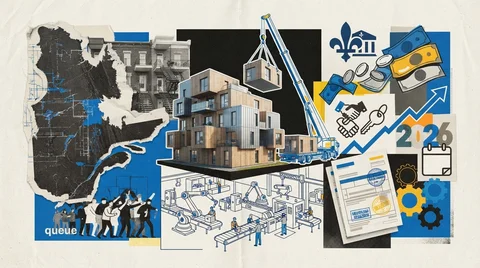
Except the chairs are not equal. In Montreal, in the most affordable rent quartile, the vacancy rate was 1.3%. In the most expensive quartile: 4.9%. In other words, the free chairs are almost all Italian leather armchairs. The chairs ordinary people can afford are still taken — with a lineup behind each one. In Quebec City, same picture: 2.4% on average, but around 1% in the affordable segment.
FRAPRU summed it up in a phrase worth repeating over dessert: the shortage is easing, but the crisis is deepening. We are building — a lot, even — but mostly expensive new units. The market easing is real; it just never reaches the people who need it most.
And meanwhile, the music is speeding up. The average rent for a two-bedroom in the Montreal region hit $1,346 per month in October 2025, up 7.2% in one year, according to CMHC. For the terms that raise eyebrows — vacancy, CMA, quartile — our modular construction and housing glossary translates it all into kitchen-table language.
The 860,000-chair hole
Now the brother-in-law will say: "OK, but how many homes are we actually short?"
Good question. In 2023, CMHC estimated Quebec would need roughly 860,000 more homes by 2030 to get back to affordability — not to put everyone in a castle, just to return to a market where housing does not eat half the paycheque. The figure dates from 2023 and the federal methodology has since been revised, but the order of magnitude is anything but subtle: we are talking hundreds of thousands of units. Quebec, for its part, set a target of 560,000 new homes by 2034 in its Stratégie québécoise en habitation.
To give a sense of the lineup: more than 30,000 households were waiting for social housing in Quebec according to the most recent compilations. Not 30,000 people who "would like a bigger balcony." Thirty thousand households waiting for a social housing unit.
"Just build more": yes, but
This is where the brother-in-law plays his trump card: "Just build more."
He is not wrong on principle. He is just underestimating the order. In 2024, Quebec recorded about 48,700 housing starts — up 26% over 2023, a genuinely good year. And yet, according to APCHQ, that pace would need to roughly quadruple to close the deficit by 2030. Not increase by 10%. Quadruple.
And you do not quadruple an industry by snapping your fingers. You need workers — and construction is chronically short of them. You need serviced land, permits, financing that arrives before the developer retires. And you have to deal with a distinctly local detail: winter, which freezes job sites for months. Build more, yes. But with the same methods, the same workforce, and the same climate, the equation does not balance.
The folding chair that comes out of a factory
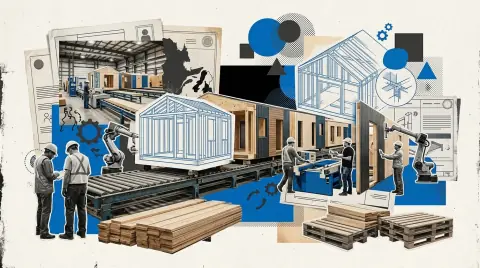
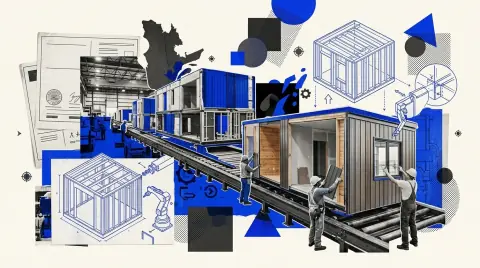
This is where factory construction enters the game — not as a magic wand, as a multiplier. While the foundation is poured on the land, the modules advance under a roof, in parallel. The documented result: McKinsey estimated as early as 2019 that modular cuts project timelines by 20 to 50%, and a field study funded by the U.S. Department of Energy (more than 50 multifamily buildings compared) measured deliveries 25 to 30% faster on average. In Quebec, the star case is called Rimouski: 155 student housing units delivered in about ten months — the full case study is in our piece on modular student housing in Rimouski.
Honesty requires it: the factory fixes neither land prices, nor zoning, nor financial structuring. It makes chairs faster; you still need the right to set them down somewhere and the means to pay for them. For the complete picture — what modular can deliver and what it cannot — our report on modular construction and the housing crisis covers it without selling dreams, and the guide to funding affordable modular housing explains who pays for what. As for the brother-in-law's prejudices about prefab — "those are trailers, right?" — we dismantle them one by one in the myths of modular construction.
Next time the music stops at dinner, you will know what to answer. And if your organization, your co-op, or your municipality is looking for more chairs — shall we look together?

8Module
Modular multi-residential buildings (6 to 24+ units) factory-built in Quebec.
Visit websiteCommercial partnership — we receive compensation. Disclosure
Frequently asked questions
Vacancy is going back up: is the housing crisis over?
How many homes is Quebec short?
Why not simply build more?
Sources
- Rental Market Report 2025 — CMHC — Canada Mortgage and Housing Corporation
- Housing Shortages in Canada — Updated Housing Need Estimates to 2030 — CMHC — Canada Mortgage and Housing Corporation
- Stratégie québécoise en habitation — Gouvernement du Québec
- Mises en chantier 2024 : une année pleine de rebondissements — APCHQ / Québec habitation
- Analyse du Rapport sur le marché locatif 2025 — FRAPRU
- Modular construction: From projects to products — McKinsey & Company
- Modular Multi-Family Construction: A Field Study — Modular Building Institute (study funded by the U.S. DOE)




Comments
A question or comment on this article? The comments section will be enabled soon.