Non-profit · 6 min
We Build Cars in Factories. Why Not Homes?
In short — Because people long believed it was lower quality, worse-looking, and harder to finance — three assumptions that no longer hold. Factory construction delivers projects 20 to 50% faster according to independent studies, meets mandatory certified standards in Quebec, and since May 2026, CMHC insures it across all its products. The real question is no longer "why build homes in a factory?" but "why so few?"
Try a thought experiment. A dealer offers you two identical cars. The first was assembled in a heated factory by teams who repeat the same motions all day long, with quality checks at every station. The second was put together outside, in a driveway, in November, by a different crew than the one that built the previous model, between two downpours. Same price.
You're laughing — but you've just described the housing market. The driveway car is the standard Quebec home. And the strangest part is that we find it perfectly normal.
The assembly line — old idea, new urgency
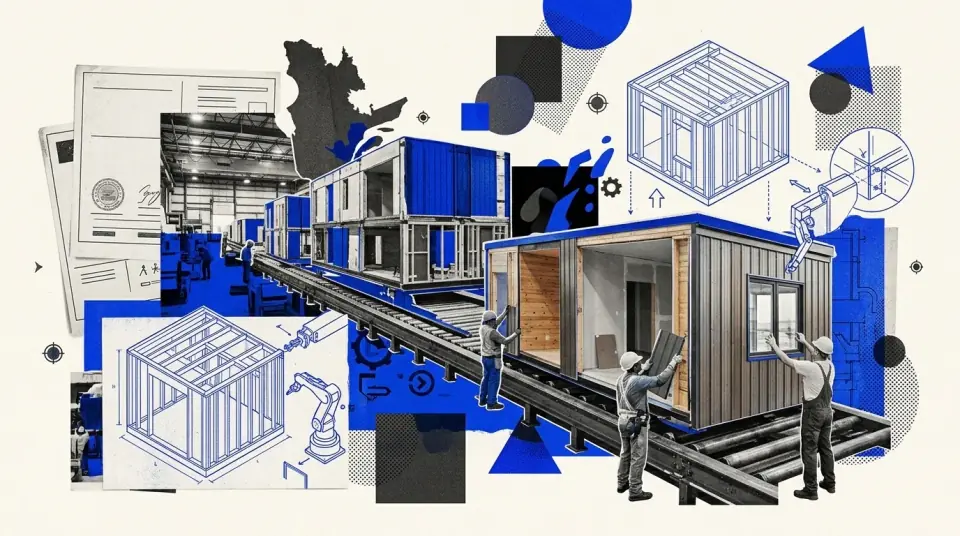
A modular construction factory is not a warehouse where people nail faster. It is an assembly line: the building moves from station to station while the workers, tools and materials stay put. La Presse visited a factory in Beloeil in December 2025: a 16-station line that produces, according to the manufacturer, a module containing two 500 sq ft units in roughly 32 hours — plumbing, wiring and kitchen cabinets included.
Thirty-two hours. The time it takes, on a conventional site, just to wait for drywall delivery.
While the modules advance inside, the foundation is poured outside. The two processes run in parallel rather than in sequence — that is precisely where the time is saved. (For the distinctions between modular, panelized and factory-built, our glossary sorts it out without jargon.)
"Yes, but is it actually faster?"
It is not just the manufacturer saying so — or rather, not only the manufacturer. McKinsey found as early as 2019 that modular construction cuts project timelines by 20 to 50%. A field study funded by the U.S. Department of Energy, comparing more than 50 real multi-family buildings, measured deliveries 25 to 30% faster on average. And CMHC cited a verified Canadian case in May 2026: in Calgary, 84 affordable units built and occupied in under a year, while a comparable conventional project in the same neighbourhood took nearly two years.
In Quebec, the headline example is Rimouski: 155 student housing units delivered in roughly ten months, first tenants in on July 1, 2025. "We estimate we're saving at least half the construction time," said the CEO of UTILE, the non-profit behind the project — a satisfied developer, so take it as such, but the dates are public record. The full case study is here.
"Yes, but is it cheaper?"
Here is where we refuse to sell you a dream. No, the factory does not cut the bill in half. Independent studies put direct savings at 0 to 20% depending on the market and scale — McKinsey said "up to 20%" for operators optimizing at volume. In some contexts it is cost parity. The factory builds your home faster; it does not negotiate your land price, your zoning or your mortgage rate.
The reliable gain is time — and in construction, time is money that has stopped hiding: fewer months of bridge financing, fewer weather delays, fewer seasonal surprises. For a non-profit or a developer, the guide to funding affordable modular housing lays out how that calculation works.
"Yes, but what about quality?"
The brother-in-law objection — the same one who doubted the housing crisis, which we've already addressed here. Short answer: in Quebec, a factory-built building cannot be sold, rented or transferred without CAN/CSA-A277 certification, per the RBQ, and the factory itself must be certified. The seal confirms conformity with the codes applicable where the home will be placed. The DOE field study measured energy performance equal to or better than comparable site-built buildings. A home assembled out of the rain has never had rain in its walls — obvious, but it counts as an argument. The other preconceptions get put through the wringer in the myths of modular construction.
So why so few?
Because three barriers held for a long time, and they have just come down almost simultaneously.
Financing first: lenders were wary of a building paid for before it existed on the lot. But since May 7, 2026, after a pilot program of more than 800 modular rental units, CMHC insures modular multi-unit buildings across all its products and has launched a product for buyers with 5% down. Then governments: Maisons Canada, launched in September 2025 with $13 billion, explicitly prioritizes prefabricated construction — its first initiative covers roughly 4,000 homes across six sites, including Longueuil. Quebec, for its part, has selected 566 highly prefabricated units since 2025; the 26 units of Projet Acadie in Montreal were completed in under 12 months, permits included.
The third barrier remains: us. Habit, zoning, the reflex that finds it normal for a house to be built in the rain. Meanwhile, CMHC estimated in 2023 that Quebec's housing shortfall would reach roughly 860,000 units by 2030, Quebec is targeting 560,000 new homes by 2034, and the APCHQ calculates that the 2024 pace — a solid year, at about 48,700 housing starts — would need to roughly quadruple. You do not quadruple a pace using the same methods, the same hands and the same winter. The full picture is in modular construction and the housing crisis. Quebec manufacturers specializing in multi-unit housing, such as 8Module, are contributing to this pipeline — projects from 6 to 24 units up to 100 units and more per the manufacturer.
Disclosure — 8Module is a commercial client of Modulaire Québec; we receive compensation when we refer a lead. This content remains editorial and independent — 8Module neither commissioned nor reviewed it. Full disclosure.
Your car came out of a factory. So did your phone. Your future neighbours might too. And if your organization, your co-op or your municipality wants to see what a factory can deliver in your community — shall we take a look together?

8Module
Modular multi-residential buildings (6 to 24+ units) factory-built in Quebec.
Visit websiteCommercial partnership — we receive compensation. Disclosure
Frequently asked questions
Is a factory-built home cheaper?
Is the quality of a factory-built home truly equivalent?
If it's this efficient, why isn't it more common?
Sources
- Modular construction: From projects to products — McKinsey & Company (2019)
- Modular Multi-Family Construction: A Field Study — Modular Building Institute (étude financée par le U.S. DOE)
- Certification des bâtiments usinés (CAN/CSA-A277) — Régie du bâtiment du Québec
- La SCHL élargit son assurance prêt au préfabriqué et au modulaire — SCHL (7 mai 2026)
- Des logements construits… en 32 heures — La Presse (20 décembre 2025)
- Le chantier à la vitesse supérieure à Rimouski (logement étudiant UTILE) — Radio-Canada (janvier 2025)
- Prime Minister Carney launches Build Canada Homes — Cabinet du premier ministre (14 septembre 2025)
- Construire autrement et plus rapidement : la voie du hautement préfabriqué est maintenant tracée — Gouvernement du Québec (22 août 2025)


Comments
A question or comment on this article? The comments section will be enabled soon.