
Residential · 7 min
Is Your Land Ready? The Test Before Ordering Your Home
In short — Before you order a modular home, your land must pass five checks: (1) the zoning allows your project, (2) the soil supports a foundation (soil study), (3) the convoy and crane can reach the site, (4) the services are available (water/sewer or well/septic), (5) no environmental constraint blocks it (shoreline buffer, wetland). A lot that fails these tests turns a simple project into a headache.
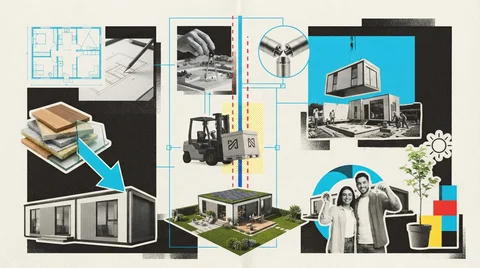
Modular has one particularity that traditional construction does not: your house arrives on a truck and is set in place by crane. The land therefore has to be ready to receive it. Here is the test to run before signing for a house.
The 5-point checklist
| # | Check | Why |
|---|---|---|
| 1 | Zoning | Does the municipality allow your project (use, dimensions, setbacks, height)? |
| 2 | Soil | A soil study confirms the foundation type and its cost |
| 3 | Convoy + crane access | Width, turns, load capacity of the road; space for the crane |
| 4 | Services | Municipal water/sewer, or well + septic system in rural areas |
| 5 | Constraints | Shoreline buffer, wetland, steep slope, servitudes |
1. Zoning: the first question
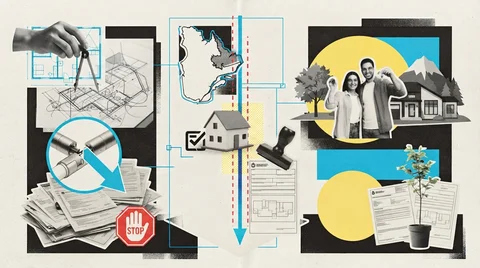
Before anything, confirm with the municipality that your project is allowed: residential use, siting, setbacks, height. A gorgeous lot with the wrong zoning is useless. See also building permit in Quebec.
2. The soil: what hides underneath
A soil study determines the type of foundation needed and avoids surprises (unstable soil, bedrock, water table). It is a small investment that protects a big budget.
3. Access: the point specific to modular
Here is where modular differs. Your house travels in sections on a convoy, and modules are lifted by crane. The road must be wide enough, bear the weight, and offer passable turns. On site, you need room for the crane. In a rural area or on a hard-to-reach lot, validate this point very early — it is often the deciding factor.
4. Services: town or country
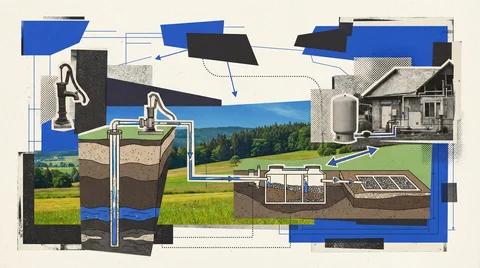
In town, water and sewer often run to the edge of the lot. In rural areas, plan for a well and a septic system — a cost and planning item in its own right, detailed in wells, septic systems and hookups in rural areas.
5. Environmental constraints
A shoreline buffer near a watercourse, a wetland, a steep slope, servitudes: these elements can limit or prohibit construction on certain parts of the lot. Check them before buying or ordering.
Worth remembering — The land conditions the project, not the other way around. Run this test before ordering the house — it is the logical order, detailed in land or home first and where to start.
Sources: Régie du bâtiment du Québec (Construction Code and zoning). Guide written by Jeremy Soares. Last updated: June 26, 2026. Zoning must be confirmed with the municipality.

8Module
Modular multi-residential buildings (6 to 24+ units) factory-built in Quebec.
Visit websiteCommercial partnership — we receive compensation. Disclosure
Frequently asked questions
What kind of lot suits a modular home?
Why is access so important for modular?
Is a soil study necessary?
What if the lot has no municipal water?
Sources
- Code de construction du Québec et zonage — Régie du bâtiment du Québec (RBQ)




Comments
A question or comment on this article? The comments section will be enabled soon.