
Non-profit · 6 min
1,650 Affordable Housing Units Announced in Montreal: Eight Projects Waiting on a Federal Green Light
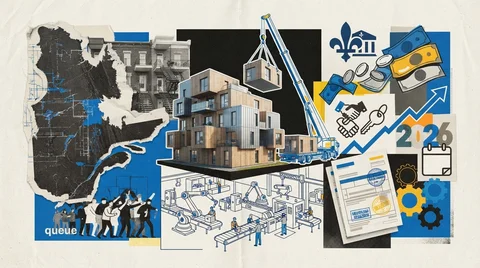
In short — Quebec and the City of Montreal have selected eight projects totalling 1,650 affordable housing units, from the Namur-Hippodrome site to the old Molson brewery. One piece of the puzzle is missing, and it is the big one: financial approval from Build Canada Homes, the new federal agency, without which no construction date exists. Here is what was announced, what is holding it up, and why the prefab world should watch closely.
Montreal had not seen a housing announcement on this scale in a long time: eight projects selected under Quebec's affordable housing program (PHAQ), 1,650 units in total, spread across the city, La Presse reported in mid-July. The biggest piece: 477 units on the Namur-Hippodrome site — Montreal's former racetrack — to be managed by Société Patrimoine Angus résidentiel.
Then come the old Molson brewery (374 units), Young Street (423), Coulée Grou (220), and projects on Connaught, Sicard, Papineau and de Gaspé streets. The addresses tell a story of their own: former industrial sites and long-awaited urban lots finally being put back into circulation for non-market housing.
The bottleneck: a federal signature
The nuance that changes everything fits in one sentence: construction could begin within the year — in the conditional. All eight projects still need financing from Build Canada Homes, the new federal housing agency, and until that approval is signed, nobody knows when shovels hit the ground.
This is the new face of affordable-housing finance in Canada: Quebec selects through the PHAQ, cities contribute land and levers, and Ottawa — now through its agency — holds the last pen. The federal housing minister's parliamentary secretary, Caroline Desrochers, sounded reassuring about timelines at the announcement, and Quebec's housing minister, Karine Boivin Roy, saw it as proof the government's financial levers deliver. Still, stacked approvals are precisely what stretches housing timelines, as we documented in our analysis of where the housing billions go.
Three other Montreal projects, smaller but further along, show what the next step looks like: through an agreement between the Société d'habitation du Québec and Build Canada Homes, 109 units are advancing. The Éthel project by Réseau habitation femmes Montréal in Verdun — 20 units for people experiencing or at risk of homelessness — and the 18 units of the John Howard Society of Quebec on Notre-Dame Street East are entering construction; the Ricochet emergency-housing project in Pierrefonds still has a few steps to clear. In all, five of the eleven projects discussed include a homelessness component.
Why the prefab industry should follow this file
An honest caveat first: nothing in the announcement says these projects will be modular. But two things make this file a test case for prefabrication — and this is our reading, not La Presse's.
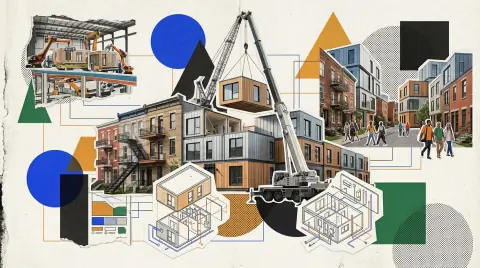
First, the schedule. When financing finally lands after months of waiting, every week saved on site counts double. Montreal has already seen what the approach can do: the L'Acadie project, delivered in 12 months, remains the local proof that a non-market building can rise in a year when most of the work happens in a factory. Across 1,650 units and eight sites, the potential gain adds up to years of rent.
Second, the federal signal. Build Canada Homes has a declared preference for modern construction methods — prefab first among them — in its own projects. A developer or nonprofit that walks in with a costed prefab proposal is speaking the funder's language. Our guide to financing affordable modular housing covers how to structure that kind of file, and our Montreal state of play maps what the city already has in motion.
Is your organization preparing a project and wants the prefab option costed before filing? We can prepare a quote request together.

8Module
Modular multi-residential buildings (6 to 24+ units) factory-built in Quebec.
Visit websiteCommercial partnership — we receive compensation. Disclosure

Comments
A question or comment on this article? The comments section will be enabled soon.