Multi-residential · 9 min
Pooling Municipalities to Build: The Housing Portfolio Model, Step by Step
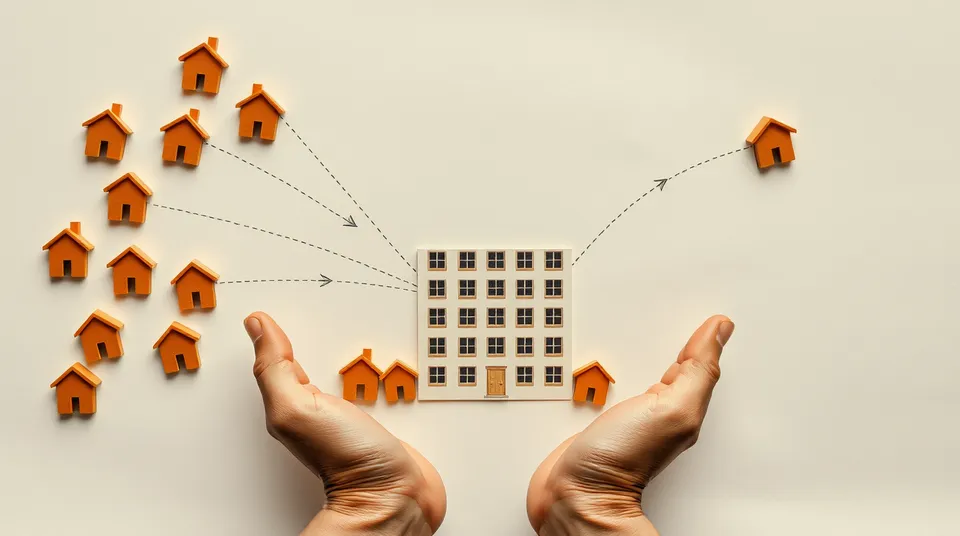
In short — A municipality of 800 residents that is short eight apartments will never convince a factory, a ministry or a lender on its own. Seventeen municipalities in eastern Quebec understood this and pooled their needs under a single nonprofit — the result: 478 housing units in one stroke, at about $313,000 per door according to the organization, roughly half the average cost of Quebec-backed projects in the region. Here is how the housing portfolio mechanism works, and the steps to reproduce it in your RCM.
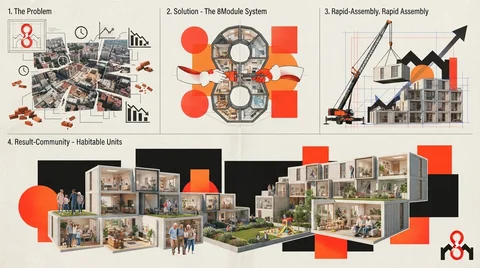
The problem is almost never the need — it is glaring, as we document in our analysis of why rents are exploding in the regions. The problem is scale. An isolated six or twelve-unit project in a small municipality stacks up every handicap at once: no purchasing power with manufacturers, no negotiating leverage with lenders, and a broken regional supply chain where every trade travels far for little work. Taken one by one, these projects never pencil out, and they die in a filing cabinet.
The contract reported by La Presse on August 22, 2026 shows the way out: the Société de développement de l'Est (SDE), a nonprofit, pooled the needs of 17 municipalities across Bas-Saint-Laurent, Gaspésie, the Côte-Nord and Outaouais into a single order of 478 prefabricated units — one of the largest contracts of its kind in Quebec history, according to the people behind it. We broke down the project itself in our article on the SDE's 478-unit contract; this one is about the mechanism, and what an RCM, a table of prefects or a housing nonprofit can take from it.
Why small isolated projects never make it
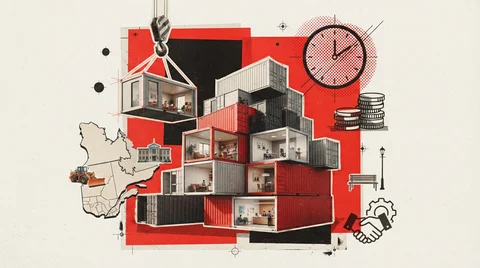
Three walls stand in front of a municipal six-to-twelve-unit project:
- The price wall. A twelve-unit order pays one-off prices: no volume to amortize, no factory production run, full mobilization for a small site. The average cost of Quebec-backed construction approached $600,000 per door last year in Gaspésie, according to La Presse — at that price, the resulting rents are no longer affordable without massive subsidies.
- The attention wall. A twelve-unit file weighs little in a queue of ministry applications. The municipality has no housing department and no project officer to carry it for years.
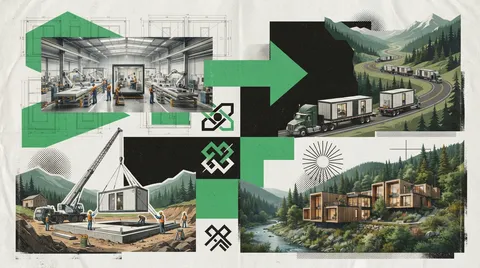
- The labour wall. Outside the big cities, little competition among contractors and crews that travel far inflate bids — when there are bidders at all. That reality is what pushed the SDE toward prefabrication, where most of the work happens in a factory, as we explain in our guide to the modular multiplex.
Every wall falls as the order grows. That is the whole idea of the portfolio.
The portfolio mechanism, piece by piece
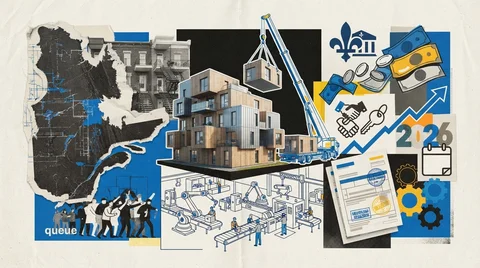
The eastern Quebec structure, as reported by La Presse, rests on five interlocking pieces:
- A single carrier. A nonprofit created for the purpose owns the buildings, manages the rents and signs the contracts. The municipalities do not become developers; they contribute.
- Municipal contributions in kind. The 17 municipalities provide the land for free and grant the nonprofit a property tax holiday of 20 to 30 years. None had to put up millions — their contribution is land and fiscal patience.
- Layered financing. In the SDE case: $13.6 million in subsidies from Quebec, about $3 million from the municipalities, an even larger but undisclosed contribution from Build Canada Homes, and low-rate loans from both levels of government. The typical layering is detailed in our guide to financing affordable modular housing.
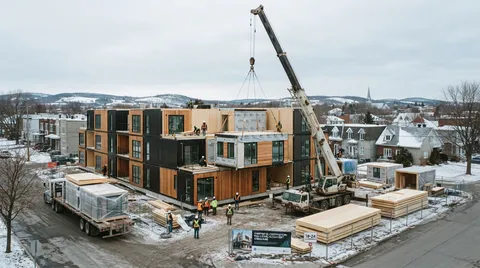
- One manufacturing order. Instead of 17 calls for tenders, a single 478-unit contract handed to manufacturers able to produce in series. The lion's share — 342 units — goes to 8Module, acting as integrator: prequalified factories produce the modules, and the client receives a firm price and delivery date guarantee, a rarity in this industry.
- Internal equalization. An average of 24 units per municipality: the smallest files, unfundable alone, travel in the same portfolio as the largest.
Disclosure — 8Module is a commercial client of Modulaire Québec; we receive compensation when a referral is made. This content remains editorial and independent — 8Module neither commissioned nor reviewed it. Full disclosure.
Step by step: reproducing the model in your RCM
What follows is our editorial reading of the model — not a how-to published by the SDE. The steps overlap with what we detail in our modular construction guide for municipalities.
1. Measure the needs, municipality by municipality. Six units here, eight there, twelve elsewhere: the portfolio starts with an honest inventory, ideally carried by the RCM or the table of prefects. The SDE portfolio itself grew out of discussions among Gaspésie's prefects, according to La Presse. Document what type of housing is missing — families, seniors, workers — because the building format depends on it, as we show in our report on workforce housing in the regions.
2. Secure the land before chasing the money. A municipal lot handed over for free, already zoned and serviced, is gold in a financing package: it lowers the cost per door and proves local commitment. The long property tax holiday is the other municipal lever — it costs little in the short term and changes the project's economics over 30 years. Our open letter to municipalities makes the case: affordable housing starts in your backyard.
3. Structure the carrier nonprofit. A credible board, a director able to talk to ministries and factories alike, and a clear mandate: own, finance, rent. The nonprofit signs everything — the municipalities remain contributors.
4. Build the financing in layers. Provincial subsidy, federal contribution, municipal in-kind support, low-rate loans: no single layer is enough, and each unlocks the next. Budget years of advocacy — it took the SDE years to convince the authorities to fund a model no one had proven at this scale, again according to La Presse.
5. Choose the production mode, and demand guarantees. At portfolio scale, prefabrication becomes almost unavoidable: it is what turns volume into savings. At contract time, the two clauses that protect a nonprofit are the price guarantee and the delivery date guarantee — precisely what the SDE portfolio's integrator offers its client.
6. Plan the leasing from day one. The SDE portfolio targets deliveries mostly from spring 2027 and full occupancy by early 2028, according to the organization's plans. The resulting rents — from $700 for a one-bedroom to $1,100 for a three-bedroom in this case — are set at the financing stage, not after delivery.
The pitfalls to plan for
- Political time. Convincing ministries to entrust millions to an unproven model takes years, not months. The portfolio survives elections only if the whole RCM carries it.
- The real cost of the tax holiday. Twenty to thirty years of foregone property taxes is a genuine budget sacrifice for a small municipality — justified by what housing brings back (families, workers, schools that stay open), but it should be voted with eyes open.
- The per-door target. The SDE case's $313,000 holds because volume, free land and prefabrication are combined. Remove one piece and the number climbs fast.
- Depending on a second wind. A successful portfolio calls for the next one — the SDE is already preparing a second, which could reach other Quebec municipalities and New Brunswick, at a target pace of one per year. Plan the sequel while building the first.
Does your RCM, table of prefects or nonprofit want to price out a portfolio while the programs are open? We can prepare a quote request together.

8Module
Modular multi-residential buildings (6 to 24+ units) factory-built in Quebec.
Visit websiteCommercial partnership — we receive compensation. Disclosure


Comments
A question or comment on this article? The comments section will be enabled soon.