Non-profit · 8 min
Build Canada Homes and Prefab Housing: What the New Federal Agency Funds in Quebec
In short — Since September 2025, the federal government has had an agency dedicated to building affordable housing: Build Canada Homes (Maisons Canada), with a reported $13 billion in initial capital and an explicit preference for prefab. Its first concrete moves: up to 4,000 direct-build homes on six federal sites — including 1,055 in Longueuil — and contributions to regional portfolios like eastern Quebec's 478 modular units. Here is what the agency actually does, and how a Quebec nonprofit, co-op or municipality can position itself.
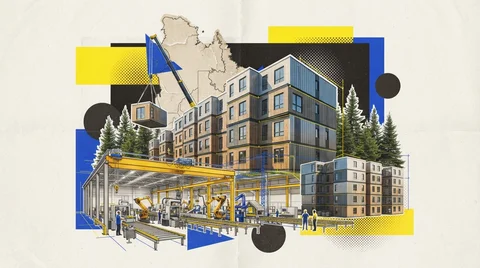
Quebec spent the last few years building its own prefab housing machine — the PHAQ and its highly prefabricated stream, whose progress we track through the SHQ's 500 prefab units and the first 336 units expected. Since September 14, 2025, a second machine has been running in parallel, this one federal: Build Canada Homes, launched with a mandate to build affordable housing at scale rather than merely subsidize it.
The nuance matters. CMHC finances and insures; Build Canada Homes also acts as a developer: it mobilizes federal public land, orders housing, and states an explicit preference for modular and prefabricated methods, Canadian lumber and Canadian workers. For a Quebec prefab industry already accelerating — the context is laid out in our report on the housing crisis and modular construction — that is a second major buyer opening its order book.
What Build Canada Homes is, in three dates
- September 14, 2025: the agency launches, billed as the centrepiece of federal housing policy.
- September 29, 2025: Ana Bailão, formerly Toronto's housing lead, takes office as CEO.
- Late November 2025: the national portal opens; by January 2026 the agency announced it was moving from planning to construction within the year.
On resources, law firm BLG reports $13 billion in initial capital and 88 federal properties identified as suitable for residential projects. The agency does not yet run an open-counter grant program comparable to the PHAQ: for now it works through direct construction, partnerships and contributions to projects carried by others.
The first builds: 4,000 homes, including 1,055 in Longueuil
Build Canada Homes' opening move is a direct-build order: up to 4,000 prefabricated homes on six federal sites, with a floor of 40% affordable units. The breakdown announced in January 2026:
| Site | City | Units |
|---|---|---|
| Arbo | Toronto | 540 |
| Naawi-Oodena | Winnipeg | 320 |
| Village at Griesbach | Edmonton | 355 |
| Pointe-de-Longueuil | Longueuil | 1,055 |
| Heron Road | Ottawa | ~1,100 |
| Shannon Park | Dartmouth | ~630 |
The Quebec site is the largest of the six. At Pointe-de-Longueuil, in the Longue-Rive sector on the St. Lawrence riverfront within walking distance of the Longueuil–Université-de-Sherbrooke metro station, phase one targets 1,055 units with 40% off-market; the full site is meant to carry about 5,000 units over a 10-to-15-year horizon, in partnership with the City of Longueuil and Canada Lands Company. The request for qualification (RFQ) for developers has been open since December 2025, with the first lot sales expected in 2026.
For Quebec module manufacturers, this is an unprecedented demand signal: a federal agency ordering prefab volume year after year is exactly the stable order book the industry needed to invest in factory capacity.
How it stacks with the PHAQ, the SHQ and CMHC
The practical question for a Quebec project sponsor is not "which one to choose" but "how to stack them." The typical financing structure of a Quebec affordable project — detailed in our guide to financing affordable modular housing — already combined a provincial subsidy (PHAQ/SHQ), a CMHC loan and municipal contributions. Build Canada Homes adds a fourth layer.
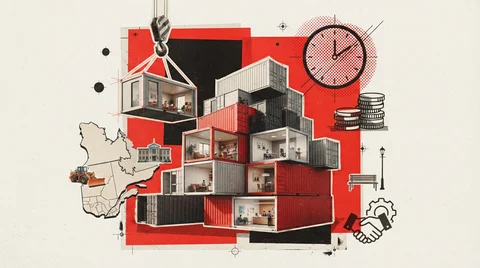
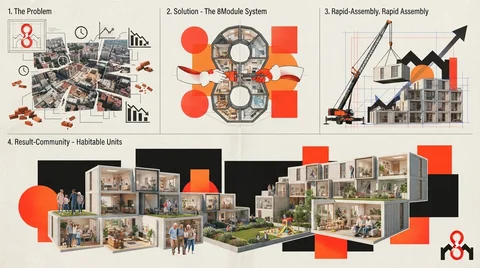
The most concrete example to date is a Quebec one: the portfolio of 478 modular units from the Société de développement de l'Est, spread across 17 municipalities in eastern Quebec. According to La Presse, Quebec is contributing $13.6 million in subsidies, the municipalities about $3 million — and Build Canada Homes an even larger contribution whose amount has not been disclosed. In other words: on the first large regional prefab portfolio in Quebec history, the federal agency is already the biggest funder. Manufacturing is led by Quebec integrators and factories, including 8Module, responsible for 342 of the 478 units.
Disclosure — 8Module is a commercial client of Modulaire Québec; we receive compensation when a referral is made. This content remains editorial and independent — 8Module neither commissioned nor reviewed it. Full disclosure.
Quebec is pushing in the same direction with the SHQ's qualification call for design-build of highly prefabricated multi-unit housing: both levels of government are converging on the same model — order big, factory-built, with prequalified partners.
What a nonprofit, co-op or municipality should prepare
Build Canada Homes works through partnerships and calls — not yet through a universal grant form. To position yourself:
- Watch the portal. Requests for qualification (like Pointe-de-Longueuil's) and calls for proposals go through the agency's national portal on the Housing, Infrastructure and Communities Canada site.
- Show up with land and a portfolio. The lesson of the SDE deal applies here too: pooled needs, secured municipal land and a tax holiday change how a file is received. Our guide for municipalities covers the preparation.
- Price in prefab from day one. The agency states its preference for modular methods; a file that arrives with a factory-built cost per door, a shortlisted manufacturer and a factory schedule speaks its language.
- Stack the layers in the right order. Provincial subsidy, municipal contribution, CMHC loan, federal contribution: each layer has its own affordability conditions — making them converge is the real structuring work.
Does your organization want to price a prefab project while both governments are placing orders? We can prepare a quote request together.

8Module
Modular multi-residential buildings (6 to 24+ units) factory-built in Quebec.
Visit websiteCommercial partnership — we receive compensation. Disclosure
Frequently asked questions
What is Build Canada Homes?
What does Build Canada Homes fund in Quebec?
Does Build Canada Homes replace CMHC?
How can a Quebec organization request funding from Build Canada Homes?
Why is the agency betting on prefab?
Sources
- Maisons Canada : des milliers de logements sont prévus (news release, January 2026) — Government of Canada
- Maisons Canada accélère la construction de logements abordables à Longueuil (news release, December 2025) — Government of Canada
- Build Canada Homes' first moves: 4,000 direct-build units — BLG (Borden Ladner Gervais)
- Maisons Canada lance la qualification pour un vaste projet de logements abordables à Longueuil — Portail Constructo
- Est du Québec : près de 500 logements abordables verront le jour — La Presse
- The SHQ launches a qualification call for design-build of highly prefabricated multi-unit housing — Gouvernement du Québec
Comments
A question or comment on this article? The comments section will be enabled soon.