Non-profit · 8 min
478 Modular Housing Units for 17 Municipalities: The Contract Changing the Scale of Eastern Quebec
Disclosure — 8Module, which is building the majority of the housing units described here, is a commercial partner of this site: we receive compensation when relevant quote requests are forwarded to it. This article remains editorial — 8Module neither commissioned nor reviewed it — but read it knowing that connection. Details.
In short — Seventeen municipalities across Gaspésie, Bas-Saint-Laurent, Côte-Nord and Outaouais pooled their needs under a single nonprofit, the Société de développement de l'Est, and landed 478 affordable prefab housing units in one stroke — one of the largest contracts of its kind in Quebec history, according to the people behind it. Target cost: about $313,000 per door, roughly half the average cost of Quebec-backed projects in Gaspésie last year. Here is how the deal holds together, who builds what, and what it means for a town of 2,000 people.
A municipality of 800 residents that is short eight apartments lives exactly the same housing crisis as Montreal — without the housing department, the purchasing power or the political weight to answer it. That is the underlying problem we document region by region in our state-of-play reports on Gaspésie–Îles-de-la-Madeleine, Bas-Saint-Laurent and the Côte-Nord: the needs are real, but each isolated six or twelve-unit project never pencils out.
The answer reported by La Presse on August 22 comes down to one word: pooling. Instead of seventeen small funding requests going nowhere, a single order of 478 units, carried by a nonprofit built for the purpose — the Société de développement de l'Est (SDE), led by Philippe Dufort — and large enough to get governments, factories and lenders to the table at once.
Where the 478 units will be built
The order covers 17 municipalities, each receiving 24 units on average:
- Bas-Saint-Laurent: Saint-Pascal, La Rédemption, Rimouski, Les Méchins, Matane
- Gaspésie: Paspébiac, Grande-Rivière, Murdochville, Sainte-Anne-des-Monts, Carleton-sur-Mer, New Carlisle, Saint-Maxime-du-Mont-Louis, Pointe-à-la-Croix
- Côte-Nord: Baie-Comeau, Tadoussac
- Outaouais: La Pêche, L'Ange-Gardien
The order of magnitude matters. In Pointe-à-la-Croix, in the Baie-des-Chaleurs, 56 units are coming to a municipality of about 2,000 residents — proportionally, the equivalent of tens of thousands of units landing in Montreal at once. The president of Gaspésie's Table des préfets, Mathieu Lapointe, calls the arrival major, and it is easy to see why: that is the kind of volume that unlocks local hiring, as we explained in our analysis of why rents are exploding in the regions.
$313,000 per door: where the gap comes from
The eyebrow-raising figure: about $313,000 per unit, according to the SDE, while the average cost of Quebec-backed construction approached $600,000 last year in Gaspésie. The gap is not a miracle; it is a stack of decisions:
- Volume. An order of 478 units negotiates very differently than an order of twelve. Factory time, engineering, transport: everything amortizes across hundreds of units.
- Land at zero. Participating municipalities provide the land for free and grant the SDE a property tax holiday of 20 to 30 years.
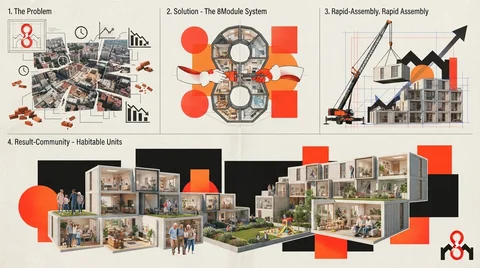
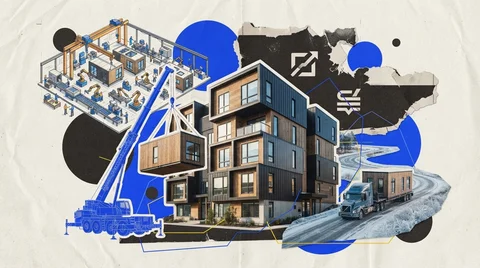
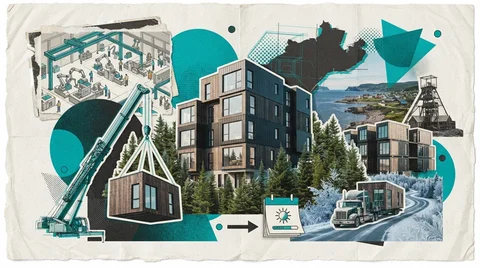
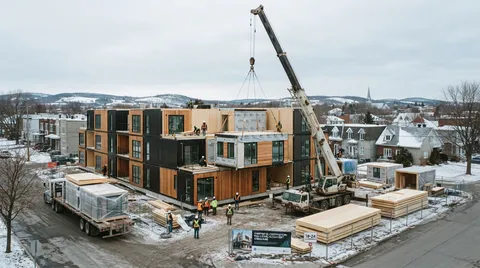
- Prefabrication. Six-unit buildings assembled from twelve factory-built modules — the exact format whose economics we break down in our guide to the modular multiplex.
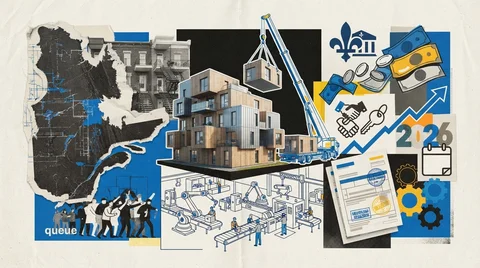
- Layered public financing. Quebec is putting in $13.6 million in subsidies, the municipalities about $3 million, Build Canada Homes an even larger but undisclosed contribution, and both levels of government round it out with low-rate loans. The typical structure is dissected in our guide to financing affordable modular housing.
The result for tenants: target rents of $700 a month for a one-bedroom up to $1,100 for a three-bedroom, in a region where a new-build two-bedroom can rent for as much as $1,800, according to Mr. Dufort.
Who builds: 8Module as integrator, Laprise alongside
To deliver an order this size, the SDE handed the entire manufacturing side — from engineering to on-site assembly — to two players: Maisons Laprise and 8Module, which takes the lion's share with 342 of the 478 units.
8Module's model, which La Presse describes as unprecedented in Canada, is that of an integrator: its founder and CEO, Paul Goulet, prequalified five of Quebec's twenty-one prefabrication factories against his own quality criteria, stricter than the industry norm, and subcontracts module production to them. The client — here the SDE — hands over the contract and the land, and receives a key. Two guarantees come with the formula, both rare in this industry: the price and the delivery date are firm.
Among the selected factories is Maisons MCG of Saint-Joseph-de-Beauce, whose assembly line La Presse visited: forty years in the trade, modules moving between stations on rails, every step archived — including what disappears behind the drywall — and floors screwed and glued rather than simply nailed. This is a long way from the "cheap" reputation inherited from the 1970s, which we took apart in our myths of modular construction.
The buildings themselves embrace their region: cedar shingles — a Gaspésie tradition with a low carbon footprint — durable metal roofs, hemp insulation, and unpaved permeable driveways and parking. The first examples already stand along Route 132 in Métis-sur-Mer, near Rimouski, where the SDE operates six-unit buildings of the same type.
The timeline
According to the organization's plans, the bulk of deliveries begins in spring 2027, with full occupancy targeted for early 2028. And the SDE is already working on a second portfolio of projects — potentially reaching other Quebec municipalities and New Brunswick — with the stated ambition of launching one per year.
It took the SDE and Paul Goulet years to convince the authorities to fund a model no one had proven at this scale. It is the same road Quebec is paving in parallel with its own prefab calls for projects, including the SHQ's 500 prefab units and the projects already delivered between Rimouski and Matane: prefab is no longer the fringe experiment of Quebec affordable housing — it has become its main channel outside the big cities.
What municipalities can take from this
The transferable lesson is not limited to eastern Quebec. What worked here was pooling: municipalities too small to carry a project alone formed a portfolio big enough to flip everything — price, financing, political attention. Our modular construction guide for municipalities walks through the steps: measure the needs, secure the land, structure the nonprofit, launch the call.
Does your municipality, RCM or nonprofit want to price out a project like this while the programs are open? We can prepare a quote request together.

8Module
Modular multi-residential buildings (6 to 24+ units) factory-built in Quebec.
Visit websiteCommercial partnership — we receive compensation. Disclosure
Comments
A question or comment on this article? The comments section will be enabled soon.