Non-profit · 7 min
5,600 Rental Homes in Toronto: When Build Canada Homes Places an Order, Modular Is on the Menu
In short — Ottawa and Toronto announced a $2.7-billion partnership on August 5 for more than 5,600 rental homes across 18 projects — with two construction choices in the showcase: a mass-timber building on Dundas West and a volumetric-modular development at 805 Wellington. When the new federal agency places an order, it orders prefab. Here are the numbers, and what they signal for Quebec organizations.
The Prime Minister's release talks about Toronto, but the news matters country-wide: more than 5,600 rental homes across 18 projects, with over 4,500 under construction by the end of 2026. Nearly 1,900 non-market units — 700-plus supportive or affordable, 1,100-plus rent-controlled — and more than 3,700 market units, a thousand of them affordable. Around 2,100 jobs per year of construction.
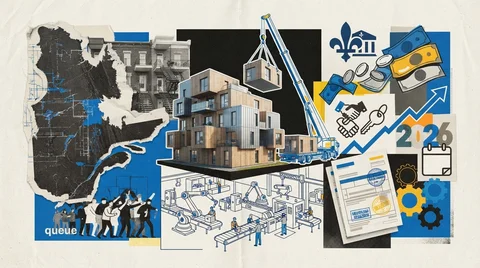
The financing stack shows how serious it is: $2.7 billion federal over three years, including more than $310 million from Build Canada Homes for nine projects on city-owned land, and $1.8 billion in CMHC apartment-construction loans for nine others — plus up to $600 million in reserve. Toronto puts in more than $530 million, land at nominal value, and property-tax exemptions running up to 99 years.
What the order says about construction methods
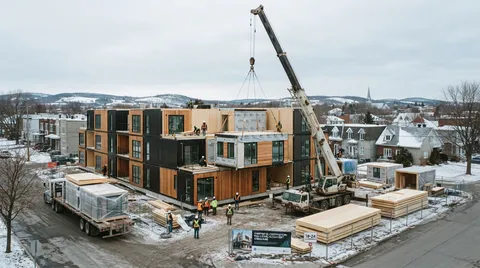
Two addresses sum up the agency's philosophy. At 1113-1125 Dundas Street West: a mass-timber, low-carbon building. At 805 Wellington: a volumetric-modular development — complete housing units built in a factory and stacked on site. The release credits modern construction methods with emissions reductions of up to 22 per cent, and Build Canada Homes makes them an explicit criterion of its orders. At 15 Denison Avenue, a 100-unit Indigenous-led supportive housing project rounds out the showcase.
This is no sudden conversion: as we told in our tour of modular construction around the world, every country that industrialized its housing did it through large-scale public ordering. Canada is getting started, and as of August 5 the agency already counted 17 partnerships totalling nearly 17,000 committed homes, more than 1,900 of them under construction.
The Quebec parallel — our reading
Put the Toronto announcement next to the Société de développement de l'Est's 478-unit contract: same mechanics, different scales. Public or municipal land contributed at nominal value, long tax holidays, federal financing that favours prefab, and an order volume that makes industrialization pay. In Toronto, the metropolis plays that role; in eastern Quebec, it is 17 pooled municipalities.
For a Quebec nonprofit, co-op or developer, the practical conclusion is the same either way: the federal funder speaks prefab. Walking into Build Canada Homes with a costed modular proposal — the 6-to-24-unit format first in line for urban and regional lots — means showing up in the language of whoever signs the cheques. And the scale of the need is not in dispute, as our file on the housing crisis and modular construction lays out.
Preparing a rental project and want the modular option costed before approaching funders? We can prepare a quote request together.

8Module
Modular multi-residential buildings (6 to 24+ units) factory-built in Quebec.
Visit websiteCommercial partnership — we receive compensation. Disclosure
Frequently asked questions
What was announced in Toronto on August 5, 2026?
Which projects use modular or mass-timber construction?
What is Build Canada Homes' role in this announcement?
How many of these homes will be affordable?
What does this change for a project in Quebec?
Sources
- Government of Canada and City of Toronto to build thousands of new rental homes — Prime Minister's Office
- Est du Québec : près de 500 logements abordables verront le jour — La Presse


Comments
A question or comment on this article? The comments section will be enabled soon.