Blanc-Sablon in numbers
| Population (2026 decree) | 1,090 |
| Area | 380.81 km² |
| MRC | Le Golfe-du-Saint-Laurent |
| Region | Côte-Nord |
| Incorporated | 1990 |
| Municipal website | www.municipalitedeblancsablon.ca |
In brief: Blanc-Sablon housing is in short supply. In October 2025 the mayor of Blanc-Sablon said that everything is rented and nothing is for sale, because the hospital and the school service centre bought up the houses. The municipality is selling land that Quebec handed over for free, at about $35,000 a lot, to get building going again. The Quebec housing society (SHQ) directory lists no subsidized housing in Blanc-Sablon. A modular project here would come down first to land, water and sewer, and a ship from Rimouski.
Housing in Blanc-Sablon does not fit the usual vocabulary of southern towns. There is no published vacancy rate, no counted waiting list and no announced social housing project. What exists are statements from the mayor, council minutes, house purchases by the health authority, and a provincial program (PHAQ) that admits in writing that building here costs more. Those pieces support some conclusions and rule out others.
Blanc-Sablon is the easternmost municipality in Quebec, at the end of the Lower North Shore. It sits in the MRC du Golfe-du-Saint-Laurent and the Côte-Nord region. For the regional logistics and the program, start with our piece on building housing in a remote region and the small municipality guide to affordable housing.
Blanc-Sablon by the Numbers: What the Data Says
The Quebec municipal directory lists 1,090 residents. The 2021 census counts 1,122, up from 1,112 in 2016, a gain of 0.9%. The two figures do not measure quite the same thing (one is a decree, the other a count), but they tell the same story: the population is not shrinking. That is unusual on this coast. In April 2024 Minister Pierre Fitzgibbon cited a 40% loss of population on the Lower North Shore since 2006, in front of the MRC's mayors (La Presse). Blanc-Sablon holds its people while its neighbours lose theirs.
A Housing Stock From the 1960s to the 1990s
The census counts 503 dwellings, 464 of them occupied. That leaves about 39 empty at census time, which says nothing about condition or availability: they could be seasonal homes, houses waiting for a buyer or buildings in poor repair. Of the total, 150 dwellings (32.6%) date from 1961 to 1980, and 105 (22.8%) from each of the next two decades. Building then nearly stops: none between 2001 and 2005, 40 from 2006 to 2010, 20 from 2011 to 2015 and 10 from 2016 to 2021. Since 2011 the census records only 30 new dwellings, about 6.5% of the stock. In a town where, according to the mayor, a vacated house is taken again at once, that pace explains much of the squeeze.
The MRC's land use plan, updated in July 2022, put Blanc-Sablon's carrying capacity at 95 units (land use plan). Its data comes from 2013 surveys, and it expected households to leave the MRC as a whole. Read that figure as an order of magnitude for theoretically available land, not as a construction target.
Owners, Renters and the Age of Households
Of 460 households, 360 own (78.3%) and 105 rent (22.8%). Only 8.6% of households (40) spend more than 30% of income on shelter, and no renter household does. The census puts median shelter cost for renters at $250 a month, far below any market rent, and for owners at $1,000. Core housing need affects 6.5% of households: 7% of owners and 0% of renters. These figures describe people who already have a home. They do not capture people who cannot find one, or workers who hesitate to come because there is nowhere to live.
Median age is 46, 19.6% of residents are 65 or older and households average 2.4 people. That is younger than the other villages in the MRC, where the median age is above 53. The median dwelling value is $150,000, which matches the mayor's $150,000 to $175,000 for an average property. Major repairs are needed in 40 dwellings (8.7%).
Blanc-Sablon Housing: What Is Happening
This is the longest section of the page because Blanc-Sablon is the one municipality in the MRC with public council minutes, a major feature article and several news reports on housing.
The Mayor: "Everything Is Rented"
In La Presse in October 2025, Colin Shattler, re-elected without opposition, said it is impossible to rent anything in town: everything is rented. As he tells it, the moment one person leaves another moves in, and no house is for sale. He blames two institutional buyers, the hospital and the school service centre, which he says have bought everything since COVID and keep paying above market.
That is an elected official's statement, not a measurement. Blanc-Sablon has no published vacancy rate, observed rent or count of households waiting. But it fits what the census shows: a stock that has barely grown since 2011 and a stable population.
Higher Costs and a Heavier Process
The same article reports that construction costs more than elsewhere and that the process is often more complicated. It gives no cost per square foot and we will not invent one. Taxation is also a brake: the municipality has about 600 tax accounts for 1,122 residents, and the mayor says it provides the services of a larger town to too few payers. Since his election in late 2023 he has been reviewing spending, starting with snow removal, then garbage, water and sewer.
For a housing project the lesson is plain. Every new connected home widens the base that pays for services. Conversely, a project that asks the municipality for water and sewer work it cannot fund runs into a ceiling the mayor knows well.
Pointe-au-Pot: Eleven Lots Ceded by Quebec
The most concrete piece of the file is the transfer of 11 oceanfront residential lots in the Pointe-au-Pot area by Quebec's natural resources ministry. It came after a 30-year erosion plan was accepted, on one condition: the sale money must be reinvested in Pointe-au-Pot, first for water and sewer on the following lots. The first lot sold for a little under $36,000, against a starting price of about $33,000 that covered the land's value and the municipality's investment. The buyer must build a home within two years and must not already own a vacant lot.
What the Minutes Confirm
The 16 June 2026 minutes approve the sale of lot 6 640 986 in Lourdes-de-Blanc-Sablon for $35,000 including taxes. The text says the land comes from a free transfer of public land, is sold as is, and that the sale respects planning guidelines. The 19 May 2026 minutes authorize water and sewer hookups for two owners on Pointe-au-Pot Street, subject to budget availability. In other words, services are extended lot by lot, at the pace of the money coming in.
What Is Not Confirmed
The 2025 article said the other ten lots were to be offered within a year. Only the June 2026 sale is confirmed in the council minutes. If you are looking for a lot, ask the Municipality of Blanc-Sablon for the current state of the offer.
The Health Authority, the Largest Buyer of Houses
The CISSS de la Côte-Nord acquired properties in Blanc-Sablon in 2022 under a regional disparity obligation in its collective agreements, meaning to house its staff. According to Radio-Canada, it holds about a hundred residences and some fifty institutional buildings, concentrated in Blanc-Sablon and Havre-Saint-Pierre. Its technical services director says buying is often simpler than building in a remote region, and acknowledges local hostility to the purchase of existing homes. The CISSS three-year plan sets aside $6 million to acquire and build.
In September 2022, Le Nord-Côtier reported the purchase of two houses for $530,000 in total, on Scheffer and Beaudoin streets, for non-resident staff, physicians and independent labour. The authority cited the scarcity of rentals and the high cost of hotel rooms. That reasoning opens a door for a modular project: an employer already paying for hotel rooms has an economic interest in owning new housing instead of outbidding others for existing homes. Whether it would do so with the municipality is not in any source. For worker housing models in the regions, see our piece on workforce housing in the regions (French only).
Seniors: A Residence Closing and No Private Residence
In March 2022 the Résidence aux Beaux Séjours in Lourdes-de-Blanc-Sablon, for seniors with mild loss of autonomy, was to stop meeting intermediate-resource standards from December 2022 and was no longer admitting new residents. The CISSS ran it in a building rented since March 2019, because no private developer came forward despite calls for tenders. The residence's final fate is not documented in the source.
That same year Radio-Canada reported that the Lower North Shore had no private seniors' residence and that the CISSS was looking for foster families in Blanc-Sablon for two or three seniors. For an older person who can no longer stay home, the options are a long-term care centre, an intermediate resource or a foster family. There is no non-profit middle option locally. Our article on modular seniors' residences explains what a project of that kind involves.
A Housing Corporation Created in 2018
The Lower North Shore Housing Corporation was created in October 2018 on the initiative of the Coasters Association. Its project report, funded by an MRC grant, looks at suitable housing for low-income families and seniors. The survey drew 238 responses, 36 of them from Blanc-Sablon. The report ties the future of the Résidence aux Beaux Séjours to a possible purchase of the building and notes that some houses stay with the same occupants for more than 50 years, which blocks turnover. The corporation leaves no trace after 2019: it may have carried on without publishing online, or it may have stopped.
Two Council Resolutions on Housing
On 18 February 2025 council denounced the SHQ's suspension of the Home Adaptation Program, justified by a surge in applications, noting that it hurts people with disabilities or declining autonomy. On 17 March 2026 it opposed protected areas on the territory identified for residential use, citing housing needs. The resolution asks that cottage areas, water supply areas and gravel sources be removed from protection perimeters. A municipality this size is fighting at once for buildable ground, for water and for services.
Housing Organizations in Blanc-Sablon and the MRC
According to the SHQ directory of housing organizations, no organization is listed in Blanc-Sablon, and the municipality has no registered public housing (HLM) or rent supplement. Which organization serves Blanc-Sablon residents has not been confirmed in any source. Two organizations exist elsewhere in the MRC.
- La Corporation du Domaine des Années d'Or, a non-profit in Saint-Augustin, runs 8 subsidized HLM-type units: 2 for families, 3 for seniors and 3 for single people. See the Saint-Augustin page.
- La Maison Mécatina inc., a non-profit in Gros-Mécatina, is listed with no subsidized units. It is an eight-room seniors' residence in La Tabatière. See the Gros-Mécatina page.
A non-profit housing organization owns and operates homes for households that cannot find housing on the market. An HLM subsidizes the gap between the rent and what a household can pay. For a municipality with no organization, the first step is often to create one or join an existing one, because PHAQ funds non-profits, co-operatives and housing offices, not municipalities acting alone. Our piece on housing co-operatives built modular describes another possible form.
What a Municipality the Size of Blanc-Sablon Can Do
With 1,122 residents and 600 tax accounts, Blanc-Sablon lacks the means of a mid-sized city, but it holds three levers: land, services and eligible status.
Land
The municipality has already shown it can obtain public land and sell it. PHAQ requires a municipal contribution of at least 40% of the SHQ base subsidy, about 20% of total cost, which can take the form of a donation of build-ready land: inside the urbanization perimeter, decontaminated and serviced. The Pointe-au-Pot lots work the other way, since they are sold to pay for the services. The town would have to choose between selling to individuals and reserving a site for a shared project. No site big enough for a multi-unit building has been announced.
Services
Stream 3 of PHAQ targets 24 or 36 units on 2 or 3 storeys, on land connected to water, storm and sanitary sewers. The May 2026 minutes, though, show hookups authorized only subject to budget. The issue is not whether it is possible in principle but the sequence: the services must come before the project. Our explanation of Stream 3 for councils lays out the conditions.
Programs and a Partner
PHAQ weights the base subsidy at 3.00 for Blanc-Sablon, against 1.00 in most southern municipalities and 4.00 in Nunavik. The base subsidy is the eligible amount per unit multiplied by that factor and by a rate of 10% to 60% depending on the length of commitment. For a building of six storeys or fewer without services, the May 2025 framework gives $246,653 for a one-bedroom and $313,923 for a two-bedroom, in June 2024 dollars, indexed each year. Our indicative calculation, for a 35-year commitment at 60%, gives about $444,000 of base subsidy per one-bedroom before indexation. That is an order of magnitude, not a promise: the real amount depends on the project and on the SHQ's decision.
The second Stream 3 call for projects closed on 14 November 2025, and successful projects were announced on 18 June 2026. The SHQ page says no call is open and does not say whether a Côte-Nord project was selected. For other funding, see our article on funding affordable modular housing.
Pooling With Other Municipalities in the MRC
Five municipalities, about 3,500 people according to the municipal directory, one marine access route: the scale of a project is regional. The regional portfolio model is described in the article on pooling municipalities and in the 478-unit SDE study in eastern Quebec. No such pooling has been announced here.
Building Modular as Far as Blanc-Sablon
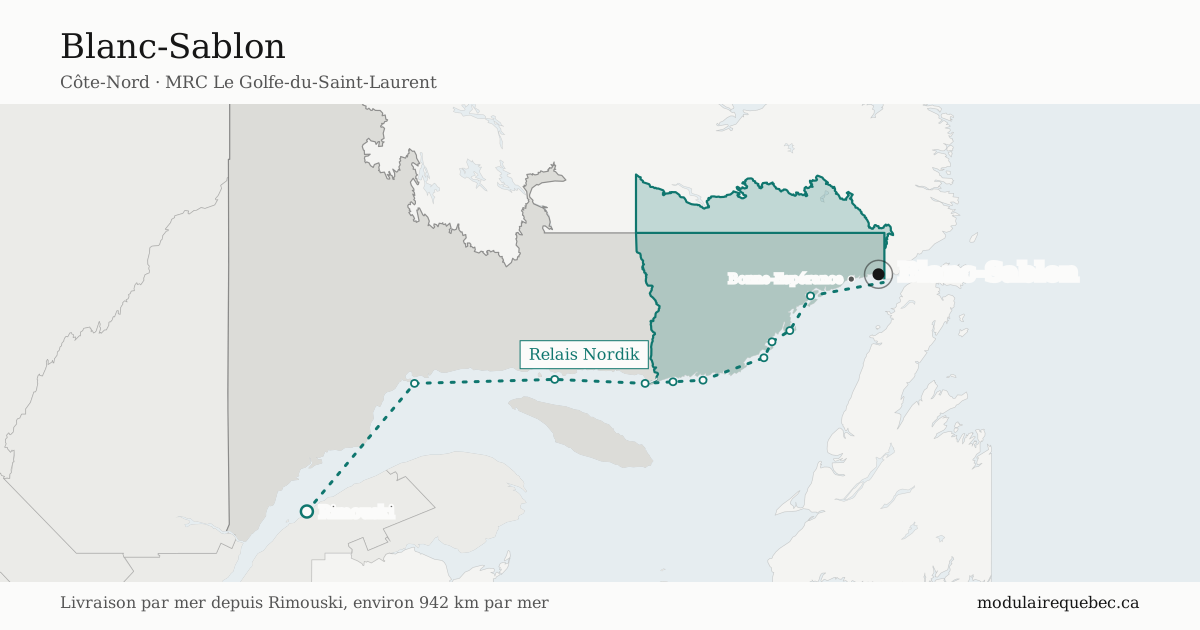
Blanc-Sablon has no road link to the rest of Quebec. About 400 km between Kegaska and Vieux-Fort are not connected to Route 138. According to the Transport ministry page updated on 13 July 2026, the Washicoutai bridge was finished at the end of 2025 and construction between Tête-à-la-Baleine and La Tabatière continues until fall 2026, while the La Tabatière to Vieux-Fort section is under study. In June 2026 La Presse reported that Quebec had dropped the full extension and floated a multimodal route. The minister says the 54-hour trip should fall to 16 hours. MRC warden Daren Jones called it a cold shower.
For a construction site, that means modules and materials arrive by ship, by the ferry from Newfoundland, or by air. Residents depend on marine and air service and the winter ice road. The ship links Rimouski to Blanc-Sablon, a seven-day round trip of more than 2,237 km, according to the STQ summer review published on 19 October 2026. The service runs from April to January. Winter therefore narrows the delivery window, and a site schedule is built around the ship's sailings.
Blanc-Sablon has one advantage over its neighbours: it is the end of the ship's run, so freight lands without an intermediate barge. For large modules, handling at the wharf, the crane available and the road from wharf to site are the first questions to settle, before the choice of manufacturer. The wharf's handling capacity and the availability of lifting equipment are not published. Our article on the timeline of a modular project explains how to sequence these steps.
Local labour for a site of this size is not documented. The mayor names the hospital, the school service centre and the fish plant as employers, without figures.
The MRC du Golfe-du-Saint-Laurent and Neighbouring Municipalities
The MRC du Golfe-du-Saint-Laurent has five municipalities: Blanc-Sablon, Côte-Nord-du-Golfe-du-Saint-Laurent, Saint-Augustin, Bonne-Espérance and Gros-Mécatina. All share the PHAQ weighting factor of 3.00. The PHAQ maximum rent for leases signed from 1 August 2026 is, in Blanc-Sablon, $630 for a one-bedroom and $778 for a two-bedroom, excluding electricity, heating and hot water, to be held for the first five years of operation. Blanc-Sablon is classed as a "rural municipality", like Saint-Augustin and Côte-Nord-du-Golfe, while Bonne-Espérance and Gros-Mécatina are classed "off-market", with caps of $1,542 and $1,807.
The contrast is telling. A rent capped at $630 for a home that costs more to build than in the city leaves an operator little margin, which is exactly why the subsidy is tripled. Whether that arithmetic balances a real project is still open. Stream 3 includes an additional subsidy for municipalities where rents are too low for a project to be viable.
The MRC's Healthy Communities Development Support Fund lists social housing among eligible initiatives, with a ceiling of $10,000 per project and no more than 80% of cost. The document gives an end date of 31 March 2021, however, and nothing says whether the fund is still active. The MRC publishes no housing action plan and no minutes online.
For the rest of the coast, the pages on Bonne-Espérance, Saint-Augustin and Gros-Mécatina describe very different situations: little or no rental housing, seniors aging in place, and the Saint-Augustin barge breaking down in July 2025.
A municipality or non-profit preparing a housing project can request a quote on the /en/soumission page.
Housing organizations in Blanc-Sablon
No housing organization is registered with the SHQ in Blanc-Sablon. Here are the ones elsewhere in the Le Golfe-du-Saint-Laurent MRC.
In the Le Golfe-du-Saint-Laurent MRC
- La Maison Mécatina inc.
Source: Housing organizations directory, Société d’habitation du Québec.
Frequently asked questions
Are there homes to rent in Blanc-Sablon?
Can you buy a lot in Blanc-Sablon?
Does Blanc-Sablon have public housing?
What rent does PHAQ allow in Blanc-Sablon?
Is a modular project possible in Blanc-Sablon?
Will Route 138 reach Blanc-Sablon?
Why does building cost more in Blanc-Sablon?
Who can sponsor an affordable housing project in Blanc-Sablon?
Sources
- La pénurie de logements s'est rendue jusqu'à Blanc-Sablon (The housing shortage has reached Blanc-Sablon) — La Presse, October 19, 2025
- Council minutes, 16 June 2026 — Municipality of Blanc-Sablon, June 16, 2026
- Council minutes, 19 May 2026 — Municipality of Blanc-Sablon, May 19, 2026
- Council minutes, 17 March 2026 — Municipality of Blanc-Sablon, March 17, 2026
- Council minutes, 18 February 2025 — Municipality of Blanc-Sablon, February 18, 2025
- Le CISSS de la Côte-Nord agrandit son parc immobilier — Radio-Canada, February 15, 2023
- Pénurie de logements : le CISSS de la Côte-Nord acquiert deux maisons à Blanc-Sablon — Le Nord-Côtier, September 27, 2022
- What Will Happen to the Résidence aux Beaux Séjours — CFBS Radio, March 24, 2022
- Un milieu d'accueil recherché pour des aînés de Blanc-Sablon — Radio-Canada, March 19, 2022
- Route 138 extension on the Lower North Shore — Government of Quebec, Ministère des Transports, July 13, 2026
- Québec abandonne le prolongement de la route 138 — La Presse, June 18, 2026
- Project Report: Presented by Lower North Shore Housing Corporation — Lower North Shore Housing Corporation, via CKOL (Coasters Association), January 1, 2019
- Programme d'habitation abordable Québec, maximum rents — Société d'habitation du Québec, July 1, 2026
- Programme d'habitation abordable Québec, weighting factors — Société d'habitation du Québec, October 14, 2026
- Stream 3, highly prefabricated multi-unit initiative — Government of Quebec, Société d'habitation du Québec, September 21, 2026
- Programme d'habitation abordable Québec, normative framework 2025-2027 — Société d'habitation du Québec, May 7, 2025
- Land use and development plan, July 2022 update — MRC du Golfe-du-Saint-Laurent, July 1, 2022
- 2021 Census profile, Blanc-Sablon — Statistics Canada, February 9, 2022
- Répertoire des municipalités du Québec — Ministère des Affaires municipales et de l'Habitation, Données Québec
- Directory of housing organizations — Société d'habitation du Québec

8Module
Modular multi-residential buildings (6 to 24+ units) factory-built in Quebec.
Visit websiteCommercial partnership — we receive compensation. Disclosure