Municipalities · 15 min
Affordable Housing in a Small Municipality: The 2026 Guide for Councils
In brief: A municipality of 300 to 15,000 residents does not need a housing department to act. It needs four things: a figures-based needs assessment, a partner to carry the project (a housing office, nonprofit or co-op), a build-ready lot and a council resolution committing at least 40% of the SHQ's base subsidy. Programs change fast: in October 2026, stream 3 of the PHAQ has no call for projects open, the federal Housing Accelerator Fund (FACL in French) is closed and Rénovation Québec is suspended. This guide says what is open, what is not, and in what order to act.
Affordable housing in a small municipality is settled first at the council table, not at the ministry: councils supply the land, the letter of interest and the resolution without which no subsidized project starts. Here is the full path, step by step, with dates and amounts checked at the source in October 2026.
This guide is the cornerstone of our series for elected officials. Two articles complete it: PHAQ stream 3 explained for councils and delivering modules to remote regions, starting from the Lower North Shore.
Why small municipalities need a method
A municipality of 800 residents that is eight units short lives through the same crisis as a big city, with fewer means to respond. No housing department, no full-time planner, few developers: a six or twelve unit project, taken alone, struggles to balance its books. That is the starting point of our guide to modular construction for municipalities.
The good news is that the council's role is well defined. It does not build; it makes building possible. The six steps below follow that order: understand the need, identify partners, prepare the land, choose the program, commit the contribution, then execute.
Step 1: do the needs assessment before talking about a project
A file without numbers will not pass a program's evaluation, and it will not persuade the neighbouring council either. The assessment rests on three sources that any municipal administration can gather in two or three weeks.
Public data
- Statistics Canada's census. The 2021 Census Profile gives, for each municipality, the number of dwellings, the share of renters, the period of construction and population growth. The 2021 census remains the most recent reference available.
- CMHC, where it exists. CMHC's rural rental market survey covers urban centres of 2,500 to 10,000 people, but it is only updated every five years, ahead of each census (latest publication 5 February 2026). Below 2,500 residents there is no official vacancy rate: you have to rebuild it yourself.
- The MRC profile. Land-use plans and territorial portraits often contain household projections. Our page on the Côte-Nord region shows, for example, how municipalities group by MRC (regional county municipality).
What the numbers do not show
In a small municipality, the real assessment happens at the counter. Four questions give a more faithful picture than any table:
- How many people turned down a job or left the municipality for lack of housing? Ask employers: plant, school service centre, health facility, shops.
- How many households are on the housing office's waiting list? The list exists even when the housing stock is tiny.
- Where do seasonal or temporary workers live? Our analysis of workforce housing in the regions shows how much this need is underestimated.
- How much of the rental stock is vacant because it is unfit? An empty unit is not an available unit.
Write the answers in a two page, dated note, with the source of each data point. That note becomes an attachment to the letter of interest, then to the partner's file.
Step 2: know the players and choose the carrier
A municipality almost never files the application itself. According to the stream 1 page of the PHAQ, the stream 1 applicant must carry on real estate activities and be a housing office, a nonprofit, a cooperative, a private company or a recognized postsecondary institution. The council therefore chooses a carrier and commits alongside it.
| Player | Concrete role for a council | What it brings |
|---|---|---|
| Housing office (office d'habitation) | Runs public housing (HLM) and can carry new projects | Knows the waiting list and the clientele |
| Housing nonprofit (OBNL) | Carries the project, signs the agreement with the SHQ, rents the units | Management expertise, eligibility for the highest subsidies |
| Housing cooperative | Same role, with governance by tenants (see our file on cooperatives) | Member commitment |
| GRT (groupe de ressources techniques, a technical resource group) | Supports nonprofits and co-ops: technical help, training, explaining programs | Builds the file with the carrier |
| SHQ (Société d'habitation du Québec) | Runs the PHAQ, receives the acceptance letter and the municipal resolution | Base subsidy |
| CMHC and Build Canada Homes | Federal financing, low-rate loans | Complements the financing plan |
| MRC | Can coordinate several municipalities | Scale, regional planning |
On housing offices, one recent benchmark: the SHQ states that the network has had 100 offices since 1 January 2026, following a consolidation effort launched in spring 2023. If your municipality relied on a small office, check which one it belongs to now: it may be your first contact.
As for GRTs, the Southwest Montérégie body describes its role as helping co-ops and nonprofits through technical assistance, training and information on government programs (listing at 211 Québec). The role of GRTs in your region may differ: call one before choosing your carrier.
To find the organizations already active in your territory, start with your MRC's page in our towns section and with the regional overview, such as the one for the Côte-Nord.
Step 3: prepare the land and the zoning
Land is the most powerful lever for a small municipality, because it is the only asset it controls directly. Three concrete moves are often enough.
A build-ready lot
For PHAQ stream 3, the SHQ requires a lot inside the urban perimeter, able to bear the building, free of contamination that would prevent residential use, with no blocking easement and connected to municipal water, storm and sanitary services. The applicant must own it outright, or hold a lease (emphyteusis) of at least 50 years. The stream 3 page says a soil study is not required at submission but is strongly recommended.
The municipal contribution can itself be a gift of land, provided it is inside the urban perimeter and ready to build: decontaminated, existing buildings demolished, civil works completed or scheduled at the municipality's expense. The council should therefore identify two or three candidate lots now and have their easements and soil checked.
Zoning
The letter of interest the council gives the carrier must confirm that the project complies with the zoning bylaw and sits within the urban perimeter. If current zoning does not allow multi-unit housing on the target lot, the amendment must be started before the letter, not after. Your planner or your MRC can tell you within a week what is blocking. In the SHQ's text, the expected time to obtain an administrative approval (planning advisory committee, minor variance) is something the resolution must state.
Taxes
A property tax holiday is a common lever: in the Eastern Quebec portfolio described below, municipalities grant the organization a property tax holiday of 20 to 30 years. The measure must be debated openly by council and validated by your legal adviser: it costs current revenue in exchange for a lasting rental stock.
Step 4: what is open today, and what no longer is
Housing programs change several times a year. Here is the picture as of 21 October 2026, with the date of each page consulted.
| Program | Status on 21 October 2026 | Source |
|---|---|---|
| PHAQ stream 1 (calls for projects) | Call closed 14 October, selected projects to be announced "in the coming months" | Stream 1 page, updated 15 October 2026 |
| PHAQ streams 2 and 4 | Applications accepted at any time | "About" page, 31 July 2026 |
| PHAQ stream 3 (highly prefabricated multi-unit buildings) | No call in progress | Stream 3 page, 21 September 2026 |
| Affordable Housing Fund (CMHC) | Portal closed, funding fully committed (19 December 2025) | CMHC |
| Housing Accelerator Fund (FACL) | Closed to new applications | CMHC |
| Rénovation Québec | Suspended since 1 April 2025 | Program page, 31 July 2026 |
The PHAQ: a four stream program
The Programme d'habitation abordable Québec (PHAQ, the Quebec affordable housing program) has four streams (volets): stream 1 for low or modest income households, stream 2 for people with particular housing needs, stream 3 for the highly prefabricated multi-unit initiative, and stream 4 for qualified developers. Streams 1 and 3 run through calls for projects; streams 2 and 4 accept applications at any time. The normative framework, which has legal value, prevails over any other description: read it before promising anything to a carrier.
Stream 1: the most accessible for a local project
Stream 1 targets construction or renovation projects for families, single people, autonomous seniors and students. The page states that the municipal letter of interest must confirm zoning compliance and say the municipality would support the project financially if selected. The latest call closed on 14 October; the next one has no published date. A carrier preparing its file today is therefore aiming at the next call.
Stream 3: factory built modules, but no call right now
Stream 3 gives carriers a predefined design, the "solution immobilière de référence" (reference real estate solution), delivered by a design-builder selected by the SHQ. Projects have 24 or 36 units over two or three storeys. A first call ended on 12 March 2025 and a second on 14 November 2025 according to the program page (the 3 September 2025 launch notice gave 7 November as the deadline). Projects from the second call were announced on 18 June 2026, and the City of Montréal says 566 highly prefabricated units were selected across the two calls. Today there is no call in progress. All the details are in our article on PHAQ stream 3.
On the federal side: a counter being reorganized
Build Canada Homes (Maisons Canada) was launched on 14 September 2025 and is meant to become the federal single window for affordable housing. According to the federal release of 19 September 2025, it has $1.5 billion in loans for the Construction stream of the Affordable Housing Fund and $385 million for its rapid housing sub-stream, with CMHC continuing to disburse funds during the transition. But the CMHC page says that as of 19 December 2025 the Affordable Housing Fund application portal is closed and all funding is committed. For a council, that means one thing: do not build a financing plan on a federal window without confirming in writing that it still accepts files. Our analysis of Build Canada Homes and prefab housing in Quebec tracks the file.
What must not be presented as open
Two programs still come up in council discussions and are not available. CMHC says Housing Accelerator Fund applications are closed. And Rénovation Québec has been temporarily suspended since 1 April 2025, for lack of new funding, with no applications accepted. If one of your municipal bylaws refers to either, check that it does not promise aid that no longer exists. For the overview of funding sources and how they stack, see our guide to funding affordable modular housing.
Step 5: the municipal contribution, what council really signs
This is where council commits money. The SHQ's page on the municipal contribution (updated 1 June 2026) sets the rules.
The calculation
The contribution must be at least 40% of the SHQ subsidy. The published formula is: 40% × eligible amount per unit × municipal weighting factor × applicable subsidy rate. The weighting factor varies by municipality, and the SHQ publishes it in a separate document: consult it before sizing your share.
Two documents, in this order
- The letter of interest. It accompanies the carrier's submission. It confirms that the project complies with the zoning bylaw and is located within the urbanization perimeter. It does not yet put a figure on the contribution.
- The specific resolution. It is adopted once the preliminary subsidy amount is known. It commits to a minimum of 40% of the base subsidy, states the form or forms of the contribution and gives the expected time to obtain any necessary administrative approval. The SHQ must receive it before the final acceptance letter and before the realization and operation agreement is signed.
Accepted forms
The contribution can be a cash payment, infrastructure work tied to the building, a tax credit, a gift of land, or a combination. For a small municipality on a tight budget, the land gift and the tax credit are the forms that weigh least on current cash. Three exceptions exist: student housing (the contribution can be replaced in whole or in part by funding from another source), victims of domestic violence (no municipal contribution required) and very expensive land (an additional contribution of 40% of the SHQ's additional subsidy). The page provides no reduction for remote regions: do not assume one.
To put an order of magnitude on your file, our cost comparison for a 6, 12 or 24 unit building gives ranges to verify with a manufacturer.
Step 6: pool your needs, the Eastern Quebec model
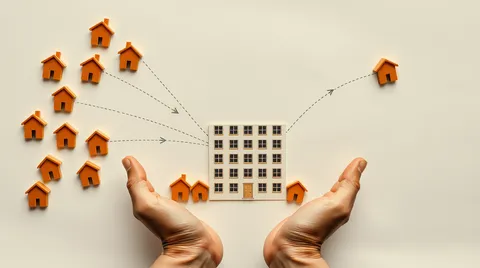
When each municipality is too small, the answer can be pooling. The SDE's 478 unit contract is the example: according to La Presse, 17 municipalities in the Gaspésie, Bas-Saint-Laurent, Côte-Nord and Outaouais entrusted their needs to a single nonprofit, the Société de développement de l'Est, for an order of 478 housing units.
What is transferable about the arrangement:
- One application instead of seventeen, hence a volume that interests funders and factories.
- Land handed over free and a property tax holiday of 20 to 30 years, granted by the municipalities.
- Stacked financing: about $13.6 million from Québec and about $3 million from the municipalities according to the article, plus an unquantified Build Canada Homes contribution and low-rate loans.
- A target cost of about $313,000 per door according to the SDE, against nearly $600,000 on average for Québec-supported builds last year in the Gaspésie. These figures are attributed to the SDE: they have not yet been tested by deliveries, which begin in spring 2027.
A small municipality's council does not need to create its own nonprofit to benefit. With its MRC, it can ask an existing organization to widen its territory. Our piece on pooling municipalities around a housing portfolio details the possible structures. And the Fédération québécoise des municipalités, which says it represents all regions of Quebec, is a good place to find elected officials who have already done it.
Why modular changes the timeline and the cost in the regions
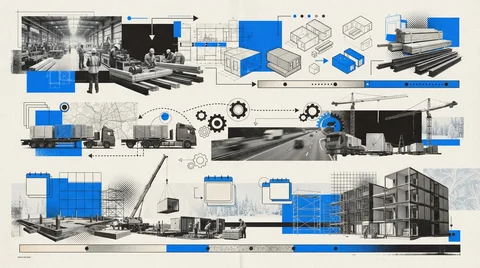
In a small municipality, the limiting factor is not always money: it is local labour and site time. Modular construction moves much of the work into a factory, where crews are already in place, where weather does not matter and where each module is inspected before it leaves. Three concrete effects.
- A short site phase. On site, what remains is foundations, connecting the modules, finishing the joints and service connections. Projet Acadie in Montréal aimed for under 12 months, building permit included, according to a consortium representative quoted in the City of Montréal's release of 18 June 2026: a target, not a measured duration. Our file on modular project timelines details the stages.
- Less dependence on local trades. When there are not enough electricians or plumbers nearby, moving the work into a factory avoids flying them in for months.
- A more predictable price. A repeated plan, like the reference real estate solution in stream 3, reduces design surprises.
Let us be clear about the limit: modular does not solve the cost of land, services or transport. The farther the site is from the factory, the more trucking weighs on the bill, and in some regions, such as the Lower North Shore, a boat has to be added.
The timeline, step by step
The durations below are planning orders of magnitude that we propose, not official deadlines. They depend on the calendar of calls for projects, which is set by the SHQ.
| When | Step | Deliverable |
|---|---|---|
| Weeks 1 to 3 | Needs assessment: census, employers, waiting list | Two page dated, sourced note |
| Weeks 3 to 6 | Choose the carrier (office, nonprofit, co-op) and call a GRT | Agreement in principle with the carrier |
| Weeks 4 to 10 | Land and zoning: candidate lots, soil condition, zoning change if required | Lot identified, zoning compliant |
| Month 3 | Council's letter of interest | Letter adopted by resolution or signed as your bylaws provide |
| Depending on the call | Carrier files the project, SHQ evaluates | File submitted |
| After the preliminary amount | Specific resolution on the municipal contribution | Resolution sent to the SHQ |
| After the acceptance letter | Realization and operation agreement, then permit | Site authorized |
| Construction | Factory fabrication, transport, assembly | Delivery of the units |
For stream 3, the SHQ says applicants receive a status letter within 90 business days after a call closes. Nothing prevents you from moving on the first three rows of the table now: they are the same whichever program you target.
Taking action
Does your municipality, your MRC or your nonprofit want to price a 6, 12 or 24 unit project while programs are open? We can prepare a quote together, starting from your land and your need.
8Module
Modular multi-residential buildings (6 to 24+ units) factory-built in Quebec.
Visit websiteCommercial partnership — we receive compensation. Disclosure
Frequently asked questions
How can a small municipality create affordable housing?
Which affordable housing programs are open in 2026?
How much must a municipality contribute to the PHAQ?
Are the Housing Accelerator Fund and Rénovation Québec still open?
Can a municipality of 500 residents really launch a project?
Do we need a nonprofit or a housing office to file a project?
How long does it take to build a small modular building?
Where can we find help assembling the file?
Sources
- About the Programme d'habitation abordable Québec — Gouvernement du Québec, SHQ
- Volet 1: projects for low- or modest-income households — Gouvernement du Québec, SHQ
- Volet 3: Initiative de multilogements hautement préfabriqués — Gouvernement du Québec, SHQ
- Municipal contribution, PHAQ (Partenaires en habitation) — Gouvernement du Québec, SHQ
- Programme Rénovation Québec — Gouvernement du Québec, SHQ
- Démarche d'optimisation des réseaux d'habitation — Gouvernement du Québec, SHQ
- Accelerating affordable housing supply by investing in Build Canada Homes and the Affordable Housing Fund — Government of Canada
- Affordable Housing Fund — CMHC
- Housing Accelerator Fund — CMHC
- Rural Rental Market Survey Data: Vacancy Rates by Bedroom and Province — CMHC
- Initiative de multilogements hautement préfabriqués: a second call for projects is launched — Gouvernement du Québec
- Projet Acadie: the 26 highly prefabricated modular units are already installed — Ville de Montréal
- Est du Québec : près de 500 logements abordables verront le jour — La Presse
- Fédération québécoise des municipalités — FQM
Comments
A question or comment on this article? The comments section will be enabled soon.